


Important Keywords: Private Limited Company PAN Card, Company PAN application, Form 94 PAN, PAN Form 94, PAN application for company, Company PAN card documents, Company PAN card fees, Company PAN application process, How to apply for company PAN, New PAN forms 2026, PAN rules 2026, Income-tax Act 2025 PAN, Income-tax Rules 2026 PAN, Track PAN application status.
Words: 3,324, Read time: 18 minutes.
Table of Contents
Overview
One of the major updates came into effect on 1 April 2026, when the PAN application process in India changed significantly under the Income-tax Act, 2025 and the Income-tax Rules, 2026. These changes affect how PAN is applied for, which forms are used, what documents are required, and when PAN must be quoted.
For example, the earlier Forms 49A and 49AA have been replaced with new PAN application forms. The requirements and procedures for proving identity, address, and date of birth or incorporation have also been updated.
These changes are particularly important for Private Limited Companies, NRIs, resident but not ordinarily resident (RNOR) individuals, foreign nationals, and foreign companies that have taxable income, investments, or other financial activities in India.
In this guide, we will explain the latest rules for a Private Limited Company PAN Card, including the applicable PAN application form, documents required, important changes from 1 April 2026, and the process for applying for or updating a company's PAN.
Key points to remember for New PAN Application Form
- From 1 April 2026, Forms 93, 94, 95 and 96 are used for fresh PAN applications, while CR-01 and CR-02 are used for changes or corrections in existing PAN data.
- Only the new PAN forms will be accepted from 01.04.2026 onwards. Old forms will not be accepted after 31.03.2026. This applies to both new PAN applications and change/correction (CR) requests. Applications pending as on 31 March 2026 will continue to remain valid and do not need to be submitted again under the new forms. Existing PAN numbers also remain valid.
- The documents required for PAN application depend on the type of applicant. For an Indian company, the prescribed documents include proof of identity, address and date of incorporation, as applicable under Rule 158.
- In Form 94 & 96, details of RA/AR are mandatory.
- Contact details of applicant and RA/AR (if applicable) are mandatory.
What is a PAN Card for a Private Limited Company?
A Permanent Account Number (PAN) is a unique 10-character alphanumeric, because PAN contains both letters and numbers issued by the Income Tax Department to a Private Limited Company. The PAN may be provided through a physical PAN card or an e-PAN.
A Private Limited Company has its own PAN, which is different from the PAN of its directors and shareholders. This is because the company has a separate legal identity from the individuals who own or manage it. The company's PAN helps the Income Tax Department identify the company and keep track of its tax and financial activities.
Want to know more about separate legal identity? [Click here to learn how a company is legally separate from its directors and shareholders.]
The company's PAN helps connect its important tax records, including income-tax returns, tax payments, TDS/TCS details, tax demands, certain financial transactions, and communication with the Income Tax Department. It also helps the tax authorities match information received from different sources and identify possible cases of tax evasion.
A company's PAN is also important for many business and financial activities. It is commonly required for opening a company bank account, filing income-tax returns, claiming TDS credits, carrying out certain financial transactions, and completing various tax and financial compliances.
Understanding the 10 Characters of a Company PAN
A typical PAN may look like AAA CP 1234A.
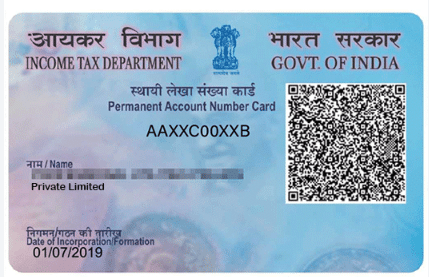
Each character in a PAN has a specific purpose:
- First three characters – "AAA": These are alphabetic characters forming a series that can range from AAA to ZZZ.
- Fourth character – "C": This identifies the status/category of the PAN holder. For a company, the fourth character is "C".
- Fifth Character – Represents the first letter of the company's/ Firm's name.
- Next four characters – "1234": These are sequential numbers ranging from 0001 to 9999.
- Last character – "A": This is an alphabetic check character used as part of the PAN's structure.
Therefore, in a PAN such as AAACP1234A, the letter "C" in the fourth position indicates that the PAN belongs to a company.
Note: The PAN structure is the same whether the company is a Private Limited Company or another type of company. The fourth character "C" indicates that the PAN holder is a company; it does not specifically mean "Private Limited Company."
i.e. The alphabet ‘F’ represents Firm, ‘T’ represents Trust, , ‘H’ for HUF, ‘P’ for Individual, ‘C’ for Company etc.
Legal Framework – PAN for private limited company
The Permanent Account Number (PAN) framework is mainly governed by Section 262 of the Income-tax Act, 2025. It explains who is required to obtain PAN, who can apply for it, how PAN is allotted, and the situations in which PAN or Aadhaar must be quoted or authenticated.
The detailed procedure for applying for PAN is provided under Rule 158 of the Income-tax Rules, 2026. It also specifies the documents that need to be submitted with the applicable PAN application form, such as proof of identity, proof of address, and proof of date of birth or incorporation.
Rule 159 specifies certain transactions and activities where PAN is required to be quoted. In certain cases, a person who does not have PAN may submit a declaration in Form 97 instead. Form 97 is a declaration used in certain specified transactions by persons who do not have PAN and is generally not available to companies or firms.
The law also provides a penalty for non-compliance. Under Section 467 of the Income-tax Act, 2025, the Assessing Officer may impose a ₹10,000 penalty for failure to comply with Section 262. A ₹10,000 penalty may also apply for certain cases involving false, missing, or unauthenticated PAN or Aadhaar details in prescribed documents.
Why PAN is required for Private Limited Company?
A private limited company is a separate legal entity, which means the company has its own identity in the eyes of law, separate from its directors and shareholders. Just as an individual has a personal PAN, the company also needs a separate PAN in its own name.
Form No. 94 is used to provide the company's details to the Income Tax Department for applying for its PAN.
Once the PAN is allotted, it is used to identify the company for tax and financial purposes. It helps the Income Tax Department keep track of the company's income-tax returns, tax payments, TDS/TCS, tax notices and certain financial transactions.
Aasaan shabdon mein: Company ka PAN uski tax identity ke roop mein kaam karta hai. Is PAN se Income Tax Department ko easily identify hota hai ki kaunse tax records aur financial transactions company se related hain. At the same time, these records remain separate from the personal tax records of the company's directors and shareholders.
Documents required for private limited companies PAN card
From 1 April 2026, an Indian Private Limited Company applying for a new PAN needs to use Form 94 under the Income-tax Rules, 2026. You need to provide documents that show the company's identity, address, and date of incorporation.
Before applying, keep these documents and details ready:
- Certificate of Incorporation/Registration
- Proof of the company's address
- Proof of date of incorporation
- CIN/registration number, where applicable
- Details and prescribed documents of the authorised/representative person, where applicable
Note: Always check the latest requirements in Form 94 and the applicable Income-tax Rules before submitting the application, as document requirements may vary depending on the application method and circumstances.
PAN Application Forms Before March 31, 2026 and After April 1, 2026
The PAN application forms have changed from 1 April 2026 under the new Income-tax Rules, 2026. The form to be used depends on whether the applicant is an individual or a non-individual entity and whether the applicant is Indian or foreign.
| Applicant Type | Before 1 April 2026 | From 1 April 2026 |
|---|---|---|
| Indian Individual | Form 49A | Form 93 |
| Indian Non-Individual Entity (including Private Limited Company) | Form 49A | Form 94 |
| Foreign Individual | Form 49AA | Form 95 |
| Foreign Non-Individual Entity | Form 49AA | Form 96 |
For a Private Limited Company: If an Indian Private Limited Company is applying for a new PAN on or after 1 April 2026, it should use Form 94.
Important: These new forms apply to fresh PAN applications made from 1 April 2026. Existing PAN numbers issued under the earlier system remain valid and do not need to be replaced merely because the new PAN forms have been introduced.
For an Indian Private Limited Company applying for a new PAN from 1 April 2026, the prescribed application form is Form 94.
Steps to apply for a Private Limited Company PAN card
Follow the below given steps to apply online:
- Visit the authorised PAN portal – Apply online through Protean or UTIITSL. For domestic companies and LLPs, PAN can also be applied for through the Common Application Form (CAF) of the MCA, where applicable.
- Select Form 94 – From 1 April 2026, Indian companies use Form 94 for a new PAN application.
- Enter company details – Provide the company's name, date of incorporation, CIN/registration number, registered office address, and other required details.
- Submit documents – Provide the Certificate of Incorporation and other documents required under the current PAN application process.
- Verify and pay – Check the details, complete the required declaration/verification, and pay the applicable fee.
- Submit and track – Complete any required document submission process and save the acknowledgement number to track the application.
- Receive PAN – After successful processing, the company will receive its e-PAN and/or physical PAN card, depending on the option selected.
Note: The instant e-PAN facility is intended for eligible individual applicants, not companies.
How to Track PAN Application Status?
After submitting your PAN application, you can track its status online through Protean or UTIITSL.
- Visit the Income Tax Department’s PAN services page and select “Track PAN Application Status.”
- Choose Protean or UTIITSL, depending on where you applied.
- Enter your application type and acknowledgement/reference number.
- Submit the details to view your application status.
- The status will show whether your PAN is under process, allotted, dispatched, or requires further action.
Fees for applying for a company PAN card
The PAN application fee depends on whether you want a physical PAN card or only an e-PAN, and on the method used to submit the application.
- If you want a Physical PAN Card
If you choose to receive a physical PAN card at an Indian address, the fee is:
- ₹107 (including applicable taxes) when the application is submitted at a PAN Centre or through online physical mode.
- ₹101 (including applicable taxes) when the application is submitted online through paperless modes such as e-KYC & e-Sign, e-Sign scanned based or DSC scanned based.
The e-PAN is also sent to the email ID provided in the application, where applicable.
- If you want only an e-PAN
If you do not need a physical PAN card, you can choose to receive only the e-PAN by email. In this case:
- ₹72 (including applicable taxes) for applications submitted at a PAN Centre or through online physical mode.
- ₹66 (including applicable taxes) for applications submitted online through paperless modes.
In this option, providing an email ID is mandatory, and no physical PAN card is dispatched.
Simply said: If your Private Limited Company needs a physical PAN card, the fee is generally ₹101–₹107, depending on the application method. If you only need the e-PAN, the fee is generally ₹66–₹72.
If a foreign communication address is used, the fee is higher because of the additional overseas dispatch charges.
The above amounts are based on the current PAN service-provider fee structure and may change depending on the application mode, delivery option and applicable taxes.
When is PAN Required for Certain High-Value Transactions?
PAN is required to be quoted for certain specified transactions under Rule 159 of the Income-tax Rules, 2026. In applicable cases, Aadhaar may be used or authenticated as permitted under the Income-tax Act and Rules. such as:
- Cash deposits or withdrawals of ₹10 lakh or more in a financial year.
- Opening a current account or cash credit account with a bank or other specified financial institution.
- Buying, selling, gifting or entering into a joint development agreement for immovable property where the amount exceeds ₹20 lakh or the stamp valuation exceeds ₹20 lakh.
- Buying or selling a motor vehicle or motorcycle worth more than ₹5 lakh. Tractors are excluded from this requirement.
- Making a cash payment of more than ₹1 lakh to a hotel, restaurant or certain venues/services for a bill or event.
Conclusion
Understanding the new PAN process is now important for every business! The new PAN framework under the Income-tax Act, 2025 and Income-tax Rules, 2026 has introduced a more streamlined process for fresh PAN applications. From 1 April 2026, Indian companies applying for a new PAN use Form No. 94, replacing the earlier Form 49A for this category. Existing PANs, however, continue to remain valid.
For a Private Limited Company, understanding these changes is important because PAN acts as the company's tax identity and is used for various tax and financial compliances.
We hope this guide has helped you understand the latest PAN rules, Form No. 94, required documents and PAN application process for a Private Limited Company in simple terms.
If you think we have missed any important point about the new PAN framework or if you have any questions, feel free to reach out to us at help@finodha.in. Your questions and suggestions can also help us make this guide more useful for other business owners and professionals.
click here: for GST and ITR filing.
Frequently Asked Question!
Question. What is Form No. 94?
Answer. Form 94 is a PAN Application form for Indian Company or an Entity incorporated in India or an unincorporated entity formed in India.
Question. Who should apply using Form No. 94?
Answer. Any Indian company, LLP, Firm, Trust, HUF, AOP, BOI and AJP incorporated/formed in India can apply for PAN by filing Form 94.
Question. What documents are required for Form No. 94?
Answer. For Form 94, the applicant generally needs to provide proof of identity, proof of address and proof of date of incorporation, along with other prescribed details and documents. The exact requirements are specified under Rule 158 of the Income-tax Rules, 2026.
Question. Can the communication address be different from the office address?
Answer. Yes, however in such case the applicant has to submit the proof of address for such communication address.
Question. What is PAN and why is it required?
Answer. PAN (Permanent Account Number) is a unique 10-character number issued by the Income Tax Department to identify a company or individual for tax purposes. It is important for filing income-tax returns, paying taxes, TDS/TCS compliance, maintaining tax records and carrying out certain financial transactions.
Question. What are the new PAN card forms introduced in 2026?
Answer. Forms 93, 94, 95, and 96 have been introduced by the Income Tax Department for new PAN applications. These forms, which are intended for various applicant categories, take the place of the previous Forms 49A and 49AA.
Question. Which PAN form should businesses and organisations use?
Answer. For fresh PAN applications, Indian companies and other non-individual entities incorporated or formed in India generally use Form 94.
Question. Can I still use Forms 49A and 49AA?
Answer. No. Forms 93, 94, 95, or 96, depending on the applicant category, should now be used for new PAN applications. Current PAN cards are still valid and don’t need to be replaced.
Question. Where can I complete the official PAN card form download?
Answer. You can access the applicable PAN forms through the Income Tax Department's official PAN services and submit PAN applications through authorised service providers such as Protean eGov Technologies Limited and UTIITSL.
Question. What is the business PAN format?
Answer. A business PAN is a 10-character alphanumeric number. For a company, the fourth character is generally “C”, which indicates that the PAN holder is a company.
Question. Which forms should be used for PAN application in 2026?
Answer. Under the Income-tax Rules, 2026, four new forms have been introduced for fresh PAN applications.
Indian individuals need to use Form No. 93, while Indian companies and other entities incorporated or formed in India need to use Form No. 94. Foreign individuals use Form No. 95, and foreign entities use Form No. 96.
For an Indian Private Limited Company, the applicable form for applying for a new PAN from 1 April 2026 is Form No. 94.
Question. What happens if a PAN application is rejected?
Answer. If a PAN application is rejected, the applicant can check why it was rejected, fix the mistake or provide the missing information/documents, and apply for fresh PAN application again.
Question. How to apply for a PAN card for a private limited company in India?
Answer. You can apply for a company or individual PAN through authorised PAN service providers such as Protean or UTIITSL. From 1 April 2026, an Indian Private Limited Company must use Form No. 94, submit the required details and documents, pay the applicable fee, and complete the verification process to obtain PAN.
Question. Best online platforms to apply for a private limited company PAN card?
Answer. There are two online platforms: (i.e. Protean or UTIITSL) to apply for a private limited company PAN card.
Question. How can I track my PAN application status?
Answer. You can track your PAN application status online through Protean or UTIITSL by entering your acknowledgement number or other required application details. The status will show the current stage of your PAN application and whether any further action is required.
Question. How do I know if a PAN is individual or company?
Answer. You can identify whether a PAN belongs to an individual or a company by checking the 4th character of the PAN number. In a company PAN, the 4th character is “C”, while “P” represents an individual.
Question. Can a company or individual have two PANs?
Answer. No, a person or company cannot legally have more than one PAN. If more than one PAN is allotted, the extra PAN should be surrendered, as having multiple PANs may attract a penalty.
Question. What is the difference between an individual PAN card and a company PAN card?
Answer. One of the main differences between an individual PAN and a company PAN is that an individual PAN belongs to a person and is used for their personal tax and financial activities. A company PAN belongs to the company and is used for its own tax, banking and financial activities.
Question. Does a Private Limited Company have a separate PAN?
Answer. Yes. A Private Limited Company has a separate PAN because, under the law, a company is treated as a separate legal entity from its directors and shareholders.
Question. Which documents are required for a business PAN card?
Answer. The documents required under Rule 158 for filing Form No. 94 include:
-Certificate of Incorporation/Registration,
-proof of the company’s address, and
-other prescribed documents and details required under the PAN application process.
Question. Where can I apply for a PAN online?
Answer. you can visit the two website for apply a PAN online i.e. Protean or UTIITSL.
Question. What are the fees for applying for a company PAN card?
Answer. The PAN application fee for an Indian address is generally ₹107 for a physical PAN card and ₹72 for e-PAN only, including applicable GST.
*The exact fee may vary depending on the application and delivery option selected.
Question. How can a company correct its PAN details?
Answer. From 1 April 2026, Form CR-02 is prescribed for changes or corrections in PAN data of non-individual entities. This is different from Form 94, which is used for a fresh PAN application.
The CBDT's April 2026 order confirms CR-01 for individuals and CR-02 for non-individuals.
We’re Available:
If you need clarity on your specific compliance requirement, you can explore our detailed service pages or connect with our team:
📞 +91-8512022044
📩 help@finodha.in
We'll handle the paperwork while you focus on building your business; If you have any questions to ask; contact us now.
Read more interesting articles:

