Important Keywords: Authorized Capital vs Paid-up Capital, Authorized Share Capital, Paid-up Share Capital, Difference between Authorized and Paid-up Capital, Increase Paid-up Capital, Increase Authorized Capital, Section 2(8) Companies Act 2013, Section 2(64) Companies Act 2013, Paid-up capital of private limited company, Authorized capital of company, Share capital structure, MCA authorized capital, PAS-3 filing, SH-7 form.
Words: 4,270, Read time: 23 minutes.
Table of Contents
Overview
Under the Companies Act, 2013, Among the different types of share capital, Authorized Capital and Paid-up Capital are the two most important concepts that every entrepreneur and investor should understand. The Companies (Amendment) Act, 2015 removed the requirement of maintaining a minimum paid-up capital for companies; however, the requirement of having an Authorized Share Capital continues to exist.
Before amendment:
Private company required minimum paid-up capital ₹1 lakh.
Public company required minimum paid-up capital ₹5 lakh.
After amendment:
"No minimum paid-up capital requirement exists."
Every company has a limit on the amount of share capital it can issue, known as Authorized Share Capital, while the amount actually received from shareholders against the shares issued is known as Paid-up Share Capital. As per the Companies Act, 2013, Authorized Share Capital is defined under Section 2(8), whereas Paid-up Share Capital is defined under Section 2(64).
Understanding the difference between Authorized Capital and Paid-up Capital is important for entrepreneurs, investors, and professionals because it helps in understanding a company's capital structure, fundraising capacity, and financial position.
In this article, we will discuss the meaning, differences, and Benefits of Authorized Share Capital and Paid-up Share Capital in detail.
A company's share capital is broadly divided into two main parts:
Authorized Share Capital
Paid-up Share Capital
What is Authorized Capital?
Section 2(8): Authorized capital means such capital as is authorized by the memorandum of a company to be the maximum amount of share capital of the company.
Authorized Share Capital, also known as Nominal Capital or Registered Capital, is the maximum amount of share capital that a company is authorized to issue as mentioned in its Memorandum of Association. This amount is decided by the subscribers/promoters at the time of incorporation and mentioned in the Capital Clause of the MOA.
A company is not required to issue all of its authorized share capital at the time of incorporation. It may issue shares in one or more stages, depending on its funding requirements.
If the company needs to raise more capital in the future, it can increase its authorized share capital by following the procedure prescribed under the Companies Act, 2013 and filing the necessary forms with the Ministry of Corporate Affairs (MCA).
Example 1 : Face Value of ₹1
XYZ Private Limited has an authorized share capital of ₹10 lakh. The company decides to keep the face value of each share at ₹1.
Authorized Share Capital: ₹10,00,000
Face Value per Share: ₹1
Maximum Shares the Company Can Issue: 10,00,000 shares
This means the company can issue up to 10 lakh shares. It cannot issue more unless it first increases its authorized share capital.
Example 2 : If Company does not issue all shares at once
PQR Private Limited has an authorized share capital of ₹20 lakh with a face value of ₹10 per share.
Maximum Shares Allowed: 2,00,000 shares
However, the company initially issues only 50,000 shares (worth ₹5 lakh) to its founders.
The remaining 1,50,000 shares can be issued later whenever the company needs more funds. The company is not required to issue all its authorized share capital at the time of incorporation.
Benefits of Authorized Capital
Authorized Capital offers several benefits by giving a company the flexibility to raise funds and grow in the future. Some of its key benefits include:
Helps Raise Funds in the Future – Allows the company to issue additional shares when capital is needed.
Supports Business Expansion – Makes it easier to raise funds for growth and expansion.
Builds Investor Confidence – Shows the company's capacity to raise capital in the future.
Reduces Frequent Amendments – Avoids the need to increase authorized capital repeatedly before issuing new shares.
Provides Financial Flexibility – Enables the company to bring in new investors or issue additional shares when required.
Helps in Strategic Planning – Supports long-term business growth and future fundraising plans.
Ensures Legal Compliance – Helps the company issue shares within the limit prescribed under the Companies Act, 2013.
Documents required for increasing Authorized Capital
Certified copy of Board Resolution
Notice of General Meeting (AGM/EGM) along with Explanatory Statement
Certified copy of Ordinary Resolution passed by shareholders
Altered Memorandum of Association (MOA)
Altered Articles of Association (AOA), if amended
Certified copy of Special Resolution, if AOA is altered
Payment details of ROC fees and applicable stamp duty
What is Paid-up Capital?
As per section 2(64) of Companies Act, 2013 said that “paid-up share capital” or “share capital paid-up” means such aggregate amount of money credited as paid-up as is equivalent to the amount received as paid-up in respect of shares issued and also includes any amount credited as paid-up in respect of shares of the company, but does not include any other amount received in respect of such shares, by whatever name called.
Let's understand this in a simple way:
Paid-up Share Capital is the actual amount of money that a company has received from its shareholders for the shares it has issued. In simple words, it is the money that shareholders have already paid to the company in exchange for their shares.
It includes only the amount paid towards the share capital. Any other money received from shareholders, such as share premium, is not included in the paid-up share capital.
Example 1
Suppose ABC Private Limited issues 1,000 shares with a face value of ₹10 each.
If all the shareholders pay the full amount, the company receives:
1,000 × ₹10 = ₹10,000
So, the company's paid-up share capital is ₹10,000.
Example 2
Suppose XYZ Private Limited is allowed to issue shares worth ₹10 lakh (authorized share capital).
However, it issues shares worth only ₹4 lakh, and the shareholders pay the full amount.
In this case:
Authorized Share Capital = ₹10 lakh
Paid-up Share Capital = ₹4 lakh
This means the company has actually received ₹4 lakh from its shareholders. The remaining ₹6 lakh can be raised later by issuing more shares, provided it stays within its authorized share capital.
Benefits of Paid-up Capital
Paid-up Capital represents the actual amount received by a company from its shareholders against the shares issued. It is an important part of a company's financial structure and provides several benefits, such as:
Provides Actual Business Funds – Paid-up capital gives the company real funds that can be used for daily operations, investments, and business growth.
Strengthens Financial Position – It represents the company's actual equity base and helps assess its financial standing.
Shows Shareholders' Commitment – It reflects the amount invested by owners, showing their confidence and commitment towards the company.
Supports Business Expansion – Companies can use paid-up capital to finance expansion plans, purchase assets, develop products, or enter new markets.
Improves Credibility – A strong paid-up capital base can enhance the company's reputation among investors, banks, suppliers, and other stakeholders.
Determines Ownership Rights – Paid-up capital helps determine the shareholders' ownership percentage, voting rights, and entitlement to dividends.
Provides Long-Term Funding – Unlike borrowed funds, paid-up capital provides permanent capital for the company without regular repayment obligations.
Helps in Obtaining Finance – A healthy paid-up capital position may improve the company's ability to attract investors or secure external funding.
Supports Compliance and Record Keeping – Maintaining accurate paid-up capital records helps the company meet statutory requirements under the Companies Act, 2013.
Reflects Company's Growth Potential – Increasing paid-up capital may indicate that the company is raising funds to support future growth and expansion.
Difference between Authorized capital and Paid-up capital
Here are the key differences:
Basis
Authorized Share Capital
Paid-up Share Capital
Meaning
The maximum amount of share capital a company is allowed to issue to its shareholders.
The actual amount of money the company has received from shareholders for the shares issued.
Simple Meaning
The company's maximum limit for raising money through shares.
The money actually received by the company.
Mentioned In
Memorandum of Association (MOA).
Company's Balance Sheet.
When It Is Decided
At the time of company incorporation.
Whenever shareholders pay for the shares issued by the company.
Can It Be Changed?
Yes. The company can increase it by following the procedure under the Companies Act, 2013 and filing the required forms with the MCA.
Yes. It increases when the company issues new shares and the shareholders pay for them.
Relationship
Always equal to or more than the paid-up capital.
It can never be more than the authorized share capital.
Example
A company has an authorized share capital of ₹10 lakh.
If it has issued shares worth ₹4 lakh and received the money, its paid-up capital is ₹4 lakh.
Note:
Authorized Share Capital = Maximum Limit
Paid-up Share Capital = Actual Money Received
Example:
Imagine you have a water tank with a capacity of 1,000 litres, but it currently contains only 400 litres of water.
Tank Capacity (1,000 litres) = Authorized Share Capital
Water Actually in the Tank (400 litres) = Paid-up Share Capital
Just as the water in the tank cannot exceed its capacity, a company's paid-up share capital cannot exceed its authorized share capital.
Step-by-Step Process to increase Authorized Capital in a company
Follow the below mention steps:-
Check the Articles of Association (AOA)
Verify whether the AOA allows an increase in authorized share capital.
If not, amend the AOA by passing a Special Resolution.
2. Hold a Board Meeting
Approve the proposal.
Fix the date, time and venue of the General Meeting.
Approve the notice and explanatory statement.
3. Hold a General Meeting (AGM or EGM)
Send the notice to shareholders.
Discuss the proposal.
4. Pass the Required Resolution
Pass an Ordinary Resolution under Section 61(1)(a) to increase the authorized share capital.
Amend Clause V (Capital Clause) of the MOA.
If the AOA is amended, pass a Special Resolution under Section 14.
5. Prepare the Altered MOA
Update the Capital Clause to reflect the revised authorized share capital.
6. File Form SH-7 with the ROC
File within 30 days of passing the resolution.
Attach the required documents.
Pay the applicable ROC filing fees and stamp duty.
7. ROC Processes the Filing
The Registrar verifies the documents.
Once the filing is accepted, the revised authorized share capital is updated in the MCA records and reflected in the company's Master Data.
Step-by-Step Process to increase Paid-up Capital in company
The basic process to increase Paid-up Capital is as follows:
1. Check Available Authorized Capital Before increasing paid-up capital, the company must ensure that sufficient Authorized Capital is available. A company cannot issue shares beyond its authorized capital limit. If required, the company must increase its authorized capital first.
2. Hold Board Meeting and Pass Resolution The company conducts a Board Meeting to approve the proposal for increasing paid-up capital and decides the mode of raising funds, such as:
Rights Issue (Section 62)
Private Placement (Section 42)
Other permitted methods of share issue
3. Obtain Shareholders' Approval (If Required) Depending on the method of issue, shareholder approval may be required by passing the necessary resolution in a General Meeting.
4. Issue Shares and Receive Money The company issues shares to eligible shareholders or investors and receives the share subscription money.
5. Allot Shares After receiving the share money, the Board approves the allotment of shares to applicants, and the amount received becomes part of the company's paid-up capital.
6. File Return of Allotment with ROC The company files Form PAS-3 (Return of Allotment) with the Registrar of Companies within 30 days from the date of allotment.
7. Issue Share Certificates The company issues share certificates to shareholders within 2 months from the date of allotment.
8. Update Company Records Finally, the company updates its statutory registers, including the Register of Members and share capital records.
Example: If a company has a Paid-up Capital of ₹10 lakh and issues new shares worth ₹5 lakh to investors, after receiving the money and completing all legal formalities, its Paid-up Capital will increase to ₹15 lakh.
Documents required to increase Paid-Up Capital
When a company increases its paid-up capital, it mainly needs to prove three things:
Certified copy of Board Resolution
Shareholders' Resolution (if applicable)
Form PAS-3
List of Allottees
Bank Statement showing receipt of share application money
Share Application Form/Offer Letter (depending on the mode of issue)
Updated Register of Members
Conclusion
In the end, both Authorized Capital and Paid-up Capital play an important role in a company's growth and financial planning. While Authorized Capital determines the maximum amount of share capital a company is permitted to issue, Paid-up Capital reflects the real investment made by shareholders. Together, these concepts provide a clear picture of a company's capital structure, financial stability, and compliance with legal requirements, helping stakeholders make well-informed business and investment decisions.
Disclaimer:The information in this article is for general purposes only and may not fit your personal situation. It is not legal, financial, or professional advice, and you should not rely on it as such. Before making any decisions, consider if this information applies to you and, if needed, get advice from a professional. The information is correct at the time of publication. While we have tried to ensure it is accurate, Finodha.in is not responsible for any loss or damage caused by using this information.
At Finodha.in, We serve a number of clients who need assistance/guide for various regulatory compliances including setting up business in India, company formation in India, income tax return filling, bookkeeping, accounting, GST and auditing. If you require any guidance for any professional service, we are here to serve you! You can also book a free consultation with us!
Join with us today! We shall be happy to assist you, and in case you require our services, please feel free to contact us at the below mentioned email details: – help@finodha.in.
Hi, Go On, Tell Us What You Think about Authorized capital vs Paid-up capital! Did we miss something to explain in this Article? Come on! Tell us what you think about our article in the comment/e-mail section.
Frequently Asked Questions (FAQs)
Question. What is authorized capital?
Answer. Every company has a limit on how many shares it can issue. This limit is called the authorized capital. It is the maximum amount of money the company is allowed to raise from its shareholders by issuing shares.
Every company has a limit on how much money it can raise by issuing shares. This limit is called authorized capital.
Question. What is paid-up capital?
Answer. Paid-up capital is the money that a company has actually received from its shareholders. You can say, it is the amount that shareholders have already paid to the company for the shares issued to them.
Question. What is the difference between authorized capital and paid-up capital?
Answer. The simple difference is that authorized capital is the company's maximum share-issuing limit, while paid-up capital is the actual money shareholders have paid to the company.
Question. Can authorized share capital and paid-up share capital be the same?
Answer. Yes, authorized share capital and paid-up share capital can be the same. Let's understand this with an example:
If a company has an authorized share capital of ₹10 lakh and issues shares worth ₹10 lakh, and shareholders pay the full amount, the company's paid-up share capital will also be ₹10 lakh.
Question. Can paid-up share capital be more than the authorized share capital?
Answer. No, paid-up share capital cannot be more than the authorized share capital.
Question. Can a company increase its authorized share capital after incorporation?
Answer. Yes, a company can increase its authorized share capital after incorporation by following the prescribed procedure under the Companies Act, 2013. For this, the company needs to pass the required resolution, alter its MOA, and file the necessary forms with the MCA.
Question. Can a company reduce its authorized share capital?
Answer. Yes, a company can reduce its authorized share capital by following the required procedure under the Companies Act, 2013. The company needs to alter its MOA and complete the necessary legal formalities to make the reduction effective.
Question. What is the process for increasing the authorized share capital of a private limited company?
Answer. To increase the authorized share capital of a private limited company, the company first needs to check its Articles of Association (AOA), pass the required board and shareholder resolutions, update its MOA, and file Form SH-7 with the Registrar of Companies within 30 days of approval.
Question. What compliance procedures are involved in increasing the paid-up share capital?
Answer. When a company wants to increase its paid-up share capital, it needs to issue additional shares, get the required approvals, receive payment from shareholders, and complete the necessary MCA filings to record the increase.
Question. What is the minimum paid-up capital required for registering a private limited company in India?
Answer. There is no fixed minimum paid-up capital required to register a private limited company in India. The founders can decide the amount of capital they want to invest based on their business requirements.
Question. Is the paid-up capital required to be fully paid at the time of incorporation?
Answer. Yes, shareholders need to pay the amount for the shares they have subscribed to, and that amount becomes the company’s paid-up capital. However, there is no fixed minimum paid-up capital requirement at the time of incorporating a private limited company in India.
Question. How do you calculate authorized share capital?
Answer. Authorized share capital is calculated by multiplying the total number of shares a company plans to issue by the face value of each share.
Formula: Authorized Share Capital = Number of Shares × Face Value per Share
Example: If a company plans to issue 1,00,000 shares with a face value of ₹10 each, its authorized share capital will be ₹10,00,000.
Question. How do you calculate paid-up share capital?
Answer. Formula: Paid-up Share Capital = Number of Shares Issued × Amount Paid per Share. Example: If a company issues 50,000 shares at ₹10 each and shareholders pay the full amount, the paid-up share capital will be ₹5,00,000.
Question. What is authorized share capital with an example?
Answer. Authorized share capital is the maximum amount of share capital a company is allowed to issue to its shareholders. For example: if a company has an authorized share capital of ₹5 lakh with a face value of ₹10 per share, it can issue up to 50,000 shares.
Question. What is paid-up share capital with an example?
Answer. Paid-up share capital is the amount that a company has actually received from its shareholders for the shares it has issued.
For example: If ABC Private Limited issues 30,000 shares with a face value of ₹10 each and shareholders pay the full amount, the company will have a paid-up share capital of ₹3 lakh.
Question. Where can I find the authorized share capital and paid-up share capital of a company?
Answer. You can find the authorized share capital and paid-up share capital of a company on the MCA (Ministry of Corporate Affairs) website by checking the company’s Master Data. These details are publicly available for registered companies in India.
Question. Where can I find the list of shareholders of a company?
Answer. A company keeps the details of its shareholders in its Register of Members. To check available information about a company, you can visit the MCA portal and view its filed documents and records.
Question. How does authorized share capital affect company registration fees?
Answer. Authorized share capital affects the company registration fees because the MCA filing fees and stamp duty for incorporation are generally calculated based on the authorized capital of the company. A higher authorized share capital usually means higher registration fees and stamp duty.
Question. Does authorized share capital affect a company's valuation?
Answer. No, authorized share capital does not directly affect a company's valuation.
Question. How does paid-up share capital impact a company's credibility?
Answer. Paid-up share capital shows how much money the shareholders have actually invested in the company. A higher paid-up capital may create more confidence among investors, lenders, or business partners, but it does not alone decide the company’s success or credibility.
Question. What factors should be considered when deciding the authorized share capital?
Answer. While deciding the authorized share capital, a company should think about its future plans, how much funding it may need, and the possibility of expansion. Choosing the right amount helps the company raise funds easily in the future without unnecessary changes and additional costs.
Question. What is unissued authorized share capital?
Answer. Let's understand with this example:-
If a company has an authorized share capital of ₹10 lakh but has issued shares worth only ₹6 lakh, the remaining ₹4 lakh is its unissued authorized share capital.
Question. Is nominal capital the same as authorized share capital?
Answer. Yes, nominal capital and authorized share capital generally mean the same thing.
Question. Where does paid-up share capital appear in the company's balance sheet?
Answer. Paid-up share capital is shown in the company’s balance sheet under the “Share Capital” section. It reflects the actual amount that shareholders have invested in the company by paying for the shares issued to them.
Question. Can a company change its paid-up share capital after incorporation?
Answer. Yes, a company can change its paid-up share capital after incorporation.
Question. Is share premium included in paid-up share capital?
Answer. No, share premium is not included in paid-up share capital. Let's understand through this example: If: Face value = ₹10 Issue price = ₹15 Then: Paid-up Capital = ₹10 Share Premium = ₹5
Question. What happens if a company issues shares beyond its authorized share capital?
Answer. A company cannot issue shares beyond its authorized share capital. If it needs to issue more shares, it must first increase its authorized share capital by following the required procedure under the Companies Act, 2013.
Question. How is paid-up share capital different from net worth?
Answer. Paid-up capital is the money invested by shareholders, whereas net worth reflects the company’s actual financial position.
Question. Why do startups usually begin with a low paid-up share capital?
Answer. Startups usually begin with low paid-up share capital because they often start with limited funding needs and want to keep the initial setup cost low.
Question. What is the role of authorized share capital in raising funds?
Answer. Authorized share capital sets the limit up to which a company can raise funds by issuing shares. When a company needs more money for growth, it can issue shares within this limit, and if the limit is not enough, it can increase its authorized share capital by following the required procedure.
Question. Why is it important to understand authorized share capital and paid-up share capital?
Answer. Because it helps business owners and investors understand the company’s funding capacity and the actual investment made by shareholders.
Question. Is Authorized Capital shown in the Balance Sheet?
Answer. No. Only Paid-up Share Capital is shown under Equity and Liabilities, and Authorized Capital is disclosed in Notes to Accounts.
Question. Is there any minimum Authorized Capital?
Answer. No. The Companies Act, 2013 does not prescribe any minimum authorized capital.
We’re Available: If you need clarity on your specific compliance requirement, you can explore our detailed service pages or connect with our team:
📞 +91-8512022044 📩 help@finodha.in
We'll handle the paperwork while you focus on building your business; If you have any questions to ask; contact us now.
Important Keywords: Company Limited by Shares, Company Limited by Shares meaning, Company Limited by Shares example, Limited by Shares, Private Company Limited by Shares, Public Company Limited by Shares, Shareholders liability, Company Limited by Shares under Companies Act 2013.
Words: 3,087, Read time: 16 minutes.
Overview
Starting a business is exciting, but legal terms like "Company Limited by Shares" can sound confusing. Don't worry—we'll make it simple. A Company Limited by Shares is one of the most popular business structures for startups, small businesses, and growing companies. It offers limited liability protection, meaning your personal assets remain safe if the company faces financial problems. Let's understand what it means in simple words.
What is Company limited by shares in India?
A Company Limited by Shares is one of the most common types of companies in India. It is a business structure in which the company is owned by its shareholders, and each shareholder's ownership is represented by shares. According to Section 2(22) of the Companies Act, 2013, a company limited by shares is a company where the liability of its members is limited to the unpaid amount on the shares they hold.
Understanding It in Simple way:
Imagine you and your friends start a company. Instead of everyone owning the business equally, the company is divided into small parts called shares. The number of shares a person owns determines how much of the company they own.
When shareholders buy these shares, they invest money in the company. This money is used to run and grow the business.
The biggest advantage of this type of company is limited liability. This means that if the company suffers losses or cannot pay its debts, the shareholders are generally not required to pay those debts from their personal savings or property. They can only lose the money they invested in the company or any unpaid amount on their shares.+
For example: If you buy shares worth ₹1,00,000 and have paid the full amount, you are generally not liable to pay anything more, even if the company faces huge financial losses. However, if you have paid only ₹70,000 and ₹30,000 is still unpaid on your shares, your maximum liability is limited to that unpaid ₹30,000.
A company limited by shares is also treated as a separate legal entity. This means the company has its own legal identity, separate from its shareholders. It can own property, open bank accounts, enter into contracts, borrow money, hire employees, and sue or be sued in its own name.
To raise funds, the company issues shares to investors. In return, the investors become shareholders and own a part of the company. If the company earns profits, it may distribute a portion of those profits as dividends to its shareholders.
In India, there are two types of companies limited by shares:
Private Limited Company – Shares cannot be offered to the general public and the company can have up to 200 members.
Public Limited Company – Shares can be offered to the public through a stock exchange, and there is no limit on the number of shareholders.
Because it offers limited liability, separate legal identity, easy ownership through shares, and the ability to raise capital, this is the most popular company structure in India. Most startups, technology companies, manufacturing businesses, trading firms, and family-owned businesses choose to register as companies limited by shares.
Example:
Suppose Aryan and Neha start a company with a capital of ₹10 lakh. They divide the company into 10,000 shares of ₹100 each.
Aryan buys 7,000 shares, so he owns 70% of the company. Neha buys 3,000 shares, so she owns 30% of the company.
If the company earns a profit, Aryan and Neha may receive dividends based on the number of shares they own.
If the company later suffers losses or cannot repay its debts, Aryan and Neha are generally not personally responsible for those debts. They can lose only the money they invested in buying their shares (or any unpaid amount on those shares). Their personal assets, such as their house, car, or savings, are generally protected.
Let's Understand with an Example
Imagine a Company Limited by Shares is like a pizza.
The company is the whole pizza.
Shares are the slices of the pizza.
Shareholders are the people who own the slices.
The more slices (shares) a person owns, the larger their ownership in the company.
If the pizza shop (company) earns money, the owners may receive a share of the profits.
If the pizza shop faces losses, the owners usually lose only the money they invested in buying their slices—not their personal house, car, or savings.
Why do most businesses choose this structure?
Many entrepreneurs choose a company limited by shares because it offers several advantages:
Limited Liability: Your personal assets are generally protected from business debts.
Separate Legal Identity: The company exists independently of its shareholders.
Easy to Raise Capital: The company can issue shares to bring in new investors.
Better Business Credibility: Customers, banks, and investors often have greater confidence in a registered company.
Business Continuity: The company continues to exist even if shareholders or directors change.
Private vs. Public company limited by shares
A company limited by shares can be either Private or Public.
Private Company
Public Company
Shares are owned by a limited number of people.
Shares can be offered to the general public.
Shares cannot be traded on a stock exchange.
Shares can be listed and traded on a stock exchange.
Easier compliance requirements.
More stringent legal and disclosure requirements.
Best for startups, SMEs, and family businesses.
Suitable for large businesses looking to raise funds from the public.
Advantages of a company limited by shares
A Company Limited by Shares is one of the most popular business structures in India because it protects the owners and makes it easier to grow the business. Here are its major advantages:
1. Limited liability protection
The biggest advantage is limited liability. Shareholders are liable only up to the unpaid amount on the shares they own. If the company suffers losses or is unable to repay its debts, their personal assets, such as their house, car, or savings, are generally protected.
Example: If you invested ₹2 lakh in the company, your maximum financial risk is generally limited to that investment (or any unpaid amount on your shares).
2. Separate legal identity
A company has its own legal identity, separate from its shareholders. This means the company itself can own property, enter into contracts, borrow money, open bank accounts, and sue or be sued in its own name.
3. Easy to raise capital
A company limited by shares can raise money by issuing shares to investors.
A Private Limited Company can issue shares to its existing shareholders or private investors.
A Public Limited Company can also raise funds from the general public by issuing shares, subject to applicable laws.
This makes it easier to arrange funds for business expansion.
4. Easy transfer of ownership
Ownership in the company is represented by shares. If a shareholder wants to transfer ownership, they can transfer their shares according to the provisions of the Companies Act, 2013, and the company's Articles of Association.
In a Private Limited Company, the transfer of shares is restricted, while in a Public Limited Company, shares are generally freely transferable.
5. Better Credibility
A registered company enjoys greater trust among customers, banks, suppliers, and investors. This improves the company's reputation and makes it easier to obtain loans, attract investors, and secure business opportunities.
6. Perpetual Succession
A company continues to exist even if a shareholder or director dies, retires, resigns, or transfers their shares. The business can continue without interruption until it is legally dissolved.
7. Better growth
Since ownership is divided` into shares, the company can bring in new investors and raise additional capital whenever needed. This makes it easier for the business to expand, launch new products, or enter new markets.
8. Professional management
The shareholders own the company, while the directors manage its day-to-day operations. This separation allows the company to appoint experienced professionals to run the business efficiently.
Disadvantage of company limited by shares
Although a Company Limited by Shares offers many benefits, it also has some disadvantages that you should know before choosing this business structure.
1. More paperwork
Starting a company is not as simple as opening a shop. You need to complete several legal formalities and submit documents to the Ministry of Corporate Affairs (MCA). Many business owners take help from professionals to complete the registration process.
2. Annual compliance is compulsory
After the company is registered, you cannot simply run the business without any formalities. Every year, the company must file certain forms and financial documents with the government. If you miss the deadlines, you may have to pay penalties.
3. Higher compliance costs
A company has to spend money on annual filings, accounting, auditing, and professional services like Chartered Accountants (CA) or Company Secretaries (CS). These costs continue every year, even if the business is not making a profit.
4. Shares cannot be freely transferred (Private Limited Company)
In a Private Limited Company, shareholders cannot sell or transfer their shares to anyone they want. They must follow the rules mentioned in the company's Articles of Association (AOA), and approval may be required before the transfer.
5. Cannot raise money from the general public (Private Limited Company)
A Private Limited Company cannot invite the general public to buy its shares. It can raise funds only from its existing shareholders or private investors. This may limit its fundraising options compared to a Public Limited Company.
6. More rules to follow
A company must comply with various laws, including company law, tax laws, and other applicable regulations. This makes running a company more regulated than other business structures.
Shareholders' Rights and Responsibilities in a company limited by shares
Rights of Shareholders
1. Right to become a part owner of the company
When you buy shares in a company, you become one of its owners. The more shares you own, the greater your ownership in the company.
2. Right to vote on important decisions
Shareholders have the right to vote on important matters affecting the company. For example, they can vote on:
Appointment or removal of directors.
Appointment of auditors.
Changes to the company's Memorandum of Association (MOA) or Articles of Association (AOA).
Other important resolutions placed before shareholders.
Generally, the more shares a shareholder owns, the greater their voting power.
3. Right to receive dividends
If the company earns profits and decides to distribute them, shareholders have the right to receive dividends according to the number and class of shares they own.
However, dividends are not guaranteed. They are paid only when the company declares them.
4. Right to receive company information
Shareholders have the right to receive important information about the company, such as:
Annual Financial Statements.
Annual Report.
Notice of General Meetings.
Details of important resolutions.
This helps shareholders stay informed about the company's performance and decisions.
5. Right to attend general meetings
Shareholders can attend the company's Annual General Meeting (AGM) and other general meetings. They can ask questions, express their opinions, and participate in important discussions.
6. Right to Transfer Shares
A shareholder can transfer their shares according to the provisions of the Companies Act, 2013 and the company's Articles of Association.
In a Private Limited Company, share transfers are subject to certain restrictions.
In a Public Limited Company, shares are generally freely transferable.
7. Right to share in the remaining assets
If the company is legally wound up and all its debts have been paid, shareholders have the right to receive their share of the remaining assets according to their shareholding.
Responsibilities of Shareholders
Owning shares also comes with certain responsibilities.
1. Pay for the shares
Shareholders must pay the amount due on the shares they subscribe to. If any amount remains unpaid, they are liable only up to that unpaid amount.
2. Follow the company's rules
Shareholders should comply with the company's Memorandum of Association (MOA) and Articles of Association (AOA), as these documents govern the company's operations.
3. Vote responsibly
Shareholders should use their voting rights wisely and make decisions that are in the best interest of the company and all its stakeholders.
4. Follow the Law
Shareholders must comply with the applicable provisions of the Companies Act, 2013 and other laws while dealing with their shares or exercising their rights.
5. Support the company's growth
Although shareholders are generally not involved in the day-to-day management of the company, they should make informed decisions, participate in important meetings, and support the company's long-term growth.
Let's understand with an example
Suppose Aayan and Nitu are shareholders of a company.
Aayan owns 70% of the company's shares, which means he owns a larger part of the company.
Nitu owns 30% of the company's shares, which means she owns a smaller part of the company.
Because Aayan owns more shares, he usually has more voting power when the company takes important decisions.
If the company earns a profit and decides to give dividends to shareholders:
Aayan will receive a larger share of the dividend because he owns more shares.
Nitu will receive a smaller share because she owns fewer shares.
Both Aayan and Nitu have the right to:
Attend company meetings.
Vote on important matters.
Know about major decisions of the company.
If either Aayan or Nitu wants to sell or transfer their shares to someone else, they must follow the company's rules and the legal requirements under the Companies Act, 2013.
Note: The more shares a person owns, the bigger their ownership, voting power, and share in profits of the company. However, all shareholders have certain rights and must follow the company's rules.
Why should you choose a company limited by shares?
If you are planning to start a business with the aim of earning profits and building something for the long term, a Company Limited by Shares can be a smart choice.
My suggestion is that if you want to create a business that has the potential to grow, attract investors, and operate professionally, this structure provides a strong foundation.
The biggest advantage of this type of company is limited liability protection. This means the company and its owners are treated separately. If the business faces losses, debts, or legal claims, shareholders are generally not required to use their personal assets, such as their savings or property, to pay the company's obligations. Their risk is usually limited to the amount they have invested in the company.
A Company Limited by Shares is suitable for businesses of all sizes and industries. Whether you are starting a small startup, running a growing business, or planning to build a large enterprise, this structure can support your future plans. Another important benefit is that it allows you to divide ownership into shares. This makes it easier to bring in new investors, raise funds, and expand the business when new opportunities arise.
Compared to running a business as an individual or through a simple partnership, a company provides a more organised structure, greater credibility, and better opportunities for long-term growth.
However, it is important to remember that a company also comes with responsibilities. You need to maintain proper records, complete annual filings, and follow the legal requirements under the Companies Act, 2013.
Conclusion
In this article, we have discussed everything you need to know about a Company Limited by Shares under the Companies Act, 2013. We explained its meaning, key features, legal definition, and how it works in India. We also discussed the rights and responsibilities of shareholders, the advantages and disadvantages of this business structure, and why it is one of the most popular choices for startups, small businesses, and growing companies.
We also covered important topics such as limited liability, share ownership, profit sharing (dividends), raising funds through shares, and how a Company Limited by Shares differs from other business structures. Understanding these concepts is important because they help entrepreneurs choose the right business structure while protecting their personal assets and supporting long-term business growth.
We hope this article has given you a clear understanding of what a Company Limited by Shares is and why many businesses choose this structure. Whether you are an entrepreneur, startup founder, investor, student, or someone interested in company law, this guide can serve as a helpful reference for understanding the basics of a Company Limited by Shares in India.
Disclaimer:The information in this article is for general purposes only and may not fit your personal situation. It is not legal, financial, or professional advice, and you should not rely on it as such. Before making any decisions, consider if this information applies to you and, if needed, get advice from a professional. The information is correct at the time of publication. While we have tried to ensure it is accurate, Finodha.in is not responsible for any loss or damage caused by using this information.
If you have any questions or notice anything missing in this article, you can contact/email me athelp@finodha.in. You can also share your queries, and I will update the article to include any missing points, making it a complete guide for everyone.
Disclaimer: The information in this article is for general knowledge purposes only and should not be considered legal, tax, or professional advice.
Hi, Go On, Tell Us What You Think about the Company Limited by Shares! Did we miss something to explain in this Article? Come on! Tell us what you think about our article in the comment/e-mail section.
FAQs: Get answers to all your queries!
Question. Is a limited company limited by shares?
Answer. A company limited by shares is a type of limited company where the liability of shareholders is limited to the unpaid amount on their shares.
Answer. No, shares are not limited, a company limited by shares means the shareholders' liability is limited to the unpaid amount on the shares they own.
Question. Can you change from limited by shares to limited by guarantee?
Answer. No, a company cannot directly change from Limited by shares to Limited by guarantee, it requires following the legal procedure prescribed under the applicable provisions of the Companies Act, 2013.
Question. What are the disadvantages of a company limited by shares?
Answer. The main disadvantages are that it involves more legal formalities, regular filings, and higher costs compared to simpler business structures.
Question. What does a company limited by shares mean?
Answer. It means shareholders are responsible only for the amount they have invested in the company's shares, and their personal assets are generally protected from the company's debts.
Question. What is an example of a share in a company?
Answer. A share is a small unit of ownership in a company. When you buy shares, you become a part-owner of that company. The more shares you own, the larger your ownership in the company.
Question. Are private companies limited by shares?
Answer. Yes, most private companies are limited by shares.
Important Keywords: Ministry of Corporate Affairs (MCA), MCA India, MCA Portal, MCA21 Portal, MCA21 V3, MCA Master Data, MCA Company Search, What is Ministry of Corporate Affairs, How to use MCA Portal, MCA Company Search, How to check company details on MCA, MCA Master Data Search, MCA21 Version 3, MCA functions, MCA responsibilities, MCA services.
Words: 4,733, Read time: 25 minutes.
Table of Contents
Overview
The Ministry of Corporate Affairs (MCA) is a ministry of the Government of India responsible for regulating the country's corporate sector. It has authority to implements and enforces important corporate laws, registers companies and Limited Liability Partnerships (LLPs),monitors legal compliance, promotes good corporate governance, and protects the interests of investors and other stakeholders.
Whether you're an entrepreneur, business owner, investor, student, or professional, understanding the role of the MCA can help you stay compliant with the law and make informed business decisions.
Now a days we know that the MCA21Portal is the official online platform of the Ministry of Corporate Affairs, where you can register a company or LLP, file documents, check company information, and access many other corporate services without visiting a government office.
In this guide, you'll learn what the Ministry of Corporate Affairs (MCA) is, what it does, the services it offers, the important laws it looks after, how the MCA21 Portal works, and answers to the most common questions.
What is the MCA portal and why should I use it?
The MCA Portal (MCA21) is the official online platform of the Ministry of Corporate Affairs (MCA), Government of India, where businesses, professionals, and the public can access a wide range of corporate services online. Instead of visiting a government office, most company-related work can now be done through this portal.
Whether you want to register a new company or LLP, file annual returns, submit statutory forms, check a company's registration status, verify directors' details, or access other corporate records, the MCA Portal provides these services in one place.
One of its most popular services is "View Company/LLP Master Data," which allows anyone to search for a registered company or LLP and view important information, such as:
Company name and Corporate Identification Number (CIN)
Date of incorporation
Registered office address
Directors' details
Company status (Active, Strike Off, etc.)
Authorized and paid-up share capital
Filing history and other basic company information
What is the Vision and Mission of MCA?
Just like every organization has a Vision and Mission to guide its work, the Ministry of Corporate Affairs (MCA) also has its own Vision and Mission. Let's see what they are and what they mean.
Vision: To build a transparent, fair, and well-governed corporate sector that follows global standards.
Mission:
The MCA aims to:
Make legal compliance easy for businesses.
Ensure fairness for companies, investors, employees, and the public.
Improve government services through better systems and institutions.
Evolution of the Ministry of Corporate Affairs (MCA): Past and Present
Every big organization has a beginning, and the Ministry of Corporate Affairs (MCA) is no different. In the early days, it was just a small government department that handled basic company-related work.
However, as India's economy started growing and more businesses and companies were established, the government's responsibilities also increased. To ensure that companies followed the law, protected investors and creditors, and conducted business fairly, the department gradually evolved into what we now know as the Ministry of Corporate Affairs (MCA).
Let's have a look at how the MCA has changed from the past to the present:
In the Past
The journey of the MCA began in 1950 as the Department of Company Law Administration under the Ministry of Commerce. At that time, its primary responsibility was to ensure that companies complied with company laws and maintained proper records.
Over the years, the department functioned under different ministries, including the Ministry of Commerce, Ministry of Law, and Ministry of Finance, as the government reorganized its administrative structure. Its main role was to administer the Companies Act, 1956, register companies, maintain company records, and monitor compliance with legal requirements.
At Present
With the rapid growth of the Indian economy and an increasing number of companies, the government realized that company regulation required a dedicated ministry. Therefore, in 2004, the department was separated from the Ministry of Finance and became an independent ministry. In 2007, it was officially renamed the Ministry of Corporate Affairs (MCA).
Today, the MCA is the primary government authority responsible for regulating companies and Limited Liability Partnerships (LLPs) in India. It administers important business laws, including the Companies Act, 2013, the Limited Liability Partnership Act, 2008, and the Insolvency and Bankruptcy Code (IBC), 2016.
One of the biggest milestones in the MCA's evolution is the launch of the MCA21 portal, which has transformed the way businesses interact with the government. Through this online platform, entrepreneurs and companies can register a company, file statutory forms, submit annual returns, access company records, and complete various compliance requirements without visiting a government office.
The MCA also oversees professional bodies such as ICAI, ICSI, and ICMAI, and regularly introduces reforms to improve corporate governance, enhance transparency, strengthen regulatory compliance, and make it easier to start and run a business in India.
Here one of the biggest change under the MCA21 V3 in 2025.
The MCA21 Version 3 (V3) is the latest digital platform introduced by the Ministry of Corporate Affairs (MCA) to make company-related services faster, easier, and more transparent. It uses Artificial Intelligence (AI) and data analytics to improve the user experience, speed up approvals, and strengthen compliance monitoring.
Unlike the earlier system, MCA21 V3 automates many processes, reducing paperwork, saving time, and improving the accuracy of corporate filings. It also helps the MCA identify non-compliant companies more efficiently and provide faster online services.
Some of the key features of MCA21 Version 3 include:
Faster company incorporation through automated approval of eligible applications.
Quick grievance resolution using AI-powered chatbots, virtual assistants, and automated complaint tracking.
Online compliance and adjudication services, making it easier for businesses to complete legal formalities digitally.
A Central Scrutiny Centre that automatically reviews many e-forms, reducing manual processing and saving time.
Automatic identification of non-compliant companies, helping the MCA take timely action against businesses that do not follow the law.
Why is MCA21 Version 3 important?
MCA21 Version 3 helps businesses, professionals, and investors by making company registration and compliance faster, reducing manual work, improving transparency, and delivering government services more efficiently through digital technology.
Note: You know MCA21 Version 3 as an upgraded and smarter version of the MCA portal. It uses AI and automation to reduce paperwork, speed up approvals, simplify compliance, and provide better online services to businesses and the public.
What information does MCA Master Data contain?
MCA Master Data provides basic and official information about a company or LLP registered with the Ministry of Corporate Affairs (MCA). It helps users verify a company's registration details and understand its current status.
The MCA Master Data generally includes the following information:
Company or LLP name
Corporate Identification Number (CIN) or LLP Identification Number (LLPIN)
Date of incorporation
Company or LLP status (Active, Strike Off, Under Liquidation, etc.)
Registered office address
Company class, category, and type
Authorised share capital
Paid-up share capital
Details of directors or designated partners
Registrar of Companies (ROC)
Last Annual General Meeting (AGM) date (where applicable)
Last balance sheet filing date
Charges registered against the company (if any)
Filing status and other basic corporate information
Why is this information useful?
MCA Master Data helps entrepreneurs, investors, professionals, lenders, and the general public verify whether a company is legally registered, check its current status, and access important corporate information before entering into any business relationship.
Functions of the Ministry of Corporate Affairs (MCA)
Here the key functions of MCA are:
Registering Companies and LLPs: The MCA registers new companies and Limited Liability Partnerships (LLPs) through the Registrar of Companies (ROC). It also maintains their official records.
Administering Company Laws: It implements and administers the Companies Act, 2013, the LLP Act, 2008, and other laws related to companies and businesses in India.
Maintaining Company Records: It maintains a central database of companies and LLPs. It keeps important information such as incorporation details, directors' information, financial statements, annual filings, and other statutory records.
Monitoring Corporate Compliance: The MCA monitors whether companies are following legal requirements, such as filing annual returns, financial statements, and other mandatory forms within the prescribed time.
Promoting good Corporate Governance: The MCA encourages companies to follow ethical business practices, maintain transparency, and operate responsibly in accordance with corporate governance standards.
Supporting ease of doing Business: The MCA simplifies company registration and compliance procedures through the MCA21 Version 3 (V3) portal and other digital services, making it easier to start and run a business in India.
Responsibilities of the Ministry of Corporate Affairs (MCA)
Apart from its functions, the MCA also has several responsibilities to protect the interests of businesses and the public.
Ensuring Companies Follow the Law: The MCA ensures that companies comply with the Companies Act and other applicable laws throughout their business lifecycle.
Protecting Investors and Other Stakeholders: It safeguards the interests of investors, creditors, employees, shareholders, and the general public by promoting transparency and accountability.
Taking Action Against Violations: If a company violates the law or fails to comply with legal requirements, the MCA can initiate regulatory action through the appropriate authorities.
Preventing Corporate Fraud: The Ministry works to detect, investigate, and prevent corporate fraud and financial misconduct to maintain trust in the corporate sector.
Encouraging Corporate Social Responsibility (CSR): The MCA oversees the implementation of CSR provisions and encourages eligible companies to contribute to social and environmental development.
Improving Corporate Governance: The Ministry continuously updates laws, policies, and digital systems to make corporate regulation more efficient, transparent, and business-friendly.
Organizational Structure of the Ministry of Corporate Affairs (MCA)
The Ministry of Corporate Affairs (MCA) is not run by a single person. It has a well-defined organizational structure with different officials and organizations working together to regulate companies, protect investors, and ensure businesses follow the law.
The MCA consists of two main parts:
The Ministry's leadership and administrative officers: who make policies and manage the ministry.
Various offices, authorities, tribunals, and institutions: which perform specific functions such as investigating fraud, resolving company disputes, regulating insolvency, and protecting investors.
1. Leadership of the Ministry
The MCA is headed by senior government officials who manage the ministry and implement corporate laws.
Cabinet Minister – Heads the Ministry of Corporate Affairs and takes major policy decisions.
Minister of State (MoS) – Assists the Cabinet Minister in carrying out the ministry's work.
Secretary – The highest-ranking administrative officer responsible for managing the ministry's day-to-day operations.
Additional Secretaries, Joint Secretaries, Directors, and other officers – Help implement policies, supervise departments, and ensure the ministry functions efficiently.
2. Organizations working under the MCA
To perform its various responsibilities, the MCA works through several specialized organizations. Each organization has a specific role.
Competition Commission of India (CCI): Promotes fair competition in the market and prevents anti-competitive business practices.
Indian Institute of Corporate Affairs (IICA): Provides training, research, and professional education on corporate laws, governance, and compliance.
National Company Law Tribunal (NCLT): Handles disputes related to companies, mergers, insolvency, oppression, and mismanagement.
National Company Law Appellate Tribunal (NCLAT): Hears appeals against the orders passed by the NCLT and certain other authorities.
Investor Education and Protection Fund Authority (IEPFA): Protects investors' interests and manages unclaimed dividends, shares, and other investor-related funds.
Insolvency and Bankruptcy Board of India (IBBI): Regulates the insolvency and bankruptcy process under the Insolvency and Bankruptcy Code (IBC), 2016.
National Financial Reporting Authority (NFRA): Monitors accounting and auditing standards and oversees the quality of auditors in India.
Corporate Social Responsibility (CSR) Division: Frames policies and monitors compliance with Corporate Social Responsibility (CSR) provisions under the Companies Act.
National Foundation for Corporate Governance (NFCG): Promotes good corporate governance by creating awareness, conducting research, and organizing training programmes.
Corporate Data Management (CDM): Maintains and manages corporate information and digital records available through the MCA system.
Major Initiatives and Reforms by the Ministry of Corporate Affairs (MCA)
Over the years, the Ministry of Corporate Affairs (MCA) has introduced several reforms to make company registration, compliance, and corporate governance simpler, faster, and more transparent. These initiatives have also helped improve the ease of doing business in India.
Some of the major initiatives and reforms introduced by the MCA over the years, from earlier reforms such as the Companies Act, 2013, DIN, and SPICe+ to the latest reforms of 2025–26, are explained below.
1. Companies Act, 2013
The Companies Act, 2013 replaced the old Companies Act, 1956 and introduced modern rules for companies in India.
It improved corporate governance, strengthened investor protection, introduced Corporate Social Responsibility (CSR) provisions, increased transparency, and made companies more accountable for their actions.
2. MCA21 Version 3 (V3) Portal
The MCA launched the MCA21 Version 3 (V3) Portal to provide almost all company-related services online.
Using this portal, businesses can:
Register a company.
File statutory forms and annual returns.
Update company information.
View public company records.
Track applications online.
This has reduced paperwork, improved transparency, and made compliance much faster and easier.
3. SPICe+ (Simplified Company Registration)
To simplify company incorporation, the MCA introduced SPICe+ (Simplified Proforma for Incorporating Company Electronically Plus).
Instead of filling out multiple forms separately, entrepreneurs can apply for several registrations through a single integrated online form, making company registration quicker and more convenient.
4. Director Identification Number (DIN)
The MCA introduced the Director Identification Number (DIN) system, which gives every company director a unique identification number.
This helps maintain accurate records of directors, improves transparency, and makes directors more accountable.
5. Director KYC Relaxation
Earlier, every company director had to complete their KYC every year. To make compliance easier, the MCA changed the rules.
From 31 March 2026, Now directors need to complete their KYC only once every three financial years instead of every year. However, if a director changes their mobile number, email address, or home address, they must update the new details with the MCA within the prescribed time. This change reduces paperwork and makes compliance much easier for directors.
6. Faster Mergers and Business Restructuring
The MCA expanded the Fast-Track Merger framework by allowing more eligible companies to merge or restructure through a simpler and quicker process.
This reduces the time, cost, and paperwork involved in mergers and corporate restructuring, making it easier for businesses to reorganize.
7. Insolvency and Bankruptcy Code (IBC), 2016
The Insolvency and Bankruptcy Code (IBC), 2016 introduced a faster and more organized system for resolving insolvency and bankruptcy cases.
It helps businesses recover from financial difficulties more efficiently while protecting the interests of creditors, investors, and other stakeholders.
8. Digital Investor Services through IEPFA
The Investor Education and Protection Fund Authority (IEPFA) launched an integrated online portal and dedicated support system to make investor services faster and more transparent.
With this system, the processing time for transferring eligible shares and dividends has been reduced from several months to just 1–2 days after approval, making it much easier for investors to claim their money and shares.
9. Higher Thresholds for Small Companies
The MCA changed the rules so that more companies can now be treated as Small Companies.
This means they have to complete fewer legal formalities, face less paperwork, and can take advantage of several compliance relaxations.
10. Decriminalization of Minor Offences
The government has removed criminal punishment for many minor mistakes and technical defaults under the Companies Act. Instead of facing criminal cases, companies now usually have to pay a monetary penalty for these small compliance mistakes.
This change makes it easier for businesses to comply with the law while ensuring they remain responsible for following the rules.
11. Central Processing Centre (CPC)
The MCA has established a Central Processing Centre (CPC) to process company e-forms and incorporation applications centrally.
This helps speed up approvals, improves consistency in processing applications, and provides faster services to businesses.
Which Documents available in MCA Master Data
Some of the important documents available on MCA are:
Certificate of Incorporation (COI)
Memorandum of Association (MOA)
Articles of Association (AOA)
Annual Financial Statements
Annual Return
Director Details
Charges and Loan Details
Company Forms and Filings
Note: Basic company information available through MCA Master Data can be viewed free of cost. However, if you want to download detailed company documents, such as the Certificate of Incorporation, MOA, AOA, annual financial statements, or annual returns, you may need to pay the prescribed fee on the MCA portal.
Conclusion
In this article, we have discussed everything you need to know about the Ministry of Corporate Affairs (MCA). We explained what the MCA is, its history, vision and mission, organizational structure, functions and responsibilities, and the important role it plays in regulating companies and LLPs in India.
We also covered the major initiatives and reforms introduced by the MCA, such as the Companies Act, 2013, MCA21 Version 3 (V3), SPICe+, the Insolvency and Bankruptcy Code (IBC), Director Identification Number (DIN), and other recent reforms that have made company registration and compliance simpler and more transparent. In addition, we explained MCA Master Data, its importance, the documents available through the MCA portal, and how to perform an MCA Company Search step by step.
We hope this article has helped you gain a clear understanding of the Ministry of Corporate Affairs and its role in India's corporate sector. Whether you are an entrepreneur, business owner, investor, professional, student, or anyone interested in company law, this guide can serve as a useful reference for understanding the MCA, its services, and the various company-related processes in India.
Disclaimer:The information in this article is for general purposes only and may not fit your personal situation. It is not legal, financial, or professional advice, and you should not rely on it as such. Before making any decisions, consider if this information applies to you and, if needed, get advice from a professional. The information is correct at the time of publication. While we have tried to ensure it is accurate, Finodha.in is not responsible for any loss or damage caused by using this information.
If you have any questions or notice anything missing in this article, you can contact/email me athelp@finodha.in. You can also share your queries, and I will update the article to include any missing points, making it a complete guide for everyone.
Disclaimer: The information in this article is for general knowledge purposes only and should not be considered legal, tax, or professional advice.
Hi, Go On, Tell Us What You Think about the Ministry of Corporate Affairs (MCA)! Did we miss something to explain in this Article? Come on! Tell us what you think about our article in the comment/e-mail section.
Frequently Asked Questions!
Question. What services are available through the MCA portal?
Question. Where can I find official information about the Ministry of Corporate Affairs?
Answer. You can find official information about the Ministry of Corporate Affairs (MCA) on its official website, www.mca.gov.in, where you can access notifications, company services, corporate laws, compliance information, forms, and other official updates.
Question. What is the Ministry of Corporate Affairs (MCA)?
Answer. The Ministry of Corporate Affairs (MCA) is a ministry of the Government of India responsible for administering corporate laws, regulating companies and Limited Liability Partnerships (LLPs), and promoting good corporate governance.
Question. What are the main functions of the Ministry of Corporate Affairs?
Answer. MCA administers laws related to: -Companies -Limited Liability Partnerships (LLPs) -Insolvency and Bankruptcy -Corporate Governance -Accounting and Auditing Standards -Investor Protection.
Question. Which laws are administered by the Ministry of Corporate Affairs?
Answer. The ministry administers several key laws, including: -Companies Act, 2013 -Limited Liability Partnership Act, 2008 -Insolvency and Bankruptcy Code, 2016 -Competition-related corporate provisions and associated regulations.
Question. What is MCA21?
Answer. MCA21 is the Ministry’s e-Governance platform that enables online filing of company and LLP forms, registrations, compliance submissions, and public access to corporate information.
Answer. A company can be registered online through the MCA21 portal by obtaining a Digital Signature Certificate (DSC), Director Identification Number (DIN), and filing the required incorporation forms.
Question. What is a Director Identification Number (DIN)?
Answer. DIN is a unique identification number allotted to an individual who wishes to become a director of a company in India.
Question. What is a Digital Signature Certificate (DSC)?
Answer. A DSC is an electronic signature used for filing forms and documents electronically with the Ministry of Corporate Affairs.
Question. What is SPICe+?
Answer. SPICe+ (Simplified Proforma for Incorporating Company Electronically Plus) is an integrated online application form used for company incorporation and related registrations.
Question. What is the National Company Law Tribunal (NCLT)?
Answer. NCLT is a quasi-judicial body that adjudicates matters related to companies, insolvency, mergers, oppression and mismanagement, and other corporate disputes.
Question. How can I check company details online?
Answer. Company and LLP information can be searched through the MCA portal using the company’s name, CIN, LLPIN, or other identification details.
Question. How can I file annual returns and financial statements?
Answer. Companies and LLPs must file annual returns and financial statements electronically through the MCA21 portal within the prescribed timelines.
Question. How can I contact the Ministry of Corporate Affairs?
Answer. Citizens can contact MCA through its official website, MCA21 Helpdesk, Regional Directors, Registrars of Companies (RoCs), and official grievance redressal mechanisms.
Question. What is a Corporate Identification Number (CIN)?
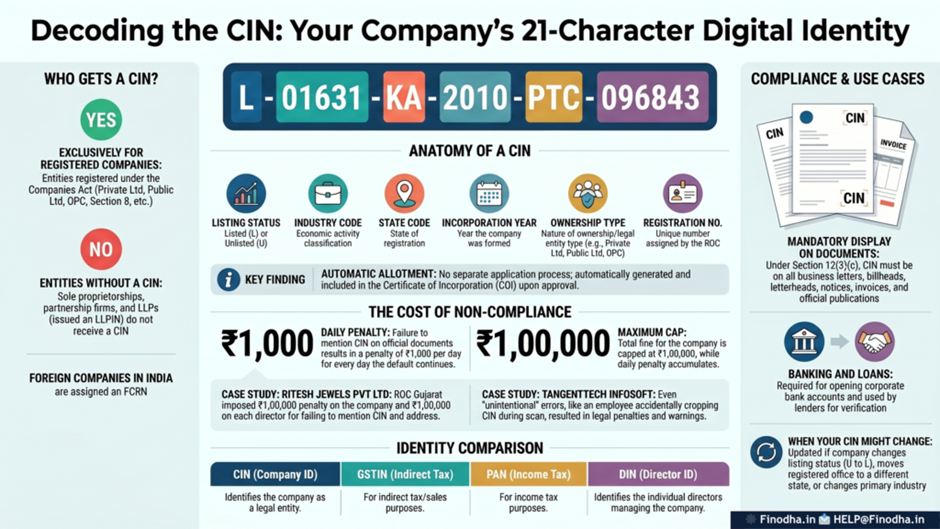
Answer. A CIN is a unique 21-digit identification number assigned to every company registered in India.
Question. What is the role of the Ministry of Corporate Affairs (MCA)?
Answer. The Ministry of Corporate Affairs (MCA) is a Government of India ministry that regulates and oversees the corporate sector in India. It administers corporate laws, registers and regulates companies and LLPs, ensures legal compliance, protects investors' interests, promotes good corporate governance, and supports a transparent and accountable business environment.
Question. What are the primary responsibilities of the MCA?
Answer. The MCA ensures that companies and LLPs in India are registered, follow corporate laws, and operate fairly. It also works to protect investors and maintain trust in the corporate sector.
Question. What is the vision and mission of the MCA?
Answer. The MCA's vision is to build a transparent, trustworthy, and business-friendly corporate environment in India where companies can grow with confidently. Its mission is to make sure businesses follow the law, protect people's interests, and make government services easier to access online.
Question. What are the major Acts governed by the MCA?
Answer. Here are the major Acts governed by the Ministry of Corporate Affairs (MCA): -Companies Act, 2013 -Limited Liability Partnership (LLP) Act, 2008 -Competition Act, 2002 -Insolvency and Bankruptcy Code (IBC), 2016 These laws regulate businesses, promote fair competition, protect the interests of stakeholders, and help ensure a transparent and accountable corporate environment in India.
Question. Who are the stakeholders served by the MCA?
Answer. The Ministry of Corporate Affairs (MCA) serves a wide range of stakeholders, including companies, LLPs, directors, shareholders, investors, professionals (such as CAs, CSs, and CMAs), creditors, entrepreneurs, startups, and the general public by providing corporate services and ensuring compliance with corporate laws.
Question. What services does the MCA provide through its portal?
Answer. The MCA portal offers various online services for businesses, professionals, and the public, such as: -Company and LLP registration -Company name reservation -Filing of statutory forms and annual returns -Viewing company records -Payment of government fees online -Tracking application status -Submitting complaints and grievances Accessing various corporate compliance and e-governance services.
Question. How can companies access MCA incorporation services?
Answer. Companies can access MCA incorporation services by visiting the MCA portal (MCA21), where they can reserve a company name, submit incorporation forms through SPICe+, upload the required documents, and track the status of their application online.
Question. How can I file annual returns and financial statements with the MCA?
Answer. You can easily file annual returns and financial statements through the MCA21 portal by logging into your account. Fill out the applicable web forms (such as AOC-4 for financial statements and MGT-7/MGT-7A for annual returns), upload the required documents, digitally sign the forms, pay the applicable filing fees, and submit them online. The portal also allows you to track the status of your filing after submission.
Question. Does the MCA handle investor grievances?
Answer. Yes. The MCA helps resolve investor grievances related to companies by accepting complaints through the MCA21 portal and forwarding them to the appropriate authority for necessary action, where applicable.
Question. What is the role of the MCA in supervising professional bodies?
Answer. The MCA monitors professional bodies such as Chartered Accountants (ICAI), Company Secretaries (ICSI), and Cost Accountants (ICMAI) to make sure they follow the rules, maintain professional ethics, and provide quality services.
Question. What is the significance of the Competition Act, 2002?
Answer. The Competition Act, 2002 is designed to keep the marketfair and competitive. It stops businesses from creating monopolies or engaging in unfair practices that can harm consumers or other businesses, helping maintain a healthy business environment.
Question. What is a Corporate Identification Number (CIN)?
Answer. A Corporate Identification Number (CIN) is a unique 21-character alphanumeric code that acts as the official identity number of a company registered in India. It also contains important information about the company, such as its listing status, industry, state of registration, year of incorporation, ownership type, and registration number.
Question. How do I check if a company is registered with the MCA?
Answer. To check if a company is registered with the MCA, go to the MCA21 portal and open the "View Company/LLP Master Data" service. Search by the company's name or CIN, and you'll be able to view its registration details and other basic information.
Question. How can I check a company's details online?
Answer. You can easily check a company's details online if you have MCA login ID of MCA21 portal. Just use the "View Company/LLP Master Data" service and enter the company's name or CIN to view its official details.
Question. How can I verify whether a company is genuine or fake?
Answer. You can verify whether a company is genuine by checking its details on the MCA21 portal. Search using the company's name or Corporate Identification Number (CIN) to confirm its registration status, registered office, directors, and other official information.
Question. Who is the current Minister of Corporate Affairs?
Answer. As of July 2026, Nirmala Sitharaman is the Union Minister of Corporate Affairs. She has been serving as the Minister of Finance and Minister of Corporate Affairs since 2019.
Question. Who is the head of the Ministry of Corporate Affairs?
Answer. The head of the Ministry of Corporate Affairs (MCA) is the Union Minister of Corporate Affairs, who is responsible for leading the ministry and making important policy decisions. As of July 2026, Nirmala Sitharaman is the Union Minister of Corporate Affairs.
Question. What is the highest post in the Ministry of Corporate Affairs?
Answer. The highest post in the Ministry of Corporate Affairs (MCA) is the Union Minister of Corporate Affairs.
Question. What does the Minister of Corporate Affairs do?
Answer. The Minister of Corporate Affairs leads the MCA and is responsible for making important decisions related to corporate laws and the corporate sector.
Question. Is the Ministry of Corporate Affairs a government department?
Answer. Yes. The Ministry of Corporate Affairs (MCA) is a ministry of the Government of India not a Government department.
Question. Is working in the Ministry of Corporate Affairs considered a government job?
Answer. Yes. Working in the Ministry of Corporate Affairs (MCA) is considered a government job because the MCA is a ministry of the Government of India.
We’re Available: If you need clarity on your specific compliance requirement, you can explore our detailed service pages or connect with our team:
📞 +91-8512022044 📩 help@finodha.in
We'll handle the paperwork while you focus on building your business; If you have any questions to ask; contact us now.
Important Keywords: LLP PAN card, LLP PAN number, LLP PAN online, Form 94 for LLP PAN, LLP PAN application process, LLP PAN documents, LLP PAN fees, LLP PAN requirements, LLP PAN 2026, New PAN rules 2026, LLP PAN through FiLLiP, LLP PAN correction, LLP e-PAN, LLP PAN vs partner PAN, LLP PAN fourth character, LLP PAN number format.
Words: 2,944, Read time: 16 minutes.
Table of Contents
Overview
From 1 April 2026, the PAN application process in India has changed under the Income-tax Act, 2025 and Income-tax Rules, 2026. The new rules have introduced new PAN application forms and updated the requirements for applying for PAN.
For an Indian LLP, Form No. 94 is used for a fresh standalone PAN application. However, if you are incorporating a new LLP, you can apply for PAN and TAN along with the incorporation application through Form FiLLiP on the MCA portal.
In this guide, we will explain the latest LLP PAN rules for 2026, including why an LLP needs PAN, when PAN is required, the difference between Form FiLLiP and Form No. 94, documents required for an Indian LLP, the PAN application process, applicable fees, and how to obtain the LLP's e-PAN after PAN is allotted.
What is LLP PAN card?
A Permanent Account Number (PAN) is a unique 10-character alphanumeric number issued by the Income Tax Department. It contains both letters and numbers and is used to identify an LLP for income-tax and other financial purposes. PAN may be available in the form of a physical PAN card or an e-PAN.
An LLP has its own PAN, which is different from the PAN of its partners or designated partners. This is because an LLP has a separate legal identity from its partners. The LLP's PAN helps the Income Tax Department identify the LLP and track its tax-related and financial activities.
The LLP's PAN is used to link important tax records, such as income-tax returns, tax payments, TDS/TCS details, tax demands and certain financial transactions. It is also used for communication with the Income Tax Department and helps the tax authorities match financial information reported by different sources.
PAN is also important for several business and financial activities carried out by an LLP. It may be required for opening a bank account, filing income-tax returns, claiming TDS credits, carrying out specified financial transactions and meeting various tax and financial compliance requirements.
Under the Income-tax Rules, 2026, Form No. 94 is applicable when an Indian LLP makes a fresh PAN application separately. The form requires the LLP to provide its registration, incorporation and other prescribed details.
Understanding the 10 Characters of a LLP PAN
A typical PAN of an LLP may look like AAA FL 1234A.
Each part of the PAN has a specific purpose:
First three characters – “AAA”: These are letters forming a series that can range from AAA to ZZZ. Fourth character – “F”: This represents the status of the PAN holder. For an LLP, “F” represents Firm. Fifth Character – Represents the first character of the company's/ Firm's name. Next four characters – “1234”: These are numbers ranging from 0001 to 9999. Last character – “A”: This is an alphabetic check character used as part of the PAN structure.
Therefore, in a PAN such as AAA FL 1234A, the fourth character “F” indicates that the PAN holder is classified as a Firm, which includes an LLP for PAN classification purposes.
The fourth character is used to identify the category of the PAN holder. For example:
P – Individual
C – Company
F – Firm/LLP
H – Hindu Undivided Family (HUF)
A – Association of Persons (AOP)
T – Trust
B – Body of Individuals (BOI)
L – Local Authority
J – Artificial Juridical Person
G – Government
Important: The letter “F” does not mean that an LLP is the same as an ordinary partnership firm under the LLP Act. It is simply the PAN's fourth-character classification used for tax identification purposes.
Fifth character – Represents the first character of the LLP's name.
Here: AAA FL 1234 A
AAA = alphabetic series F = Firm/LLP L = first character of the LLP's name 1234 = sequential number A = check character
Features of Limited Liability Partnership
Separate legal entity distinct from its partners
Limited liability of partners, subject to the LLP Act
No statutory minimum capital requirement
Perpetual succession
Flexible management structure
Generally fewer statutory compliances than a private limited company, depending on the LLP's circumstances
What if the LLP is newly incorporated?
If you are incorporating a new LLP through the MCA portal, you do not normally need to apply for PAN separately after incorporation. The PAN/TAN application is included in Form FiLLiP, which is used for LLP incorporation.
While filing FiLLiP, the required PAN/TAN details are provided along with the incorporation details and documents. Once the incorporation application is successfully processed, the LLP is incorporated and the LLPIN, PAN and TAN are allotted, as applicable.
Important: New LLP → File FiLLiP → PAN/TAN applied along with incorporation → LLPIN and PAN/TAN allocated.
Therefore, if the LLP has already received its PAN through the FiLLiP incorporation process, there is generally no need to file a separate PAN application again just because the LLP has been incorporated.
Why does an LLP need PAN?
PAN is the LLP's tax identification number. It is used for its income-tax compliance and for transactions where PAN is required.
For income-tax purposes, an LLP is treated as a firm and files its income-tax return in ITR-5, subject to the applicable provisions.
Legal Framework – PAN for Limited Liability Partnership
The PAN application and related requirements for an LLP are covered under the Income-tax Act, 2025 and the Income-tax Rules, 2026.
Under the 2026 framework, an Indian LLP applying separately for a fresh PAN uses Form No. 94. The form requires details such as the LLP's name, date of formation, office and communication address, status and registration number. The prescribed proof may include the LLP's Certificate of Registration or its LLP Identification Number (LLPIN).
The new PAN forms apply to fresh PAN applications made on or after 1 April 2026. Existing PANs remain valid, so an LLP that already has a PAN does not need to obtain a new PAN merely because the PAN application forms have changed.
For tax compliance, an LLP is treated as a firm for income-tax purposes and generally files its income-tax return using ITR-5.
Documents for LLP PAN under the 2026 framework
For an Indian LLP, the following documents/information may be required for PAN:
New LLP: PAN can be applied for through Form FiLLiP during the LLP incorporation process. No separate PAN application is generally required if PAN is successfully allotted through FiLLiP.
Existing LLP: If PAN is applied for separately, the LLP must provide the documents and information prescribed under the Income-tax Rules, 2026.
Proof of registration: An Indian LLP can provide either:
Certificate of Registration issued by the Registrar of Limited Liability Partnerships; or
LLP Identification Number (LLPIN) allotted by the Registrar.
Address and authorised person details: The prescribed details and supporting documents relating to the LLP's address and authorised/representative person, wherever applicable, may also be required.
In simple terms: These documents establish the LLP's legal existence, registration, address and authorised details for PAN purposes.
PAN Application Fees for LLP
The following fees are based on the current PAN service-provider fee structure and may be revised from time to time.
For an LLP with an Indian communication address:
Physical PAN + e-PAN: ₹107 through PAN Centre/physical mode or ₹101 through paperless online mode.
Only e-PAN: ₹72 through PAN Centre/physical mode or ₹66 through paperless online mode.
For a foreign communication address, the fee is higher due to overseas dispatch charges.
Important: These fees apply to a separate PAN application. If PAN/TAN is applied for during new LLP incorporation through MCA Form FiLLiP, the PAN application is integrated into the incorporation process and should not be treated as a separate mandatory PAN fee.
How to apply for PAN for an LLP
There are two situations for obtaining PAN for an LLP:
PAN for a new LLP
When a new LLP is being incorporated, its PAN/TAN application is made through Form FiLLiP on the MCA portal.
Fill in the PAN/TAN details in Form FiLLiP. Submit the LLP incorporation application along with the required documents and fees. After successful processing, the LLP is registered and its LLPIN and PAN/TAN are allocated.
2. PAN for an existing LLP
If an existing LLP does not have a PAN and needs to apply separately:
Use the new PAN application process applicable from 1 April 2026.
An Indian LLP must use Form No. 94 for a fresh PAN application.
Provide the prescribed LLP registration details and supporting proof, as required under the Income-tax Rules, 2026.
Submit the application through the applicable PAN service channel.
After submission, the application can be tracked using the acknowledgement/application details provided by the PAN service provider. Once PAN is allotted, the LLP can obtain its e-PAN through the applicable PAN service.
In simple terms: A new LLP can obtain PAN/TAN as part of its MCA incorporation process through FiLLiP. An existing LLP applying separately for a new PAN follows the 2026 PAN application process using Form No. 94.
Difference between LLP PAN and partner’s PAN
Here are the major differences:
Basis
LLP PAN
Partner’s PAN
Issued to
Issued in the name of the LLP
Issued to the individual partner
Identifies
Identifies the LLP as a separate entity
Identifies the partner as an individual taxpayer
PAN category
Fourth character is “F”, representing Firm/LLP
Fourth character is “P”, representing Individual
Tax matters
Used for the LLP’s income-tax and other tax compliances
Used for the partner’s personal tax compliances
Financial activities
Used for the LLP’s business transactions and bank account
Used for the partner’s personal financial transactions and investments
Relationship
The PAN is linked to the LLP and remains with the LLP even if its partners change.
The PAN is linked to the individual partner and remains with the partner regardless of the LLP.
In simple terms: The LLP PAN is for the LLP’s business and tax matters, while the partner’s PAN is for the partner’s individual tax and financial matters.
Conclusion
For an LLP, PAN is more than just a tax number. It serves as the LLP’s tax identity and is required for important activities such as filing income-tax returns, claiming TDS credit, opening a bank account, GST registration, and carrying out other financial transactions.
We hope this guide has helped you understand the latest LLP PAN rules, Form No. 94, required documents, and the PAN application process in simple terms. Keeping the LLP’s PAN details accurate and updated can also help avoid unnecessary issues in its tax and financial compliances.
If you think we have missed any important point about the new PAN framework or have any questions, feel free to reach out to us at help@finodha.in. Your questions and suggestions can also help us make this guide more useful for LLPs, partners, and business professionals.
Question. What is Form No. 94 used for in LLP PAN applications?
Answer. An Indian LLP uses Form No. 94 to apply for a new PAN separately under the 2026 PAN rules.
Question. What documents are required for an LLP PAN application?
Answer. The main document required for an LLP PAN application is proof of the LLP's registration, such as its LLPIN or Certificate of Registration.
Question. When should an LLP apply for PAN after incorporation?
Answer. An LLP does not normally need to apply for PAN separately after incorporation because the PAN/TAN application is integrated into Form FiLLiP at the time of incorporation.
Question. What happens if an LLP does not have a PAN?
Answer. If an LLP has not received PAN through the incorporation process, it can make a separate fresh PAN application using Form No. 94 under the Income-tax Rules, 2026.
Answer. No. An LLP should have only one PAN. If more than one PAN has been allotted, the additional PAN(s) should be surrendered through the prescribed process.
Question. How can an LLP correct wrong information on its PAN?
Answer. If an LLP already has a PAN but needs to correct or update its PAN details, it should use the prescribed PAN correction process applicable to non-individuals, including Form PAN CR-02 under the 2026 framework.
Question. What should an LLP do if its PAN card is lost or damaged?
Answer. If an LLP loses or damages its PAN card, it can request a reprint or reissue of the PAN card using the same PAN number.
Question. Can an LLP change its PAN after changing its name?
Answer. No. An LLP does not get a new PAN merely because its name is changed. It can update the new name in its existing PAN records through the prescribed PAN correction process.
Question. What happens to the PAN when a partnership firm is converted into an LLP?
Answer. When a partnership firm is converted into an LLP, the LLP has its own PAN. The partnership firm's PAN does not automatically become the LLP's PAN.
Question. Can an LLP surrender its PAN after closure or dissolution?
Answer. Yes. If an LLP is dissolved and closed, it can request surrender of its PAN after completing its pending tax compliances.
Question. How is an LLP PAN different from a partner's PAN?
Answer. The major difference between an LLP PAN and a partner’s PAN is that the LLP PAN is issued in the name of the LLP, whereas the partner’s PAN is issued to the individual partner.
Question. What does the fourth character of an LLP PAN mean?
Answer. The fourth character of an LLP’s PAN is “F”, which indicates that the PAN belongs to a Firm/LLP.
Question. Can an LLP receive TDS credit using its PAN?
Answer. Yes. An LLP can claim TDS credit against its own PAN because the TDS deducted on the LLP’s income is reported under the LLP’s PAN.
Question. Can an LLP apply for TAN along with PAN?
Answer. Yes. An LLP can apply for PAN and TAN together during the incorporation process through Form FiLLiP.
Question. What happens to an LLP's PAN if it becomes inactive?
Answer. If an LLP becomes inactive, its PAN remains valid and does not automatically get cancelled. The LLP continues to use the same PAN unless it is formally dissolved and the PAN is surrendered through the prescribed process.
Question. Is PAN mandatory for every LLP registered in India?
Answer. Yes. Every LLP registered in India must have its own PAN for income-tax and other financial compliances.
Question. Does an LLP get a new PAN after changing its registered office?
Answer. No. Changing the registered office does not normally result in a new PAN. The LLP should update the changed details through the prescribed PAN correction process.
Question. Can an LLP use a partner's PAN instead of its own PAN?
Answer. No. An LLP cannot use a partner’s PAN in place of its own PAN. The LLP has its own PAN for use of LLP’s tax, business and financial transactions.
We’re Available: If you need clarity on your specific compliance requirement, you can explore our detailed service pages or connect with our team:
📞 +91-8512022044 📩 help@finodha.in
We'll handle the paperwork while you focus on building your business; If you have any questions to ask; contact us now.
Important Keywords: Corporate Identification Number (CIN) in India, What is CIN, CIN full form, CIN under Companies Act 2013, CIN structure explained, How to find CIN number, CIN vs GSTIN vs PAN, Importance of CIN number, CIN for companies in India, MCA CIN search, ROC CIN details, CIN registration process, CIN legal requirements India.
Words: 4,652, Read time: 25 minutes.
Table of Contents
Overview / Corporate Identification Number (CIN) in India
"A Corporate Identification Number (CIN) is a 21-character unique code assigned to every company registered in India & CIN is more than a number — it’s the DNA that defines a company’s identity."
Just like DNA reveals the true identity of an individual, the CIN unveils the legal identity of a company. In this article, we will explore how this unique code is far more than just a registration detail; it’s the blueprint that tells you who the company is, how it is structured, and where it belongs in the corporate ecosystem. With a CIN, you can decode essential information about any registered business. In this article, we’ll explore how CIN works, why it matters, and how it serves as the DNA of corporate existence. Let’s begin the decoding journey….
Decoding the Corporate Identification Number
Do not confuse the Corporate Identification Number (CIN) with the Challan Identification Number (CIN), which is a 20-digit code used for tax payments.
Don’t get confused—they may sound similar, but they are used for completely different purposes.
Corporate Identification Number (CIN): A 21-digit code given to every company by the Registrar of Companies (ROC) through the Ministry of Corporate Affairs (MCA) at the time of incorporation. It works like a company’s ID card, helping people check its basic details.
Challan Identification Number (CIN): A 20-digit code used when you pay taxes. It is generated by the Income Tax Department and acts like a payment receipt number to track your tax payment.
Now, we will discuss the Corporate Identification Number (CIN) in this article.
What is Corporate Identification Number (CIN)?
As per Section 7(3) of the Companies Act, 2013, once a company is incorporated, the Registrar of Companies (ROC) assigns a Corporate Identification Number (CIN) to the company. This CIN is also mentioned on the Certificate of Incorporation.
The CIN is a unique identification code issued to every company in India by Registrar of Companies (ROC) through the Ministry of Corporate Affairs (MCA) portal. It serves as the official identity of the company and must be mentioned in almost all official documents and communications. Every company is required to print its name, registered office address, and CIN, along with contact details such as telephone number, fax (if any), email, and website (if available), on all business letters, billheads, letterheads, notices, and other official publications.
The CIN is not just a legal formality—it is essential for building trust and ensuring smooth business transactions. Understanding CIN is crucial for legal compliance, transparency, and efficient business operations in India. It is a key identifier that plays an important role in a company’s interactions with regulatory authorities, clients, and financial institutions.
Importance of Corporate Identification Number
The Corporate Identification Number (CIN) is far more than just a code- It plays multiple roles in a company. It works like an ID card for a company.
Unique Identity: Just like no two people can share the same Aadhaar number, no two companies can share the same CIN. It helps to clearly identify and track a company.
Transparency: The CIN tells you what type of company it is, which industry it belongs to, and where it is registered. This makes it easier for investors, clients, and regulators to trust the company.
Compliance: Regulators use the CIN to check if a company is following all the legal rules and filing requirements. It’s a way to keep companies accountable.
Official Use: The CIN must be printed on all important documents like letterheads, invoices, notices, and e-filings. This shows professionalism and builds credibility.
*The CIN is not just a number—it’s the company’s official identity, helping with trust, compliance, and smooth business operations.
When do you need a CIN number?
A CIN is required in many common business situations, such as:
Opening a current bank account in the company’s name
Signing important agreements, contracts, or legal documents
Filing annual returns and other statutory compliances with ROC
Applying for government licences, registrations, or permits
Communicating or dealing with government departments
Approaching banks or financial institutions for loans or credit facilities
Applying for a business loan, whether online or offline
Mentioning it on company documents like invoices, letterheads, and official filings
Banks and lenders often use the CIN to check a company’s details, compliance history, and overall credibility before approving a loan.
Who does not require a CIN?
A CIN is not required for all types of businesses in India. It is issued only to companies that are registered under the Companies Act. Therefore, the following types of entities do not receive a CIN:
Sole proprietorships
Partnership firms
Limited Liability Partnerships (LLPs) – they receive an LLPIN instead (
NGOs registered as societies or trusts
Small or unregistered businesses
In simple terms, only companies registered under the Companies Act are issued a CIN.
Structure of Corporate Identification Number (CIN)
A Corporate Identification Number (CIN) is a unique 21-character alphanumeric code issued by the Registrar of Companies (ROC) to every registered company. It is structured in a way that each part of the number provides specific information about the company.
For example, a CIN looks like L01631KA2010PTC096843 can be understood in six meaningful parts:
Section 1 – Listing status: Indicates whether the company is listed or unlisted Section 2 – Industry code: Shows the nature of business activity Section 3 – State code: Represents the state where the company is registered Section 4 – Year of incorporation: Mentions the year the company was formed Section 5 – Ownership type: Identifies the form of ownership (e.g., Private Limited, Public Limited) Section 6 – Registration number: The unique number assigned to the company by the ROC
*CIN is not just a number—it is a coded identity that reveals key details about a company’s legal and business structure.
Breakdown the structure
A Corporate Identification Number (CIN) is a 21-character alphanumeric code that is divided into six distinct parts, and each part conveys specific information about a company. This can be better understood with the example below:
U – 12345 – DL – 2020 – PLC – 098765
Breakdown of CIN structure:
First character (U/L)– Showing Listing status: The first letter indicates whether the company is listed or unlisted. “L” represents a listed company on BSE/NSE, while “U” represents an unlisted company.
Next 5 digits – Showing Industry code: This five-digit number represents the company’s industry classification, assigned by the Registrar of Companies (ROC) based on its business activity.
Next 2 letters – Showing State code: This part shows the state in which the company is registered. For example, DL refers to Delhi, Maharashtra is "MH", Tamil Nadu is "TN", Madhya Pradesh will be "MP", and Gujarat will be "GJ".
Next 4 digits – Showing Year of incorporation: These digits indicate the year in which the company was incorporated, such as 2020 in this example.
Next 3 letters – Showing Type of company/ownership: This section defines the nature of the company. For instance, PLC stands for Public Limited Company, while other codes represent different types such as private companies.
Last 6 digits – Showing Registration number: This is the unique registration number assigned to the company by the ROC.
*A CIN works like a structured identity code for a company - each segment provides specific information about its listing status, industry, location, year of incorporation, type, and registration details.
Abbreviation in CIN number
These are the abbreviations that appear in the CIN's sections 5:
Company Type Code
Full Form
Common Use / Meaning
FLC
Financial Lease Company (Public Limited)
Specialized financial institutions
FTC
Foreign Subsidiary Company (Private Limited)
Indian subsidiaries of multinational companies (e.g., Google India Pvt. Ltd.)
GAP
General Association Public
Trade associations, industry bodies
GAT
General Association Private
Trade associations, industry bodies
GOI
Government of India Owned Companies
PSUs like ONGC, BHEL, SBI, LIC
NPL
Not-for-Profit License Company (Section 8 Company)
NGOs, educational trusts, foundations, professional bodies
State electricity boards, DISCOMs, state undertakings
ULL
Unlimited Liability Public Company
Rare: mainly older registrations or professional setups
ULT
Unlimited Liability Private Company
Rare: mainly older registrations or professional setups
CIN vs LLPIN vs FCRN
Type
Used For
CIN
Companies
LLPIN
LLPs
FCRN
Foreign companies
How CIN is issued (process)
Getting a Corporate Identification Number (CIN) is part of registering your company with the Ministry of Corporate Affairs. Just follow these basic steps:
Choose a company name
Prepare documents (MOA, AOA, etc.)
Apply for incorporation through SPICe+ form on MCA portal
DIN (for directors) is allotted during this process (if not already available)
Submit application with fees
Once approved:
The Registrar of Companies issues Certificate of Incorporation
CIN is automatically generated and mentioned in it.
*You do not need to apply for a Corporate Identification Number (CIN) separately. It is automatically assigned when your company is incorporated by the Ministry of Corporate Affairs through the Registrar of Companies.
Once your company is approved, the CIN is mentioned in the Certificate of Incorporation (COI), which serves as proof of your company’s legal existence.
How to Check / Track CIN?
The CIN of any company can be easily found online. Visit the official website of the Ministry of Corporate Affairs to find the CIN. The website allows you to search for the following –
Registration number of the company
Name of the existing company or name of the Limited Liability Partnership (LLPs use LLPIN, not CIN)
Active or inactive CIN
Name of the LLP or the old company (LLPs use LLPIN, not CIN)
After the required details are filled in, you need to enter a CAPTCHA code and then click on search.
Where to check CIN
Go to MCA website
Click “View Company Master Data”
Enter company name
Changes in Corporate Identification Number (CIN)
The CIN generally remains the same, it can change in certain situations, such as:
Change in listing status: If a company gets listed on a stock exchange or becomes unlisted, the first letter of the CIN changes (e.g., from “U” to “L” or vice versa).
Change in registered office (state-wise): If the company shifts its registered office from one state to another, the state code in the CIN changes. (No change if the office shifts within the same state.)
Change in industry or business activity: If there is a major change in the company’s primary business activity, the industry code (first 5 digits) in the CIN may be updated.
How CIN fits into the bigger system (In broader concept)
Corporate Compliance System in India, It is a part of Company registration, ROC filings and Legal identity tracking.
Penalty
As per Section 12(3)(c) of the Companies Act, 2013, every company is required to print its Corporate Identity Number (CIN) on all important official documents such as business letters, invoices, notices, and other publications. This CIN acts like the company’s unique identification number.
If a company fails to include its CIN on these documents, then under Section 12(8) of the Act, the company must pay a penalty of ₹1,000 for each day the default continues.
However, the law also sets a limit. The total penalty cannot exceed ₹1,00,000, no matter how long the company continues to miss adding the CIN.
Even minor omissions (like missing CIN on letterheads) are treated as technical non-compliance and can attract penalties.
MCA imposes penalty for companies’ failure to mention CIN on documents
Let’s understand this with real MCA adjudication cases:
Case 1: Tangenttech Infosoft Private Limited.
Tangenttech Infosoft Private Limited, a company based in Ahmedabad, filed certain documents on the MCA portal. However, in some documents, the company did not mention its CIN and registered office address, which is mandatory under Section 12(3)(c) of the Companies Act, 2013.
This mistake was noticed by the Registrar of Companies during routine verification.
Issue in this case
As per the Companies Act, every company must mention its CIN and registered office address on all official documents.
But in this case, the company failed to include these details in:
Board Resolution (2017)
Letter attached with ADT-1
Letter attached with ADT-2 (2021)
This was treated as a non-compliance, and the company along with its officers became liable for penalty under Section 12(8).
Action taken by Authorities:
The Regional Director (NWR), Ahmedabad directed the ROC to take action.
The ROC issued a notice on 17.09.2021 for non-compliance.
Initially, the company did not respond to the notice.
Later:
A hearing notice was issued on 25.11.2021
Hearing was fixed for 05.01.2022, but adjourned
Final hearing took place on 23.03.2022
Company’s Response
During the hearing, the company (through its Company Secretary) stated that:
The company follows the law and had no intention of ignoring compliance requirements.
The missing CIN and registered office address happened by mistake when an employee scanned the document.
The letterhead did have the CIN and address, but the employee scanned it incorrectly, leaving out that part.
The company has filed other documents with the Registrar of Companies (ROC) that correctly include the CIN and registered office address, as required under Section 12(1) of the Companies Act, 2013.
The company secretary explained that the error was unintentional, caused by a scanning mistake, and that the company has otherwise complied with the law in its filings. Also the company secretary asked the Adjudicating Officer to consider the company’s financial struggles and losses due to COVID-19 before giving any penalty order.
The Presenting Officer pointed out that in some documents (like the board resolution of 28.12.2017 and a letter dated 23.02.2021 filed with ADT-2), the company did not include its CIN number and registered office address on the letterhead, which is required by law.
He explained that this is a violation of Section 12(3)(c) of the Companies Act, 2013, and therefore attracts penalties under Section 12(8).
However, in other filings (like MGT-7 in 2019), the company did mention the CIN and address correctly.
So, the issue was not constant but occasional.
Based on these facts, the Registrar of Companies (acting as Adjudicating Officer) concluded that the company and its officers had indeed violated the law in those specific cases and are liable for penalties.
The company secretary asked for leniency due to financial hardship, but the authorities found that the company had failed to follow the rule of mentioning CIN and address on certain documents, which counts as a violation and makes them liable for penalty.
Before deciding the penalty, the Registrar of Companies looked at three things:
Whether the company gained unfair advantage.
Whether investors lost money.
Whether the mistake was repeated.
The Presenting Officer said there was no clear proof of unfair gain or investor loss, and such things are hard to measure in this case.
He also noted that the company’s balance sheet showed it was not a “small company,” so it could not get the benefit of reduced penalties under Section 446B.
After considering all facts, the Registrar of Companies decided that the company and its directors had violated Section 12(3)(c) of the Companies Act, 2013.
Therefore, he imposed penalties on the company and its directors, stating that the punishment was fair and matched the seriousness of the failure.
The officer checked if there was unfair gain, investor loss, or repeated mistakes. Finding violations in specific documents, and since the company isn’t a “small company,” he imposed penalties on the company and its directors.
The Adjudicating order (Final Order)
The Registrar of Companies decided that the company and its directors violated Section 12(3)(c) of the Companies Act, 2013.
A penalty of ₹1,000 each was imposed on the company and its five directors (total ₹6,000).
The company was told to immediately fix the mistake and update its registered office details with the Registrar.
The penalty must be paid online within 90 days, and proof of payment filed with the Registrar.
The company and directors can appeal the order within 60 days to the Regional Director in Ahmedabad.
If the penalty is not paid within 90 days:
The company can be fined between ₹25,000 and ₹5,00,000.
The defaulting directors can face up to 6 months in jail or fines between ₹25,000 and ₹1,00,000, or both.
The order warned that prosecution will be filed if payment is not made, without any further notice.
With this, the adjudication notice was closed.
In short: The company and its directors were fined ₹6,000 total, told to correct the mistake, pay within 90 days, or face heavier fines/jail.
Case 2: RITESH JEWELS PRIVATE LIMITED
[(CIN: U52393GJ2009PTC057924) Date of final hearing- 06.03.2024]
In this case, the Registrar of Companies (ROC), Gujarat, took action against M/S Ritesh Jewels Private Limited for not following the rules under Section 12(3)(c) of the Companies Act, 2013.
As per the law, every company must mention its CIN (Corporate Identification Number) and registered office address on all official documents like letterheads, invoices, notices, etc. However, this company failed to do so.
Because of this mistake:
The company violated the legal requirement.
Both, the company and its directors were held responsible for this non-compliance.
Even after receiving official notices and being given chances to explain their side, the company did not respond properly. Due to this, the ROC proceeded with the penalty under Section 454 of the Companies Act.
The authority clearly stated that:
Not knowing the law is not an excuse.
Directors and officers must ensure that the company follows all legal requirements.
Penalty imposed:
₹1,00,000 on the company
₹1,00,000 each on two directors (Mr. Ritesh Jayendrabh Adeshara and Ms. Minaben Jayendrabhai Adeshara)
This case shows that even small mistakes like not mentioning the CIN and registered office address can lead to heavy penalties. It also highlights that directors have a duty to ensure full compliance with the law.
# From both cases, we’ve learned that compliance isn’t just paperwork—it’s a legal duty. Even small mistakes, like missing the CIN or address, can cause serious financial and legal trouble for the company and its directors.
Difference between CIN and Other numbers
Many people get confused between CIN and other registration numbers, but each one is used for a different purpose.
CIN (Corporate Identification Number): (Company identity) -This is like the identity card of a company. It shows that the company is legally registered with the Ministry of Corporate Affairs.
DIN (Director Identification Number): (Director identity) - This is the identity of a director, which is used for all compliance and legal filings related to the company, such as appointments, resignations, and disclosures. It helps the government track and verify the details of directors across companies.
GSTIN: (Sales tax (GST)) - This is used when a company deals with GST (tax on goods and services). It is only for tax purposes.
PAN: (Income Tax) - This is used for income tax purposes of the company.
TAN: (TDS/TCS tax) - This is used when a company deducts or collects tax at source (TDS/TCS).
LLPIN: (LLP identity) - This is like the identity card of LLP.
Conclusion
In this article, we learned about the CIN (Corporate Identification Number), which is like the official identity of a company in India. It is automatically given when a company is registered and must be mentioned on all important documents to maintain transparency and follow legal rules.
We also covered important points such as what a CIN number is, why it is important, who gets it, how it is issued, and the penalties for not using it properly. Along with this, we discussed a couple of real cases where companies faced issues for not mentioning their CIN on official documents.
So, by reading this article, you now have a clear and practical understanding of CIN and its role in company compliance.
In simple terms, a CIN is not just a number—it helps the government and the public identify a company easily. Once you understand how it works, things like checking company details, following compliance rules, and doing proper verification become much easier.
We hope this article helps you understand CIN in a simple way and gives you the right and reliable information for your needs.
Disclaimer: The information in this article is for general purposes only and may not fit your personal situation. It is not legal, financial, or professional advice, and you should not rely on it as such. Before making any decisions, consider if this information applies to you and, if needed, get advice from a professional. The information is correct at the time of publication. While we have tried to ensure it is accurate, Finodha.in is not responsible for any loss or damage caused by using this information.
At Finodha.in, We serve a number of clients who need assistance/guide for various regulatory compliances including setting up business in India, company formation in India, income tax return filling, bookkeeping, accounting, GST and auditing. If you require any guidance for any professional service, we are here to serve you! You can also book a free consultation with us!
Join with us today! We shall be happy to assist you, and in case you require our services, please feel free to contact us at the below mentioned email details: – help@finodha.in.
Question. How can I get Company registration in India?
Answer. To get company registration in India, you must apply online through the MCA portal, complete the SPICe+ (INC-32) form, and obtain a Certificate of Incorporation (COI) from the Registrar of Companies (ROC).
Question. CIN number is mandatory for a Company?
Answer. yes, It is mandatory for the Company because it is the Identity of the Company.
Question. Is there any difference between Company registration number and CIN number?
Answer. Yes, there is a difference — Company Registration Number is the number you get when the company is registered, while the Corporate Identity Number (CIN) is the unique identification number assigned by the Registrar of Companies (ROC) after incorporation.
Question. How do I open my CIN number?
Answer. You don’t open a CIN; it is automatically assigned at incorporation, and you can check it on your Certificate of Incorporation or search it on the MCA portal.
Question. How would I download a Company CIN number?
Answer. You can't download the CIN itself, but you can download your Certificate of Incorporation or company master data from the MCA portal, which contains your CIN.
Question. Can two companies have a same CIN number?
Answer. No, As we know CIN is a unique identification number issued by the ROC at the time of incorporation. so two companies can never have the same CIN number.
Question. Is CIN mandatory to be mentioned on the invoices, bills, and receipts of a company?
Answer. Yes, It is mandatory to be mentioned on the invoices, bills, and receipts of a company.
Question. How to apply for CIN?
Answer. There is no separate process to apply for a CIN. It is automatically generated at the time of incorporation.
Question. How to read a CIN number?
Answer. There is no separate process to apply for it. The CIN is automatically generated at the time of incorporation by the Registrar of Companies (ROC).
Question. Who is eligible for a CIN number?
Answer. Yes, your statement is correct — only companies registered in India under the Companies Act, 2013 are eligible for a CIN number.
Question. Is CIN allotted to LLP?
Answer. No, CIN is not allotted to LLP.
Question. Are CIN and GST the same?
Answer. CIN and GST are different. The Corporate Identity Number (CIN) is a company identity number issued by the Registrar of Companies under the Companies Act, 2013, while the Goods and Services Tax Identification Number (GSTIN) is issued under GST law for tax purposes.
Question. What is CIN verification?
Answer. CIN verification is the process of validating a company’s identity and registration details using its unique CIN.
Question. Where to use the CIN Number?
Answer. The CIN number is a unique identity number of the company, and it must be mentioned on all official documents, filings, and communications.
Question. Is CIN mandatory for all companies?
Answer. Yes, a CIN is mandatory for all companies registered in India under the Companies Act, 2013.
Question. Can a sole proprietorship or partnership have a CIN?
Answer. No, a sole proprietorship or partnership cannot have a Corporate Identity Number (CIN).
Question. What happens if a company does not mention its CIN?
Answer. Failing to mention the CIN is a violation of Section 12(3), and the penalty is imposed under Section 12(8) of the Act.
Question. Can I verify a company’s authenticity using CIN?
Answer. Yes — you can verify a company’s authenticity using its CIN through the MCA portal, which shows the company’s registration details, status, and compliance records.
Question. How long does it take to get a CIN?
Answer. CIN is issued immediately upon approval of incorporation. The total incorporation process may take 5–10 working days depending on approvals.
Question. What documents are required for CIN registration?
Answer. No separate documents are required to obtain a CIN. The CIN is automatically allotted upon company incorporation. However, certain documents are required for company registration, during which the CIN is issued.
Question. What are the fees for CIN registration in India?
Answer. A Corporate Identification Number (CIN) is not registered separately and does not have any separate government fee. it is automatically generated at the time of incorporation.
Question. Can a foreign company obtain a CIN in India?
Answer. Yes, Foreign companies registered under the Companies Act (having a place of business in India) are assigned a CIN or FCRN (Foreign companies are assigned FCRN (Foreign Company Registration Number), not a standard CIN) upon registration with ROC.
Question. Can a company change its CIN?
Answer. CIN is not manually altered, but it may change automatically by the Registrar of Companies when the company’s type, state of registration, or industry classification changes.
Question. How can I know my corporate ID?
Answer. Your CIN is printed on the Certificate of Incorporation and can be verified anytime on the MCA portal.
Question. What is the purpose of CIN?
Answer. The main purpose of a CIN is to provide basic information about a company, such as its type, year of incorporation, listing status (listed or unlisted), and the state in which it is registered, among other details.
Question. How to find CIN number online?
Answer. You can find a CIN online through the MCA portal by searching the company name in the “View Company Master Data” section.
Question. Are CIN and PAN number the same?
Answer. No, CIN and PAN both are completely different number. CIN is the identity of company and PAN is the identity of the individuals.
Question. What is a 21 digit CIN number?
Answer. A Corporate Identification Number (CIN), such as L12345MH2020PLC123456, is a 21-character alphanumeric code and not a 21-digit numeric number. In India, CINs are always a combination of letters and numbers.
Question. Is CIN number equal to GST number?
Answer. No, a Corporate Identification Number (CIN) and a GST number are completely different.
Question. How to get GST from CIN?
Answer. You cannot get GST directly from CIN. You must search GSTIN separately using the company name or PAN on the GST portal.
Question. Who is eligible for CIN number?
Answer. CIN is allotted only to companies registered under the Companies Act, such as Private Limited, Public Limited, OPC, Section 8, government companies, and certain foreign companies registered in India.
— Finodha Making Compliance Affordable
Video Explanation:
We’re Available: If you need clarity on your specific compliance requirement, you can explore our detailed service pages or connect with our team:
📞 +91-8512022044 📩 help@finodha.in
We'll handle the paperwork while you focus on building your business; If you have any questions to ask; contact us now.