Important Keywords: Private Limited Company PAN Card, Company PAN application, Form 94 PAN, PAN Form 94, PAN application for company, Company PAN card documents, Company PAN card fees, Company PAN application process, How to apply for company PAN, New PAN forms 2026, PAN rules 2026, Income-tax Act 2025 PAN, Income-tax Rules 2026 PAN, Track PAN application status.
Words: 3,324, Read time: 18 minutes.
Table of Contents
Overview
One of the major updates came into effect on 1 April 2026, when the PAN application process in India changed significantly under the Income-tax Act, 2025 and the Income-tax Rules, 2026. These changes affect how PAN is applied for, which forms are used, what documents are required, and when PAN must be quoted.
For example, the earlier Forms 49A and 49AA have been replaced with new PAN application forms. The requirements and procedures for proving identity, address, and date of birth or incorporation have also been updated.
These changes are particularly important for Private Limited Companies, NRIs, resident but not ordinarily resident (RNOR) individuals, foreign nationals, and foreign companies that have taxable income, investments, or other financial activities in India.
In this guide, we will explain the latest rules for a Private Limited Company PAN Card, including the applicable PAN application form, documents required, important changes from 1 April 2026, and the process for applying for or updating a company's PAN.
Key points to remember for New PAN Application Form
From 1 April 2026, Forms 93, 94, 95 and 96 are used for fresh PAN applications, while CR-01 and CR-02 are used for changes or corrections in existing PAN data.
Only the new PAN forms will be accepted from 01.04.2026 onwards. Old forms will not be accepted after 31.03.2026. This applies to both new PAN applications and change/correction (CR) requests. Applications pending as on 31 March 2026 will continue to remain valid and do not need to be submitted again under the new forms. Existing PAN numbers also remain valid.
The documents required for PAN application depend on the type of applicant. For an Indian company, the prescribed documents include proof of identity, address and date of incorporation, as applicable under Rule 158.
In Form 94 & 96, details of RA/AR are mandatory.
Contact details of applicant and RA/AR (if applicable) are mandatory.
What is a PAN Card for a Private Limited Company?
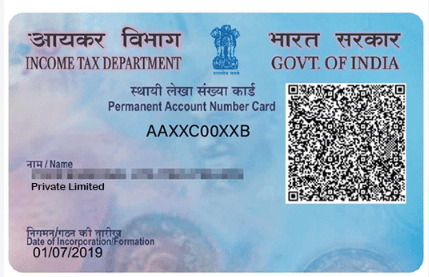
A Permanent Account Number (PAN) is a unique 10-character alphanumeric, because PAN contains both letters and numbers issued by the Income Tax Department to a Private Limited Company. The PAN may be provided through a physical PAN card or an e-PAN.
A Private Limited Company has its own PAN, which is different from the PAN of its directors and shareholders. This is because the company has a separate legal identity from the individuals who own or manage it. The company's PAN helps the Income Tax Department identify the company and keep track of its tax and financial activities.
The company's PAN helps connect its important tax records, including income-tax returns, tax payments, TDS/TCS details, tax demands, certain financial transactions, and communication with the Income Tax Department. It also helps the tax authorities match information received from different sources and identify possible cases of tax evasion.
A company's PAN is also important for many business and financial activities. It is commonly required for opening a company bank account, filing income-tax returns, claiming TDS credits, carrying out certain financial transactions, and completing various tax and financial compliances.
Understanding the 10 Characters of a Company PAN
A typical PAN may look like AAA CP 1234A.
PAN Image
Each character in a PAN has a specific purpose:
First three characters – "AAA": These are alphabetic characters forming a series that can range from AAA to ZZZ.
Fourth character – "C": This identifies the status/category of the PAN holder. For a company, the fourth character is "C".
Fifth Character – Represents the first letter of the company's/ Firm's name.
Next four characters – "1234": These are sequential numbers ranging from 0001 to 9999.
Last character – "A": This is an alphabetic check character used as part of the PAN's structure.
Therefore, in a PAN such as AAACP1234A, the letter "C" in the fourth position indicates that the PAN belongs to a company.
Note: The PAN structure is the same whether the company is a Private Limited Company or another type of company. The fourth character "C" indicates that the PAN holder is a company; it does not specifically mean "Private Limited Company."
i.e. The alphabet ‘F’ represents Firm, ‘T’ represents Trust, , ‘H’ for HUF, ‘P’ for Individual, ‘C’ for Company etc.
Legal Framework – PAN for private limited company
The Permanent Account Number (PAN) framework is mainly governed by Section 262 of the Income-tax Act, 2025. It explains who is required to obtain PAN, who can apply for it, how PAN is allotted, and the situations in which PAN or Aadhaar must be quoted or authenticated.
The detailed procedure for applying for PAN is provided under Rule 158 of the Income-tax Rules, 2026. It also specifies the documents that need to be submitted with the applicable PAN application form, such as proof of identity,proof of address, and proof of date of birth or incorporation.
Rule 159 specifies certain transactions and activities where PAN is required to be quoted. In certain cases, a person who does not have PAN may submit a declaration in Form 97 instead. Form 97 is a declaration used in certain specified transactions by persons who do not have PAN and is generally not available to companies or firms.
The law also provides a penalty for non-compliance. Under Section 467 of the Income-tax Act, 2025, the Assessing Officer may impose a ₹10,000 penalty for failure to comply with Section 262. A ₹10,000 penalty may also apply for certain cases involving false, missing, or unauthenticated PAN or Aadhaar details in prescribed documents.
Why PAN is required for Private Limited Company?
A private limited company is a separate legal entity, which means the company has its own identity in the eyes of law, separate from its directors and shareholders. Just as an individual has a personal PAN, the company also needs a separate PAN in its own name.
Form No. 94 is used to provide the company's details to the Income Tax Department for applying for its PAN.
Once the PAN is allotted, it is used to identify the company for tax and financial purposes. It helps the Income Tax Department keep track of the company's income-tax returns, tax payments, TDS/TCS, tax notices and certain financial transactions.
Aasaan shabdon mein: Company ka PAN uski tax identity ke roop mein kaam karta hai. Is PAN se Income Tax Department ko easily identify hota hai ki kaunse tax records aur financial transactions company se related hain. At the same time, these records remain separate from the personal tax records of the company's directors and shareholders.
Documents required for private limited companies PAN card
From 1 April 2026, an Indian Private Limited Company applying for a new PAN needs to use Form 94 under the Income-tax Rules, 2026. You need to provide documents that show the company's identity, address, and date of incorporation.
Before applying, keep these documents and details ready:
Certificate of Incorporation/Registration
Proof of the company's address
Proof of date of incorporation
CIN/registration number, where applicable
Details and prescribed documents of the authorised/representative person, where applicable
Note: Always check the latest requirements in Form 94 and the applicable Income-tax Rules before submitting the application, as document requirements may vary depending on the application method and circumstances.
PAN Application Forms Before March 31, 2026 and After April 1, 2026
The PAN application forms have changed from 1 April 2026 under the new Income-tax Rules, 2026. The form to be used depends on whether the applicant is an individual or a non-individual entity and whether the applicant is Indian or foreign.
Applicant Type
Before 1 April 2026
From 1 April 2026
Indian Individual
Form 49A
Form 93
Indian Non-Individual Entity (including Private Limited Company)
Form 49A
Form 94
Foreign Individual
Form 49AA
Form 95
Foreign Non-Individual Entity
Form 49AA
Form 96
For a Private Limited Company: If an Indian Private Limited Company is applying for a new PAN on or after 1 April 2026, it should use Form 94.
Important: These new forms apply to fresh PAN applications made from 1 April 2026. Existing PAN numbers issued under the earlier system remain valid and do not need to be replaced merely because the new PAN forms have been introduced.
For an Indian Private Limited Company applying for a new PAN from 1 April 2026, the prescribed application form is Form 94.
Steps to apply for a Private Limited Company PAN card
Follow the below given steps to apply online:
Visit the authorised PAN portal – Apply online through Protean or UTIITSL. For domestic companies and LLPs, PAN can also be applied for through the Common Application Form (CAF) of the MCA, where applicable.
Select Form 94 – From 1 April 2026, Indian companies use Form 94 for a new PAN application.
Enter company details – Provide the company's name, date of incorporation, CIN/registration number, registered office address, and other required details.
Submit documents – Provide the Certificate of Incorporation and other documents required under the current PAN application process.
Verify and pay – Check the details, complete the required declaration/verification, and pay the applicable fee.
Submit and track – Complete any required document submission process and save the acknowledgement number to track the application.
Receive PAN – After successful processing, the company will receive its e-PAN and/or physical PAN card, depending on the option selected.
Note: The instant e-PAN facility is intended for eligible individual applicants, not companies.
How to Track PAN Application Status?
After submitting your PAN application, you can track its status online through Protean or UTIITSL.
Visit the Income Tax Department’s PAN services page and select “Track PAN Application Status.”
Choose Protean or UTIITSL, depending on where you applied.
Enter your application type and acknowledgement/reference number.
Submit the details to view your application status.
The status will show whether your PAN is under process, allotted, dispatched, or requires further action.
Fees for applying for a company PAN card
The PAN application fee depends on whether you want a physical PAN card or only an e-PAN, and on the method used to submit the application.
If you want a Physical PAN Card
If you choose to receive a physical PAN card at an Indian address, the fee is:
₹107 (including applicable taxes) when the application is submitted at a PAN Centre or through online physical mode.
₹101 (including applicable taxes) when the application is submitted online through paperless modes such as e-KYC & e-Sign, e-Sign scanned based or DSC scanned based.
The e-PAN is also sent to the email ID provided in the application, where applicable.
If you want only an e-PAN
If you do not need a physical PAN card, you can choose to receive only the e-PAN by email. In this case:
₹72 (including applicable taxes) for applications submitted at a PAN Centre or through online physical mode.
₹66 (including applicable taxes) for applications submitted online through paperless modes.
In this option, providing an email ID is mandatory, and no physical PAN card is dispatched.
Simply said: If your Private Limited Company needs a physical PAN card, the fee is generally ₹101–₹107, depending on the application method. If you only need the e-PAN, the fee is generally ₹66–₹72.
If a foreign communication address is used, the fee is higher because of the additional overseas dispatch charges.
The above amounts are based on the current PAN service-provider fee structure and may change depending on the application mode, delivery option and applicable taxes.
When is PAN Required for Certain High-Value Transactions?
PAN is required to be quoted for certain specified transactions under Rule 159 of the Income-tax Rules, 2026. In applicable cases, Aadhaar may be used or authenticated as permitted under the Income-tax Act and Rules. such as:
Cash deposits or withdrawals of ₹10 lakh or more in a financial year.
Opening a current account or cash credit account with a bank or other specified financial institution.
Buying, selling, gifting or entering into a joint development agreement for immovable property where the amount exceeds ₹20 lakh or the stamp valuation exceeds ₹20 lakh.
Buying or selling a motor vehicle or motorcycle worth more than ₹5 lakh. Tractors are excluded from this requirement.
Making a cash payment of more than ₹1 lakh to a hotel, restaurant or certain venues/services for a bill or event.
Conclusion
Understanding the new PAN process is now important for every business! The new PAN framework under the Income-tax Act, 2025 and Income-tax Rules, 2026 has introduced a more streamlined process for fresh PAN applications. From 1 April 2026, Indian companies applying for a new PAN use Form No. 94, replacing the earlier Form 49A for this category. Existing PANs, however, continue to remain valid.
For a Private Limited Company, understanding these changes is important because PAN acts as the company's tax identity and is used for various tax and financial compliances.
We hope this guide has helped you understand the latest PAN rules, Form No. 94, required documents and PAN application process for a Private Limited Company in simple terms.
If you think we have missed any important point about the new PAN framework or if you have any questions, feel free to reach out to us at help@finodha.in. Your questions and suggestions can also help us make this guide more useful for other business owners and professionals.
Question. What documents are required for Form No. 94?
Answer. For Form 94, the applicant generally needs to provide proof of identity, proof of address and proof of date of incorporation, along with other prescribed details and documents. The exact requirements are specified under Rule 158 of the Income-tax Rules, 2026.
Question. Can the communication address be different from the office address?
Answer. Yes, however in such case the applicant has to submit the proof of address for such communication address.
Question. What is PAN and why is it required?
Answer. PAN (Permanent Account Number) is a unique 10-character number issued by the Income Tax Department to identify a company or individual for tax purposes. It is important for filing income-tax returns, paying taxes, TDS/TCS compliance, maintaining tax records and carrying out certain financial transactions.
Question. What are the new PAN card forms introduced in 2026?
Answer. Forms 93, 94, 95, and 96 have been introduced by the Income Tax Department for new PAN applications. These forms, which are intended for various applicant categories, take the place of the previous Forms 49A and 49AA.
Question. Which PAN form should businesses and organisations use?
Answer. For fresh PAN applications, Indian companies and other non-individual entities incorporated or formed in India generally use Form 94.
Answer. No. Forms 93, 94, 95, or 96, depending on the applicant category, should now be used for new PAN applications. Current PAN cards are still valid and don’t need to be replaced.
Question. Where can I complete the official PAN card form download?
Answer. You can access the applicable PAN forms through the Income Tax Department's official PAN services and submit PAN applications through authorised service providers such as Protean eGov Technologies Limited and UTIITSL.
Question. What is the business PAN format?
Answer. A business PAN is a 10-character alphanumeric number. For a company, the fourth character is generally “C”, which indicates that the PAN holder is a company.
Question. Which forms should be used for PAN application in 2026?
Answer. Under the Income-tax Rules, 2026, four new forms have been introduced for fresh PAN applications. Indian individuals need to use Form No. 93, while Indian companies and other entities incorporated or formed in India need to use Form No. 94. Foreign individuals use Form No. 95, and foreign entities use Form No. 96. For an Indian Private Limited Company, the applicable form for applying for a new PAN from 1 April 2026 is Form No. 94.
Question. What happens if a PAN application is rejected?
Answer. If a PAN application is rejected, the applicant can check why it was rejected, fix the mistake or provide the missing information/documents, and apply for fresh PAN application again.
Question. How to apply for a PAN card for a private limited company in India?
Answer. You can apply for a company or individual PAN through authorised PAN service providers such as Protean or UTIITSL. From 1 April 2026, an Indian Private Limited Company must use Form No. 94, submit the required details and documents, pay the applicable fee, and complete the verification process to obtain PAN.
Question. Best online platforms to apply for a private limited company PAN card?
Answer. There are two online platforms: (i.e. Protean or UTIITSL) to apply for a private limited company PAN card.
Question. How can I track my PAN application status?
Answer. You can track your PAN application status online through Protean or UTIITSL by entering your acknowledgement number or other required application details. The status will show the current stage of your PAN application and whether any further action is required.
Question. How do I know if a PAN is individual or company?
Answer. You can identify whether a PAN belongs to an individual or a company by checking the 4th character of the PAN number. In a company PAN, the 4th character is “C”, while “P” represents an individual.
Question. Can a company or individual have two PANs?
Answer. No, a person or company cannot legally have more than one PAN. If more than one PAN is allotted, the extra PAN should be surrendered, as having multiple PANs may attract a penalty.
Question. What is the difference between an individual PAN card and a company PAN card?
Answer. One of the main differences between an individual PAN and a company PAN is that an individual PAN belongs to a person and is used for their personal tax and financial activities. A company PAN belongs to the company and is used for its own tax, banking and financial activities.
Question. Does a Private Limited Company have a separate PAN?
Answer. Yes. A Private Limited Company has a separate PAN because, under the law, a company is treated as a separate legal entity from its directors and shareholders.
Question. Which documents are required for a business PAN card?
Answer. The documents required under Rule 158 for filing Form No. 94 include: -Certificate of Incorporation/Registration, -proof of the company’s address, and -other prescribed documents and details required under the PAN application process.
Question. Where can I apply for a PAN online?
Answer. you can visit the two website for apply a PAN online i.e. Protean or UTIITSL.
Question. What are the fees for applying for a company PAN card?
Answer. The PAN application fee for an Indian address is generally ₹107 for a physical PAN card and ₹72 for e-PAN only, including applicable GST. *The exact fee may vary depending on the application and delivery option selected.
Question. How can a company correct its PAN details?
Answer. From 1 April 2026, Form CR-02 is prescribed for changes or corrections in PAN data of non-individual entities. This is different from Form 94, which is used for a fresh PAN application.
The CBDT's April 2026 order confirms CR-01 for individuals and CR-02 for non-individuals.
We’re Available: If you need clarity on your specific compliance requirement, you can explore our detailed service pages or connect with our team:
📞 +91-8512022044 📩 help@finodha.in
We'll handle the paperwork while you focus on building your business; If you have any questions to ask; contact us now.
Important Keywords: Registrar of Companies, Registrar of Companies India, What is ROC, ROC Filing, ROC Office, ROC Functions, ROC Meaning, ROC under Companies Act, Registrar of Companies Functions, MCA and ROC, Annual ROC Filing, ROC Registration, ROC Jurisdiction, ROC Office List, ROC Filing Due Date, ROC Penalty.
Words: 4,288, Read time: 23 minutes.
Table of Contents
Overview
Most people think the Registrar of Companies (ROC) only registers companies, but its role is much bigger than that. The ROC is the government authority under the Ministry of Corporate Affairs (MCA) that looks after companies throughout their entire journey—from their incorporation to their closure.
In this article, we will understand the ROC in a broader and simpler way. We will explain how it maintains company records, monitors whether companies follow the Companies Act, 2013, takes action against companies that fail to comply with the law, and helps ensure transparency and accountability in India's corporate sector. By the end of this guide, you will have a clear understanding of what the ROC does and why it plays such an important role for every company in India.
What is ROC?
Many people believe that the Ministry of Corporate Affairs (MCA) directly registers every company in India. However, that's not exactly how the process works.
Under the Companies Act, 2013, every company is registered through the Registrar of Companies (ROC), a government office functioning under the MCA. While Section 3 of the Act lays down the requirements for forming a company, the ROC examines the incorporation documents, verifies whether all legal requirements have been fulfilled, and issues the Certificate of Incorporation if everything is in order.
The ROC's job does not end with company registration. It also maintains the company's official records, monitors compliance with the Companies Act, 2013, records important changes such as directors or registered office, and takes action against companies that fail to comply with the law.
Since one office cannot manage companies across the entire country, the Central Government has established multiple ROC offices across different States and Union Territories. The ROC that regulates your company depends on the location of your registered office. For example, a company registered in Noida comes under ROC Uttar Pradesh-II, while a company registered in Mumbai falls under ROC Mumbai-I.
All ROC offices function under the supervision of a Regional Director (RD), who ensures that the provisions of the Companies Act, 2013 are implemented properly within their respective regions.
What is the Role of the Registrar of Companies (ROC)?
Here are the broader roles of the ROC:
Company Registration
This is the most well-known function. The ROC examines incorporation documents, registers companies and LLPs, and issues the Certificate of Incorporation.
Corporate Compliance Regulator
After a company is incorporated, the ROC continuously monitors whether it complies with the Companies Act, 2013. This includes:
Annual financial statement filings
Annual return filings
Event-based filings (e.g., appointment of directors, change of registered office, allotment of shares)
Other statutory compliances
Custodian of Public Corporate Records
The ROC maintains a public database of companies, including:
Company incorporation details
Directors and KMP details
Registered office
Charges on company assets
Financial statements
Annual returns
This information promotes transparency and helps investors, banks, creditors, regulators, and the public verify a company's legal status.
Regulatory and Enforcement Authority
The ROC has the power to:
Issue notices to defaulting companies.
Seek explanations and documents.
Impose penalties where the law permits.
Initiate adjudication proceedings for certain defaults.
Recommend prosecution in cases involving offences under the Companies Act.
Inspection, Inquiry, and Investigation
Where the Companies Act authorizes it, the ROC can:
Inspect company books and records.
Conduct inquiries into a company's affairs.
Order or recommend investigations when there are indications of fraud, misconduct, or serious non-compliance.
Protecting Stakeholders
The ROC's role is not limited to regulating companies. It also protects the interests of:
Shareholders
Creditors
Investors
Employees
The general public
It does this by ensuring companies disclose accurate information and comply with legal requirements.
Administration of Corporate Law
The ROC administers many provisions of the Companies Act, 2013 by:
Registering statutory documents.
Recording corporate changes.
Maintaining legal records.
Ensuring procedural compliance.
Strike-off and Dissolution
The ROC can remove the name of a company from the register when it is eligible for strike-off or has failed to comply with legal requirements, subject to the provisions of the Companies Act, 2013.
What the ROC is not?
It is equally important to understand the ROC's limits:
It does not decide company disputes between shareholders.
It does not conduct statutory audits.
It does not regulate the securities market (that is the role of Securities and Exchange Board of India).
It does not handle direct tax matters (those are administered by the Income Tax Department).
Functions of the Registrar of Companies (ROC)
The following are the major functions of the Registrar of Companies (ROC):
Incorporation of Companies
One of the primary functions of the ROC is to register companies incorporated under the Companies Act, 2013. Before granting incorporation, the ROC examines the documents filed by the promoters to ensure they comply with the provisions of the Act.
Once all legal requirements are satisfied, the ROC:
Approves the incorporation of the company.
Issues the Certificate of Incorporation.
Allots a Corporate Identity Number (CIN).
Enters the company's details in the official register maintained by the Ministry of Corporate Affairs (MCA).
This gives the company a separate legal identity and allows it to commence its legal existence.
Approval of Company Name
The ROC examines proposed company names to ensure they comply with the Companies Act, 2013 and the Companies (Incorporation) Rules, 2014.
Before approving a name, the ROC checks whether:
The proposed name is unique.
It is not identical or too similar to an existing company or LLP.
It does not violate the Emblems and Names (Prevention of Improper Use) Act or applicable trademark laws.
It is not undesirable or prohibited under the Companies Act.
If the proposed name does not satisfy these conditions, the ROC may reject the application and require the applicant to choose another name.
Maintaining the Register of Companies
The ROC maintains the official register of companies incorporated within its jurisdiction.
This register contains important information such as:
Company name and CIN.
Registered office address.
Directors and Key Managerial Personnel (KMP).
Share capital details.
Charges created on company assets.
Annual returns.
Financial statements.
Other statutory filings.
Maintaining these records helps ensure transparency and creates an authentic database of registered companies in India.
Monitoring Statutory Compliance
The ROC continuously monitors whether companies comply with the Companies Act, 2013 and the rules made thereunder.
It ensures companies file statutory documents within the prescribed timelines, including:
Annual Returns.
Financial Statements.
Appointment and resignation of directors.
Allotment of shares.
Change in registered office.
Charges, resolutions, and other event-based filings.
Where companies fail to comply with legal requirements, the ROC may issue notices, seek explanations, or initiate proceedings as permitted under the law.
Administration of Corporate Law
The ROC is responsible for administering several provisions of the Companies Act, 2013 within its jurisdiction.
Its responsibilities include:
Registering statutory documents.
Recording changes in company information.
Examining applications submitted under various provisions of the Act.
Ensuring that companies comply with procedural requirements prescribed by law.
In this way, the ROC acts as the primary authority responsible for implementing corporate law at the field level.
Approving and Recording Corporate Changes
Throughout the life of a company, several changes may take place that require filing with or approval from the ROC, depending on the applicable legal provisions.
These changes may include:
Change in company name.
Change of registered office.
Appointment, resignation, or change in designation of directors.
Increase or reduction of authorised share capital.
Allotment of shares.
Alteration of the Memorandum of Association (MOA) or Articles of Association (AOA), where applicable.
Conversion of one type of company into another.
The ROC verifies these filings and updates the official records accordingly.
Maintaining Public Corporate Records
The ROC serves as the official repository of corporate information.
Many documents filed with the ROC can be accessed by investors, banks, financial institutions, creditors, professionals, government authorities, and members of 123 the public upon payment of the prescribed fee, wherever applicable.
This promotes transparency and enables stakeholders to verify important information before dealing with a company.
Inspection, Inquiry, Investigation, and Enforcement
The ROC has powers under the Companies Act, 2013 to inspect company records, conduct inquiries, and, in appropriate cases, initiate or recommend investigations where there are indications of non-compliance or misconduct.
Where violations of the Companies Act are identified, the ROC may:
Issue notices.
Call for information or documents.
Initiate adjudication proceedings for specified defaults.
Impose penalties where authorised by law.
File complaints or recommend prosecution for offences requiring court action.
These powers help ensure that companies comply with legal requirements and maintain proper corporate governance.
Striking Off and Dissolution of Companies
The ROC also plays an important role when a company ceases to carry on business.
Subject to the provisions of the Companies Act, 2013, the ROC may:
Strike off the name of a company that is eligible for removal from the register.
Process applications for voluntary strike-off filed by companies.
Publish the necessary notices and complete the statutory procedure before removing the company's name from the register.
Once the company's name is struck off, it ceases to exist as a legal entity, except for limited purposes permitted under law.
Promoting Corporate Transparency and Accountability
Beyond regulatory functions, the ROC contributes to maintaining confidence in India's corporate system.
By ensuring timely disclosures, maintaining authentic public records, enforcing statutory compliance, and taking action against defaulting companies, the ROC helps:
Protect shareholders and creditors.
Promote responsible corporate governance.
Improve transparency in business operations.
Strengthen trust in the corporate sector.
In this way, the ROC acts as an important link between companies, the Government, investors, and the public.
Filing is mandatory every year in ROC?
Yes, Every company registered under the Companies Act, 2013 must file its Annual Return and Financial Statements with the Registrar of Companies (ROC) every year, even if the company has not conducted any business during the financial year.
What is ROC Filing Due Date for 2026?
The due dates for AOC-4 and MGT-7/MGT-7A are not fixed, as they depend on the actual date of the Annual General Meeting (AGM). The table below assumes that the company holds its AGM on 30 September 2026, which is the last permissible date for most companies following the financial year ending on 31 March 2026.
Filing Form
Timeline
Illustrative Due Date
DPT-3
On or before 30 June every year
30 June 2026
Annual General Meeting (AGM)
On or before 30 September 2026 (for most companies)
30 September 2026
ADT-1
Within 15 days of the AGM
15 October 2026
AOC-4 (Financial Statements)
Within 30 days of the AGM
30 October 2026
MGT-7 / MGT-7A (Annual Return)
Within 60 days of the AGM
29 November 2026
MGT-14(where applicable)
Within 30 days of passing the applicable Board or Shareholders' Resolution
Depends on the date of the resolution
Note: One person companies (OPCs) are not required to hold an AGM. Therefore, the due date for filing AOC-4 is calculated separately under the Companies Act, 2013 and is generally within 180 days from the close of the financial year.
What is the Penalty for Non-Filing ROC Forms?
Every company registered under the Companies Act, 2013 is required to file various ROC forms within the prescribed due dates. If a company fails to file these forms on time, it may have to pay additional filing fees and may also face penalties or other legal consequences under the Act.
If a company fails to file certain ROC forms within the prescribed due date, the Ministry of Corporate Affairs (MCA) imposes an additional filing fee in accordance with the Companies (Registration Offices and Fees) Rules. For delayed filing of the Annual Return (Section 92) and Financial Statements (Section 137), an additional fee of ₹100 per day is payable from the day following the due date until the actual date of filing.
Apart from the additional filing fee, delayed ROC filings not only increase a company's compliance costs but may also affect its compliance status and attract regulatory action in cases of continued default. Therefore, every company should file all ROC forms within the prescribed timelines to avoid unnecessary expenses and ensure smooth compliance with the Companies Act, 2013.
List of Registrar of Companies (ROC) Offices and Their Jurisdictions in India
Every company in India is assigned to a Registrar of Companies (ROC) based on its registered office address. Since one ROC cannot manage companies across the entire country, the Ministry of Corporate Affairs (MCA) has established multiple ROC offices, each responsible for specific States, Union Territories, or districts.
The table below will help you easily identify which ROC office has jurisdiction over your company.
State / Union Territory
ROC Office
Jurisdiction
Delhi (NCT)
ROC NCT of Delhi-I (South Delhi)
South Delhi, South West Delhi, New Delhi, South East Delhi and East Delhi
ROC NCT of Delhi-II (Central Delhi)
Central Delhi, West Delhi, North Delhi, North West Delhi, North East Delhi and Shahdara
Haryana
ROC Haryana (Chandigarh)
Entire State of Haryana
Uttar Pradesh
ROC Uttar Pradesh-I (Kanpur)
Most districts of Uttar Pradesh, mainly eastern and central regions
ROC Uttar Pradesh-II (Noida)
Agra, Aligarh, Baghpat, Bulandshahr, Etah, Firozabad, Gautam Buddha Nagar, Ghaziabad, Hapur, Hathras, Kasganj, Mainpuri, Mathura, Meerut, Muzaffarnagar, Saharanpur and Shamli
Assam, Meghalaya, Manipur, Mizoram, Nagaland, Tripura and Arunachal Pradesh
Puducherry
ROC Puducherry
Union Territory of Puducherry
Jammu & Kashmir & Ladakh
ROC Jammu
Both Union Territories
How do you know which ROC your company comes under?
You don't have to choose your ROC office yourself. It is automatically determined based on the registered office address of your company at the time of incorporation.
For example:
If your registered office is in Noida, your company comes under ROC Uttar Pradesh-II (Noida).
If your registered office is in Mumbai, your company falls under ROC Mumbai-I.
If your registered office is in Jaipur, your company is regulated by ROC Jaipur.
Similarly, if your company changes its registered office to another State or to an area that falls under a different ROC, you may be required to complete the prescribed legal procedure under the Companies Act, 2013 before the jurisdiction is changed.
Why is ROC Important?
The Registrar of Companies (ROC) makes sure companies operate according to the law. It registers companies, keeps their official information up to date, checks whether they follow the Companies Act, 2013, and takes legal action against companies that do not comply.
Why are there multiple ROC offices?
Having separate ROC offices across India makes the administration of company law more efficient. Instead of one office handling millions of companies nationwide, each ROC manages companies within its assigned jurisdiction.
This helps in:
Faster processing of company registrations and filings.
Better monitoring of legal compliance.
Efficient handling of inspections, notices, and regulatory actions.
Improved record management for companies within each region.
Quick Note: The ROC office responsible for your company is determined solely by the location of your registered office, not by where your directors live, where your business operates, or where your customers are located.
Who has to deal with ROC?
Here are the list of companies which deals with ROC are:
Private Limited Company
Public Company
OPC
Section 8 Company
Producer Company
Nidhi Company
Foreign Company
LLP (to a limited extent under LLP law)
Common ROC Forms
Here are the following forms:
INC-20A
ADT-1
AOC-4
MGT-7
DIR-12
PAS-3
INC-22
SH-7
Note: Now the most ROC filings are made electronically through the MCA portal.
Conclusion
In this article, we have discussed everything you need to know about the Registrar of Companies (ROC) under the Ministry of Corporate Affairs (MCA). We explained the meaning, role, importance, and functions of the ROC, along with the legal provisions governing its powers under the Companies Act, 2013.
We also covered important topics such as the ROC's role in company registration, maintaining public records, monitoring statutory compliance, approving and recording corporate changes, conducting inspections and inquiries, striking off companies, annual ROC filing requirements, due dates, penalties for non-compliance, and the jurisdiction of various ROC offices across India.
We hope this article has helped you gain a clear understanding of the Registrar of Companies (ROC) and its role in regulating companies in India. Whether you are a business owner, company director, professional, student, investor, or someone interested in company law, this guide can serve as a useful reference for understanding the ROC's functions, compliance requirements, and its importance in ensuring corporate transparency and accountability.
Disclaimer:The information in this article is for general purposes only and may not fit your personal situation. It is not legal, financial, or professional advice, and you should not rely on it as such. Before making any decisions, consider if this information applies to you and, if needed, get advice from a professional. The information is correct at the time of publication. While we have tried to ensure it is accurate, Finodha.in is not responsible for any loss or damage caused by using this information.
If you have any questions or notice anything missing in this article, you can contact/email me athelp@finodha.in. You can also share your queries, and I will update the article to include any missing points, making it a complete guide for everyone.
Disclaimer: The information in this article is for general knowledge purposes only and should not be considered legal, tax, or professional advice.
Hi, Go On, Tell Us What You Think about the Registrar of Companies (ROC)! Did we miss something to explain in this Article? Come on! Tell us what you think about our article in the comment/e-mail section.
FAQs: Get answers to all your queries!
Question. What is the Registrar of Companies (ROC)?
Answer. The Registrar of Companies (ROC) is a government office under the Ministry of Corporate Affairs (MCA) that registers companies in India, maintains their official records, and ensures they are compliant with the provisions of the Companies Act, 2013.
Question. What are the main functions of the ROC?
Answer. The main functions of the Registrar of Companies (ROC) are: -Registers companies and issues the Certificate of Incorporation (COI). -Approves company names before a company is incorporated. -Maintains official records of all registered companies. -Ensures companies follow the provisions of the Companies Act, 2013. -Receives and records important filings such as annual returns, financial statements, and other forms filed with the MCA. -Takes action against companies that do not comply with the law. -Allows the public to access certain company records to promote transparency.
Question. Who controls the Registrar of Companies (ROC) in India?
Answer. The Registrar of Companies (ROC) is controlled by the Ministry of Corporate Affairs (MCA), Government of India. The MCA oversees and supervises the functioning of all ROC offices across the country.
Question. How do I find the ROC jurisdiction of my company?
Answer. You can find the ROC jurisdiction of your company in the following ways: -Check your Certificate of Incorporation (COI). -Search for your company on the MCA portal. -Check your Corporate Identity Number (CIN).
These three methods will help you identify which Registrar of Companies (ROC) office has jurisdiction over your company.
Question. Can the ROC reject a company incorporation application?
Answer. Yes. The Registrar of Companies (ROC) can reject a company incorporation application if it does not comply with the requirements of the Companies Act, 2013 or the applicable MCA rules.
Question. What is a Corporate Identity Number (CIN), and who issues it?
Answer. A Corporate Identity Number (CIN) is a unique 21-character identification number given to every company registered in India. It is issued by the Registrar of Companies (ROC) at the time of incorporation and is used to identify the company in all official records and MCA filings.
Question. How much does it cost to register a company in India?
Answer. The cost of registering a company in India depends on the type of company you choose. Generally, the cost of registering a Private Limited Company ranges between ₹6,000 and ₹15,000.
Question. How long does it take to register a company in India?
Answer. It usually takes around 7 to 15 working days to register a company in India.
Question. Is ROC filing mandatory for every company every year?
Answer. Yes. Every company registered under the Companies Act, 2013 is required to file annual ROC returns every year, regardless of whether it is actively doing business or has earned any income.
Question. What happens if a company fails to file ROC forms on time?
Answer. If a company does not file its ROC forms on time, it may have to pay late fees, face penalties, and deal with legal action.
Question. Are companies required to file Board Resolutions with the ROC?
Answer. No. Not every Board Resolution has to be filed with the ROC. Only specific Board Resolutions that are required under the Companies Act, 2013 must be filed with the ROC within the prescribed time limit.
Question. Are ROC records available to the public?
Answer. Yes. Certain ROC records are available to the public through the Ministry of Corporate Affairs (MCA) portal.
Question. Can a company change its ROC jurisdiction?
Answer. Yes, a company can change its ROC jurisdiction from one ROC to another.
Question. What is the difference between the ROC and the Ministry of Corporate Affairs (MCA)?
Answer. The MCA makes the rules for companies in India, while the ROC works under the MCA to register companies and maintain their official records.
Question. Does every State in India have its own ROC office?
Answer. No. Every State does not have its own ROC office. Instead, one ROC office may serve more than one State or Union Territory. The ROC office that handles your company is based on the location of your registered office.
Question. Can the ROC strike off a company from the register?
Answer. Yes. If a company stops doing business or does not follow the legal requirements, the ROC can remove its name from the official register of companies.
Question. What is the difference between ROC filing and annual filing?
Answer. The main difference between ROC filing and annual filing is that ROC filing includes both annual filings and event-based filings, whereas annual filing is only a type of ROC filing.
It means, all annual filings are ROC filings, but not all ROC filings are annual filings.
We’re Available: If you need clarity on your specific compliance requirement, you can explore our detailed service pages or connect with our team:
📞 +91-8512022044 📩 help@finodha.in
We'll handle the paperwork while you focus on building your business; If you have any questions to ask; contact us now.
Important Keywords: Face Value of Shares, Face Value meaning, Face Value of Share, Nominal Value, Par Value, Difference between Face Value and Market Price, Face Value Formula, How Face Value is calculated, Share Market Basics, Equity Shares, Market Capitalization.
Words: 3,069, Read time: 16 minutes.
Table of Contents
Overview / Face Value of Shares
When people start investing in the stock market, they often notice that a share has two different values—Face Value and Market Price. This can be confusing because a share may have a Face Value of ₹10, while its Market Price is ₹1,100 or even higher. So, many beginners wonder, "Why does the same share have two different values?" and "Which value is actually important?"
The answer is that both values are correct, but they serve different purposes. While the Market Price is the price at which a share is bought and sold in the stock market, the Face Value is the original value decided by the company when the share is first issued.
In this blog, we'll explain what face value of shares is, how it differs from market value, and why every investor should understand this important concept.
Quick Summary
Face Value is fixed.
Market Price changes daily.
Dividend is generally calculated on Face Value (unless otherwise specified by the company).
Investors buy and sell at Market Price.
Face Value does not determine whether a stock is expensive or cheap.
What is Face Value?
When you buy a share, you pay the Market Price. But when you look at the company's details, you may also see another value called the Face Value. This often confuses beginners because they wonder, "Why does the same share have two different values?"
The answer is simple—both values are correct, but they have different purposes.
Face Value (also called Nominal Value or Par Value) is the original value assigned to a share or bond by the company when it is first issued. This value is decided by the company and usually remains the same unless it is changed through a corporate action, such as a stock split or share consolidation.
Market Price, on the other hand, is the price at which the share is bought and sold in the stock market. It changes every day based on factors like demand and supply, the company's performance, and overall market conditions.
For example: A company may issue a share with a Face Value of ₹10. Over time, if the company performs well, the share's Market Price may rise to ₹500, ₹1,000, or even more. Even then, the Face Value will still remain ₹10.
In simple words, Face Value is the company's original value of a share, while Market Price is the price investors pay to buy or sell it. Face Value is mainly used for purposes such as calculating dividends, stock splits, and maintaining the company's financial records, whereas the Market Price determines your investment value.
What is Market Value of a Share?
Market Value (Market Price) is the price at which a share is currently bought and sold in the stock market. It is the actual price you pay when buying a share or receive when selling it. Unlike face value, the market value keeps changing every day because it depends on how many people want to buy or sell the share, how well the company is performing, and what investors expect from the company in the future. In simple terms, Market value is the price that people are willing to pay for a company's share at a particular time.
Difference Between Face Value and Market Value (Market Price)
Let's understand the difference between Face Value and Market Value with a few simple examples.
Example 1: When the Share Price Increases
Suppose a company issues a share with a Face Value of ₹10.
After a few years, the company performs well, so more people want to buy its shares. As a result, the Market Price increases to ₹800.
Now the share has:
Face Value: ₹10
Market Price: ₹800
What does this mean? Even though investors are buying the share for ₹800, its Face Value is still ₹10 because the company has not changed it.
Example 2: When the Share Price Decreases
Suppose another company also issues a share with a Face Value of ₹10.
After some time, the company does not perform well, so fewer people want to buy its shares. As a result, the Market Price falls to ₹6.
Now the share has:
Face Value: ₹10
Market Price: ₹6
What does this mean? The Market Price can be higher or lower than the Face Value, but the Face Value remains ₹10 unless the company officially changes it.
Example 3: How Face Value is Used
Suppose you own 100 shares of a company.
Face Value of each share: ₹10
Market Price of each share: ₹500
The company announces a 20% dividend.
The dividend is calculated on the Face Value, not on the Market Price.
So, you will receive:
Dividend per share: ₹2 (20% of ₹10)
Total dividend: ₹200 (100 × ₹2)
What does this mean?
Even though the share is worth ₹500 in the market, the dividend is calculated using the Face Value of ₹10.
Why is Face Value Important?
If you buy or sell shares in the stock market, you may think that only the Market Price matters. So, you might wonder, "Why should I care about the Face Value?"
The answer is simple. Although Face Value does not affect the price at which you buy or sell a share, it is still important because the company uses it as the base value for many important decisions.
For example: If a company announces a dividend, it is usually calculated on the Face Value of the share. Similarly, if the company decides to split its shares or issue bonus shares, the Face Value plays an important role. It is also used to determine the company's share capital and maintain its financial records.
In simple words, the Market Price is important for investors because it determines your profit or loss, whereas the Face Value is important for the company because it is used for many financial and corporate decisions.
Formula of Face Value.
The Face Value of a share can be calculated by dividing the company's Paid-up equity share capital by the total number of issued equity shares.
Formula:
Face Value per share = Paid-up Equity share capital ÷ Total Number of issued Equity shares.
Example:
Suppose a company has:
Paid-up Equity Share Capital: ₹50,00,000
Total issued Equity Shares: 5,00,000
Face Value = ₹50,00,000 ÷ 5,00,000 = ₹10 per share
This means the face value of each share is ₹10
Common Questions People Actually Ask (Face Value in the Share Market)
Before you check the face value of a stock, you should know the common questions regarding face value:
Q.Is face value the same as market price?
Reality - No. Face value is fixed, while market price changes every day.
Q.Do I receive the face value when selling a share?
Reality - No. You receive the current market price.
Q.Does face value decide whether a stock will rise?
Reality - No. Stock prices move because of demand, supply, company performance, and market conditions.
Q.Can a stock trade below its face value?
Reality - Yes. If investors lose confidence in the company, its market price may fall below its face value.
Q.Does a higher face value mean a better company?
Reality - No. Face value has nothing to do with a company's actual worth.
How to Check Face Value
You can check the face value of any listed company by visiting:
NSE
BSE
Company's Annual Report
Company's Investor Relations page
Stock market apps like Zerodha Kite, Groww, Angel One, etc.
Where is Face Value Mentioned?
Face value can be found:
Share Certificate
Annual Report
Balance Sheet
NSE
BSE
Which Face Values Are Commonly Used by Companies in India?
The following face values are commonly used for equity shares by Indian companies:
₹1
₹2
₹5
₹10
₹100
Note: There is no rule that every company's shares must have the same face value. Each company decides the face value of its shares when they are issued, while following the applicable legal requirements.
Conclusion
In this article, you learned what the face value of a share is, how it is different from the market price, and why it is important. We also explained how face value is used in corporate actions such as dividends, bonus shares, stock splits, and for accounting purposes.
Understanding face value will help you understand the basics of the stock market. However, always remember that when you buy or sell a share, the price you pay or receive is the market price, not the face value.
Disclaimer:The information in this article is for general purposes only and may not fit your personal situation. It is not legal, financial, or professional advice, and you should not rely on it as such. Before making any decisions, consider if this information applies to you and, if needed, get advice from a professional. The information is correct at the time of publication. While we have tried to ensure it is accurate, Finodha.in is not responsible for any loss or damage caused by using this information.
If you have any questions or notice anything missing in this article, you can contact/email me athelp@finodha.in. You can also share your queries, and I will update the article to include any missing points, making it a complete guide for everyone.
Disclaimer: The information in this article is for general knowledge purposes only and should not be considered legal, tax, or professional advice.
Hi, Go On, Tell Us What You Think about the Face Value of Shares! Did we miss something to explain in this Article? Come on! Tell us what you think about our article in the comment/e-mail section.
FAQs: Get answers to all your queries!
Question. What is Face Value in the stock market?
Answer. Face Value is the original value of a share decided by the company at the time of issue. It remains the same in most cases and is used for important company decisions like dividends and stock splits.
Question. Why is Face Value important?
Answer. Face Value is important because it helps companies manage their shares. It is used for important decisions like paying dividends, splitting shares, and maintaining company records.
Question. What is the difference between Face Value and Market Value?
Answer. Face Value is fixed by the company when the share is issued, while Market Value changes every day based on demand, supply, and the company's performance.
Question. Does Face Value affect the Market Price of a share?
Answer. No, Face Value and Market Price are different. Face Value usually remains the same, whereas the Market Price keeps changing based on how investors value the company.
Question. Can the Face Value of a share change?
Answer. Yes, the Face Value of a share can change, but only through corporate actions such as a stock split or share consolidation. Otherwise, it usually remains the same.
Question. Is Face Value the same as Par Value?
Answer. Yes. Face Value is also known as Par Value or Nominal Value. All three terms refer to the original value of a share decided by the company.
Question. What is the difference between Face Value and a bond's price?
Answer. Face Value is the original amount printed on the bond by the issuer. The bond's price is the amount buyers are willing to pay for it in the market.
In simple words: one is fixed by the issuer, while the other changes according to market demand.
Question. How is the Face Value of a share decided?
Answer. The Face Value of a share is decided by the company before the shares are issued. The company selects a value such as ₹1, ₹2, ₹5, ₹10, or ₹100 based on how it wants to divide its share capital among the total number of shares.
Question. How do you calculate the Face Value of a share?
Answer. The Face Value of a share is found by dividing the company's total share capital by the total number of shares issued. For example, if a company has ₹5 lakh as share capital and issues 1 lakh shares, the Face Value of each share will be ₹5.
Question. How can I find the Face Value of a stock?
Answer. You can easily check the Face Value of a stock on the company's official website, stock exchange websites like NSE or BSE, or any trusted stock market app or financial website.
Question. What is the difference between Face Value and Issue Price?
Answer. Think of Face Value as the company's official value of a share and Issue Price as the price at which the company first sells that share to investors. For example: If the Face Value is ₹10 and the company sells the share for ₹150, then ₹10 is the Face Value and ₹150 is the Issue Price.
Question. Can the Market Value be lower than the Face Value?
Answer. Yes, the Market Value can be lower than the Face Value. The stock market decides the Market Value, so it can rise or fall depending on demand, supply, and investor sentiment.
Answer. When a company launches an IPO, it first decides the Face Value of each share. It then sets the IPO price, which is the price investors pay. For example, a share may have a Face Value of ₹10 but an IPO price of ₹300.
Question. What is the minimum Face Value of a share?
Answer. There is no fixed minimum Face Value for a share in India. The company decides the Face Value at the time of issue, with ₹1, ₹2, ₹5, ₹10, and ₹100 being some of the most commonly used values.
Question. Is a higher Face Value good or bad?
Answer. A higher or lower Face Value is neither good nor bad. It does not indicate whether a company is a good investment.
Question. Can face value of a share change?
Answer. Yes, the face value of a share can change if the company decides to split or consolidate its shares.
Answer. No, the face value of a share does not directly affect its market price.
Example: If a share has a face value of ₹10, its market price could be ₹50, ₹500, or even ₹5,000, depending on how the market values the company.
Question. How is face value shown in the balance sheet?
Answer. The face value of a share is shown in the balance sheet under the "Share Capital" section. It is disclosed along with the number of shares issued, subscribed, and paid-up, as well as the face value per share. Example: If a company has 1,00,000 equity shares of ₹10 each, the balance sheet will show Share Capital: ₹10,00,000 (1,00,000 equity shares of ₹10 each).
Question. What is the face value of a share with example?
Answer. The face value of a share is the fixed value assigned by a company when it issues its shares. Example: A share may have a face value of ₹10 but trade on the stock exchange at ₹450. Here, ₹10 is the face value (nominal value), while ₹450 is the market price, which changes based on investor demand and the company's performance.
Question. What is the difference between face value and market value of share?
Answer. Let's understand with this below example: - If a company's share has a face value of ₹10 but is trading at ₹450 on the stock exchange, ₹10 is the face value, while ₹450 is the market value.
Question. Is face value important for investors?
Answer. Yes, face value is important, but it is only one part of the picture. A good investment decision depends more on the company's business, earnings, and market value.
Question. What is the good face value of share?
Answer. There is no "good" or "bad" face value for a share. A face value of ₹1, ₹2, ₹5, or ₹10 does not indicate whether a company is a good investment.
Question. What happens when face value is increased?
Answer. When the face value is increased, shareholders receive fewer shares, but each share has a higher face value. This change does not normally affect the overall value of their investment.
Example: Suppose you own 100 shares with a face value of ₹10 each (total face value = ₹1,000). If the company increases the face value to ₹20, you will generally receive 50 shares of ₹20 each. The total face value remains ₹1,000, and the overall value of your investment generally stays the same, subject to market price changes.
Question. What is the face value of stock for example?
Answer. The face value of a stock is the base value assigned by the company for accounting and legal purposes. It is different from the stock's market price.
Example: If a stock has a face value of ₹2 and is trading at ₹180, ₹2 is the face value and ₹180 is the market price.
Question. What is the face value in the share market?
Answer. The face value in the share market is the original value of a share decided by the company when it is issued. It does not change with daily trading and should not be confused with the market price of the share.
Question. What are the key differences between face value and issue price?
Answer. Let's understand with the below example: Eg: If a share has a face value of ₹10 but is issued to investors at ₹150, then ₹10 is the face value and ₹150 is the issue price.
Question. How is the face value different from the market value?
Answer. Understand through this example: Eg: If a company's share has a face value of ₹10 but is trading at ₹500 on the stock exchange, ₹10 is the face value, while ₹500 is the market value (market price).
We’re Available: If you need clarity on your specific compliance requirement, you can explore our detailed service pages or connect with our team:
📞 +91-8512022044 📩 help@finodha.in
We'll handle the paperwork while you focus on building your business; If you have any questions to ask; contact us now.
Important Keywords: Board Meeting under Companies Act 2013, Board Meeting meaning, Board Meeting procedure, Board Meeting quorum, Board Meeting notice period, Section 173 Companies Act, First Board Meeting, Board Meeting compliance, Board Meeting rules, SS-1 Compliance, Director Meeting, Board Meeting agenda sample, Board Meeting minutes, Minimum Board Meetings in a year, Penalty for not holding Board Meeting.
Words: 4,084, Read time: 22 minutes.
Table of Contents
Overview
A Board Meeting is a gathering of the company's directors to discuss the company's affairs and make important business decisions. It provides an opportunity for directors to review the company's performance, consider future strategies, resolve issues, and guide the company towards its goals.
In this article, we will discuss the meaning of a Board Meeting, its importance in a company, the legal requirements prescribed under the Companies Act, 2013, and the quorum needed to conduct a valid Board Meeting.
Quick Summary/Board Meeting under Companies Act 2013
Provision
Requirement
First Board Meeting
Within 30 days of incorporation
Regular Companies
Minimum 4 Board Meetings every year
Maximum Gap Between Meetings
120 days
Notice Period
At least 7 days
Short Notice Meeting
Allowed for urgent business
Director Participation
Physical or Video Conferencing
Penalty for Not Giving Notice
₹25,000
OPC/Small/Dormant Company
1 meeting in each half-year
OPC with One Director
No Board Meeting requirement
What is a Board Meetings?
A Board Meeting is a meeting of a company's directors where they discuss important company matters and make decisions for the business. During the meeting, directors review the company's performance, discuss future plans, solve business issues, and ensure that the company is being managed properly and following the law.
Why Are Board Meetings Important?
Board Meetings are important because they give directors an opportunity to come together and discuss the company's important matters. These meetings help directors understand how the business is performing, make necessary decisions, address any problems, and plan for future growth. They also ensure that the company is being managed properly and complying with all legal requirements.
Legal Provisions Governing Board Meetings Under the Companies Act, 2013
This provision is from Section 173 of the Companies Act, 2013, which deals with Board Meetings. Here's a simple explanation in easy language:
1. First Board Meeting
Every company must hold its first Board Meeting within 30 days of incorporation (registration of the company).
Example: If a company is incorporated on 1 January, the first Board Meeting must be held on or before 30 January.
2. Minimum number of Board Meetings
After the first meeting, the company must hold at least 4 Board Meetings every year.
Also, the gap between two consecutive Board Meetings should not exceed 120 days.
Example:
Meeting 1: January
Meeting 2: April
Meeting 3: August
Meeting 4: November
This ensures directors regularly review the company's affairs.
3. Government can give exceptions
The Central Government can give special exemptions or relaxations to certain companies from these rules. It can also change how the rules apply to them through an official notification.
In simple words, some companies may get special relaxation through government notification.
4. Directors can attend online
Directors do not always need to be physically present at a Board Meeting. They can also participate in the following ways:
In person
Through video conferencing
Through other audio-visual means
However, the system used must be able to:
Identify the director attending the meeting
Record the director's participation
Record and store the proceedings of the meeting along with the date and time
Example:
A director living in Mumbai can join a Board Meeting online while other directors are in Delhi.
5. Some matters must be discussed physically
The Central Government can specify certain important matters that cannot be dealt with only through video conferencing.
However, if the required quorum is physically present, other directors can still join through video conferencing.
6. Notice of Board Meeting
Every director must receive a written notice at least 7 days before the meeting.
The notice can be sent through:
Hand delivery
Post
Email or other electronic means
Example:
If the meeting is on 20 June, notice should generally be sent by 13 June or earlier.
7. Urgent meetings can be called at short notice
If there is urgent business, the Board meeting can be called with less than 7 days' notice.
Condition:
At least one Independent Director (if the company has any) should be present.
If no Independent Director attends:
The decisions must be circulated to all directors.
They become final only after approval by at least one Independent Director.
8. Penalty for not sending notice
If the officer responsible for sending the notice fails to do so, a penalty of ₹25,000 can be imposed.
9. Special rule for OPC, small companies, and Dormant Companies
A:
One Person Company (OPC)
Small Company
Dormant Company
does not need to hold 4 Board Meetings every year.
They only need:
One Board Meeting in each half of the calendar year (January–June and July–December).
The gap between the two meetings should be at least 90 days.
Example:
First meeting: March
Second meeting: October
This requirement is satisfied.
10. OPC with only one director
If an OPC has only one director, the Board Meeting requirements and quorum provisions do not apply.
In simple words, a one-director OPC is not required to hold Board Meetings.
Minutes of Board Meeting?
One of the most important parts of a Board Meeting is keeping a proper record of what was discussed and the decisions that were made. This record is called the Minutes of the Meeting.
Minutes of a Board Meeting are the official written notes of the meeting. They record the important discussions, decisions made by the directors, and the actions to be taken after the meeting. These minutes are usually prepared by the Company Secretary and serve as a record for future reference.
Board Meeting Agenda sample
A Board Meeting agenda is a roadmap for the meeting. This roadmap (list) helps directors stay organized and ensures that all important matters are covered.
Main Details
Date of the meeting
Time of the meeting
Venue/Location of the meeting
Agenda Items
Call to Order
The Chairman formally starts the meeting.
Attendance and Quorum
Confirm the presence of directors and ensure that the required quorum is available.
Approval of Previous Meeting Minutes
Review and approve the minutes of the last Board Meeting.
Review of Company's Performance
Discuss the company's business performance, operations, and important updates.
Financial Review
Review the company's financial statements, income, expenses, and overall financial position.
Important Business Matters
Discuss and decide on key matters, such as:
New projects or business opportunities
Budget approvals
Investments or expansion plans
Risk management and compliance matters
Committee Reports (if any)
Review updates from committees such as the Audit Committee or CSR Committee.
Any Other Business
Discuss any additional matters raised by the directors.
Conclusion of the Meeting
Summarize the decisions taken and action points.
The Chairman closes the meeting and thanks all participants.
Can Resolutions be passed without holding a Board Meeting?
Yes, Sometimes, directors may need to make a decision without conducting a Board Meeting. In such cases, Section 175 of the Companies Act, 2013 allows the company to circulate the proposed resolution to all directors for approval. If the required majority of directors approve it, the resolution is considered valid and passed.
Procedure to conduct a Board Meeting
Call the Board Meeting
The company must send a notice of the Board Meeting to all directors at least 7 days before the meeting. The notice should include the date, time, venue, and agenda of the meeting. Directors should also be informed if they can attend through video conferencing or other audio-visual means.
Prepare the Agenda
Before the meeting, a list of topics to be discussed should be prepared and shared with the directors. This helps directors understand the matters that require discussion and decision-making.
Ensure Quorum
Before starting the meeting, the required quorum must be present. Quorum means the minimum number of directors required to legally conduct the meeting.
Conduct the Meeting
The Chairman presides over the meeting. During the meeting, directors discuss the agenda items, review the company's performance, consider important proposals, and make decisions in the best interest of the company.
Pass Resolutions
After discussion, the Board may approve or reject proposals by passing resolutions. The decisions taken by the Board become official resolutions of the company.
Record the Minutes
The discussions and decisions made during the meeting should be recorded in the Minutes Book. These minutes serve as the official record of the Board Meeting.
Close the Meeting
Once all agenda items have been discussed and decisions have been made, the meeting is concluded and the Chairman thanks the directors for their participation.
What is Quorum for a Board Meeting?
Quorum means the minimum number of directors who must be present for a Board Meeting to be held legally. If the required number of directors is not present, the meeting cannot proceed and no valid decisions can be made.
As per Section 174 of the Companies Act, 2013, the quorum for a Board Meeting is:
One-third of the total number of directors, or
Two directors,
whichever is higher.
Example:
If a company has 6 directors, one-third is 2, so at least 2 directors must be present.
If a company has 9 directors, one-third is 3, so at least 3 directors must be present.
A Board Meeting can only take place when the required minimum number of directors attend the meeting. If quorum is not present, the meeting must be postponed or adjourned until the quorum requirement is fulfilled.
What is the Role of Secretarial Standard-1 (SS-1) in Board Meetings?
SS-1 (Secretarial Standard-1) is a set of rules issued by the Institute of Company Secretaries of India (ICSI) for conducting Board Meetings in a proper and organized manner.
Earlier, these standards were only recommendations that companies could follow voluntarily. However, after the Companies Act, 2013 came into effect, compliance with Secretarial Standards became mandatory. Section 118(10) of the Act requires companies to follow the Secretarial Standards approved by the Central Government.
SS-1 provides detailed guidance on various aspects of Board Meetings, including:
How and when notice of a Board Meeting should be sent.
The information that should be included in the agenda.
Quorum requirements for a valid meeting.
Participation of directors through video conferencing or other audio-visual means.
Recording attendance of directors.
Passing resolutions during the meeting.
Preparation and maintenance of minutes of the meeting.
Preservation of meeting records and documents.
In simple words, SS-1 acts like a rulebook for Board Meetings. It helps companies conduct meetings in a uniform, transparent, and legally compliant manner. By following SS-1, companies can avoid procedural mistakes, improve decision-making, and ensure good corporate governance.
There are two important Secretarial Standards:
SS-1 – Deals with Meetings of the Board of Directors.
SS-2 – Deals with General Meetings of shareholders.
Simply state that:
SS-1 explains how directors should conduct Board Meetings.
SS-2 explains how shareholders' meetings should be conducted.
Together, these standards help companies maintain proper governance, transparency, and legal compliance in their meetings.
Note: SS-1 acts as a practical guide for conducting Board Meetings correctly. It helps companies follow a proper procedure regarding notice, agenda, quorum, attendance, minutes, and other meeting-related compliances, ensuring transparency and good corporate governance.
Penalty
The Companies Act, 2013 does not specifically prescribe a separate penalty for every type of non-compliance relating to Board Meetings. Therefore, where no specific penalty is provided, Section 450 (Punishment where no specific penalty is provided elsewhere in the Act) may apply.
Section 450 is a general penalty provision that is used when the Act does not specify a separate punishment for a particular violation. Therefore, if a company fails to comply with the Board Meeting requirements under Section 173, penalties may be imposed under Section 450.
Under this section, the company and every officer responsible for the default may be fined ₹10,000. If the non-compliance continues, an additional penalty of ₹1,000 per day may be charged until the default is corrected. However, the maximum penalty is limited to ₹2 lakh for the company and ₹50,000 for each officer in default.
Conclusion
In this article, we have discussed everything you need to know about Board Meetings under the Companies Act, 2013. We explained the meaning and importance of Board Meetings, the legal provisions governing them, the minimum number of meetings required, quorum requirements, and the procedure for conducting a valid Board Meeting.
We also covered important aspects such as notice requirements, participation through video conferencing, minutes of meetings, meeting agendas, and the penalties that may apply in cases of non-compliance. Understanding these requirements is essential because Board Meetings play a vital role in the management, decision-making, and overall governance of a company.
We hope this article has helped you gain a clear understanding of Board Meetings and their significance in running a company effectively. Whether you are a business owner, director, professional, student, or someone interested in company law, this guide can serve as a useful reference for understanding the key requirements and compliance obligations related to Board Meetings.
Disclaimer:The information in this article is for general purposes only and may not fit your personal situation. It is not legal, financial, or professional advice, and you should not rely on it as such. Before making any decisions, consider if this information applies to you and, if needed, get advice from a professional. The information is correct at the time of publication. While we have tried to ensure it is accurate, Finodha.in is not responsible for any loss or damage caused by using this information.
If you have any questions or notice anything missing in this article, you can contact/email me athelp@finodha.in. You can also share your queries, and I will update the article to include any missing points, making it a complete guide for everyone.
Disclaimer: The information in this article is for general knowledge purposes only and should not be considered legal, tax, or professional advice.
Hi, Go On, Tell Us What You Think about the Board Meeting! Did we miss something to explain in this Article? Come on! Tell us what you think about our article in the comment/e-mail section.
FAQs: Get answers to all your queries!
Question. What happens if a board meeting does not follow proper procedures?
Answer. If a company does not follow the proper rules while conducting a Board Meeting, it may have to pay penalties, face legal issues, and the decisions made in the meeting may not be considered valid.
Question. How often should board meeting effectiveness be reviewed?
Answer. Companies should review their Board Meetings regularly to make sure they are effective and helping the business grow in the right direction.
Question. How often should a board meeting be held?
Answer. Companies should hold Board Meetings regularly. Generally, at least four Board Meetings must be conducted every year, and the gap between two meetings should not exceed 120 days. Companies should hold Board Meetings regularly. Generally, at least four Board Meetings must be conducted every year, and the gap between two meetings should not exceed 120 days.
Question. What is the ideal length of a board meeting?
Answer. A Board Meeting should be long enough to discuss all important matters properly. In most cases, it usually lasts around 1 to 3 hours.
Question. Who is responsible for preparing the agenda?
Answer. The agenda of a Board Meeting is usually prepared by the Company Secretary. The Chairman and other senior officials may also help decide which matters should be included in the meeting.
Question. How can boards deal with passive participation from directors?
Answer. If some directors are not actively participating, the board should encourage them to speak up, ask questions, share their opinions, and take part in important discussions and decisions.
Question. What is meant by a Board Meeting?
Answer. A Board Meeting is a meeting where the directors of a company sit together to discuss the company's activities, performance, and future plans. They exchange ideas, solve important issues, make business decisions, and ensure that the company continues to grow and operate smoothly.
Question. Who runs a Board Meeting?
Answer. The Chairman usually leads the Board Meeting and guides the discussion. If the Chairman is absent, the directors can choose another director to conduct the meeting.
Question. Who is more powerful, the Board of Directors or the CEO?
Answer. The Board of Directors is generally considered more powerful than the CEO because the Board oversees the overall management of the company and has the authority to appoint or remove the CEO.
Question. What are the main types of meetings?
Answer. The main types of company meetings are Annual General Meetings (AGMs), Extraordinary General Meetings (EGMs), Board Meetings, and Committee Meetings, each serving a different purpose.
Question. What are the 4 reasons for meetings?
Answer. There are four main reasons for holding meetings: to discuss important topics, make decisions, solve issues, and keep everyone informed about what is happening in the organization.
Question. Is a director's meeting the same as a board meeting?
Answer. Yes, both terms generally refer to the same thing because they involve the company's directors meeting to discuss important business matters, make decisions, and oversee the management and operations of the company.
Question. Who is more powerful, shareholders or board of directors?
Answer. Shareholders are generally more powerful than directors because they are the owners of the company and have the power to appoint or remove directors. On the other hand, directors are responsible for managing and overseeing the company's affairs and making decisions for its day-to-day governance.
Question. Can a director call a board meeting?
Answer. Yes, any director can request or call a Board Meeting when there is a need to discuss important company matters and make decisions.
Answer. The seven common categories of meetings in an organization are Board Meetings, Annual General Meetings (AGMs), Extraordinary General Meetings (EGMs), Committee Meetings, Management Meetings, Team Meetings, and Project Meetings, each serving a specific purpose.
Question. What are the four types of boards?
Answer. The four main types of boards are: 1. Advisory Boards 2. Governing Boards 3. Executive Boards, and 4. Working Boards, each having different roles and responsibilities within an organization.
Question. What are the 5 types of motions in a board meeting?
Answer. A motion is a formal suggestion made during a Board Meeting for discussion and approval. It can be used to propose a new idea, change a proposal, postpone a matter, or help manage the meeting effectively.
Question. What are the different types of board meetings?
Answer. There are four types of Board Meetings: Regular Board Meetings, Special Board Meetings, Emergency Board Meetings, and Committee Meetings. These meetings are conducted based on the purpose of the meeting and the urgency of the matters to be discussed.
Question. Why do board meetings often suffer from overloaded agendas?
Answer. Board Meetings can become overloaded when there are too many issues to discuss at once, making it difficult for directors to focus on the most important matters.
Question. How Many Days Before the Board Meeting Notice is Given?
Answer. As per Section 173(3) of the Companies Act, 2013, notice of a Board Meeting must be given to every director at least 7 days before the meeting, allowing sufficient time for them to prepare and attend the meeting.
Question. How Many Board Meetings Are Mandatory in a Year?
Answer. A company is generally required to hold at least four Board Meetings in a year.
Question. Can one director hold a Board Meeting?
Answer. No, One director cannot hold a board meeting.
Question. What is quorum in a Board Meeting?
Answer. Quorum means having enough directors present to conduct a Board Meeting. If the required quorum is not available, the meeting cannot proceed and any decisions made may not be considered valid.
Question. Can a Board Meeting be held through video conferencing?
Answer. Yes, a Board Meeting can be held through video conferencing.
Question. Who can call a Board Meeting?
Answer. A Board Meeting can be called by any director of the company whenever important business matters need to be discussed or decisions need to be made.
Question. Is a Company Secretary mandatory for Board Meetings?
Answer. No, a Board Meeting can be held without a Company Secretary. If the company has a Company Secretary, they usually help with arranging the meeting, preparing documents, and maintaining records of the meeting.
Question. What is Section 173 of the Companies Act, 2013?
Answer. Section 173 of the Companies Act, 2013 lays down the rules relating to Board Meetings. It covers important aspects such as the frequency of meetings, notice period, participation of directors, and compliance requirements for holding a valid Board Meeting.
Question. What is the difference between a Board Meeting and General Meeting?
Answer. The main difference is that a Board Meeting is a meeting of the company's directors, while a General Meeting is a meeting of the company's shareholders.
Question. What happens if quorum is not present?
Answer. If the required quorum is not present, the Board Meeting cannot be held. The meeting will need to be postponed and conducted later when the required number of directors are present.
Question. Can resolutions be passed without holding a Board Meeting?
Answer. Yes, in some cases, directors can approve a resolution without holding a Board Meeting. This is done by circulating the proposed resolution to all directors for their approval, as permitted under the Companies Act, 2013.
We’re Available: If you need clarity on your specific compliance requirement, you can explore our detailed service pages or connect with our team:
📞 +91-8512022044 📩 help@finodha.in
We'll handle the paperwork while you focus on building your business; If you have any questions to ask; contact us now.
Important Keywords: First Auditor under Companies Act, 2013, Appointment of First Auditor, Form ADT-1 Filing, First Auditor of a Company, Section 139(6), Section 139(7), Section 139(8), Section 140, Section 141, MCA Amendment 2025, Companies (Audit and Auditors) Amendment Rules, 2025, ROC Filing.
Words: 4,099, Read time: 22 minutes.
Table of Contents
"No Candle loses its light while lighting another candle...! So never stop sharing and helping".
I believe that knowledge grows when it is shared. If you notice any information that is missing, inaccurate, or could be explained more clearly in this article, please let me know. Your suggestions and feedback are always welcome and will help make this guide more accurate, comprehensive, and useful for everyone.
Overview / First Auditor under Companies Act, 2013.
Whenever a new company is incorporated, one of the first legal compliances it must complete is the appointment of its first auditor. However, many business owners are unaware of who can be appointed as the first auditor, when the appointment should be made, who has the authority to appoint the auditor, and what happens if the company fails to comply with this requirement.
If you also have these questions, don't worry. In this article, we will explain everything you need to know about the appointment of the first auditor under the Companies Act, 2013 in simple and easy-to-understand language.
An auditor plays an important role in every company. They independently examine the company's financial records and help ensure that the financial statements present a true and fair view of the company's financial position. This not only helps the company comply with the law but also builds confidence among shareholders, investors, banks, and other stakeholders.
Since a newly incorporated company starts carrying out financial transactions soon after its incorporation, it is important to appoint an auditor at the earliest. For this reason, the Companies Act, 2013 requires every company to appoint its first auditor within the prescribed time.
In this article, we will discuss who can be appointed as the first auditor, the eligibility criteria, the appointment process, the required documents, the time limit for appointment, the role and responsibilities of the first auditor, common mistakes made by companies, and the consequences of non-compliance. By the end of this article, you will have a clear understanding of the legal provisions relating to the appointment of the first auditor in a company.
Legal Provisions at a Glance
Provision
Purpose
Section 139(6)
Appointment of first auditor
Section 139(1)
Appointment after first AGM
Section 139(7)
Government companies
Section 139(8)
Casual vacancy
Section 140
Removal of auditor
Section 141
Eligibility and disqualifications
Rule 4
Notice to ROC through ADT-1
Who is First Auditor?
When a new company is incorporated, one of the first legal requirements is to appoint a first auditor. The first auditor is responsible for checking the company's books of accounts and financial statements to ensure that everything is recorded correctly and follows the law.
In India, a person can be appointed as an auditor only if they are a Chartered Accountant (CA) recognised under the Chartered Accountants Act, 1949 and meet the eligibility requirements prescribed under the Companies Act, 2013. Since every company is required to have its financial statements audited, appointing an auditor is not optional—it's a legal requirement.
The first auditor continues in office until the company's first Annual General Meeting (AGM). After that, the shareholders appoint the company's regular auditor in accordance with the Companies Act, 2013.
Key functions of an auditor
Some of the main responsibilities of the first auditor are:
Checks the company's financial records to make sure all transactions are recorded correctly. Reviews the company's initial financial transactions after incorporation. Ensures the company follows the applicable legal and accounting requirements while maintaining its financial records. Identifies mistakes or irregularities, if any, in the books of accounts. Examines the financial statements and confirms whether they present a true and fair view of the company's financial position.
Simply put, you can think of the first auditor as a financial reviewer who checks whether the company has started maintaining its accounts properly. Their role is to help ensure that the company's financial records are accurate, reliable, and prepared in accordance with the law.
Legal frame work of First auditor appointment
as per section 139(i) of the companies act 2013, states that a company chooses its auditor at its first AGM. The auditor normally remains appointed for the next five years (up to the sixth AGM), after which the company needs to appoint or reappoint an auditor again according to the legal process.
Proviso of subsection (1) explains that before appointing an auditor, the company must make sure that the auditor is willing to take the role and is eligible under the law. After the appointment, the company must inform both the auditor and the ROC. These rules apply every time an auditor is appointed, including when an existing auditor is reappointed.
Sub-section (2) of Section 139 says that certain companies cannot continue with the same auditor for an unlimited period. An individual auditor can work as the company's auditor for up to 5 continuous years, while an audit firm can continue for up to 10 continuous years. Once this period is over, they must wait for 5 years before they can be appointed as the auditor of the same company again. This rule helps bring a fresh perspective to the audit process and reduces the chances of bias, making the company's financial reporting more reliable and transparent.
This sub-section (3) gives shareholders the power to decide how the company's accounts are audited. They can change the audit team after some time or appoint more than one auditor to check the company's financial records.
Eligibility criteria for appointing the first auditor
As per Section 141(1) and Section 141(2) of the Companies Act, 2013, these provisions explain who is eligible to become a company's auditor.
According to these provisions, only a qualified Chartered Accountant (CA) can be appointed as an auditor of a company.
A company can also appoint an audit firm or a Limited Liability Partnership (LLP) as its auditor. However, the majority of the partners in the firm must be qualified Chartered Accountants practising in India. Further, only those partners who are Chartered Accountants are authorised to carry out the audit and sign the audit report on behalf of the firm.
Who are not eligible to be appointed as a company's auditor?
As per section 141 (3), The following persons cannot be appointed as a company's auditor:
An employee or officer of the company.
A person who has a close business or financial relationship with the company.
A person whose relative is a director or a Key Managerial Personnel (KMP) of the company.
A person who holds shares or has a significant financial interest in the company (except as permitted by law).
A person who owes money to the company or has guaranteed someone else's debt to the company beyond the prescribed limit.
A person who is already employed full-time elsewhere or is the auditor of more than the prescribed number of companies.
A person who has been convicted of fraud within the last 10 years.
A person who provides certain prohibited services to the company, as these may affect the auditor's independence.
*The law does not allow anyone to become an auditor if their personal, financial, or professional relationship with the company could affect their ability to conduct an independent and unbiased audit.
Which Companies must appoint a First Auditor?
Private Limited Companies
Public Companies
One Person Companies (OPCs)
Government Companies (with a different appointment process)
MCA Amendment 2025: A major change in the filing of Form ADT-1
The Ministry of Corporate Affairs (MCA) introduced a significant change through the Companies (Audit and Auditors) Amendment Rules, 2025, notified under G.S.R. 359(E). These amendments came into force on 14 July 2025 and brought much-needed clarity regarding the filing of Form ADT-1 for the appointment of the first auditor.
Earlier, there was confusion about whether a company had to file Form ADT-1 for the appointment of its first auditor. The 2025 amendment has now removed that confusion.
What changed?
The MCA updated Form ADT-1 by adding separate options for:
First Auditor appointed by the Board of Directors
First Auditor appointed by the Members
First Auditor appointed by the Comptroller and Auditor General (C&AG) in the case of Government companies
By including these options in the form, the MCA has made it clear that Form ADT-1 must also be filed for the appointment of the first auditor.
What is the rule now? (From 14 July 2025)
If your company appoints its first auditor after 14 July 2025, you must file Form ADT-1 with the Registrar of Companies (ROC).
This rule applies whether the first auditor is appointed by:
The Board of Directors,
The shareholders at an Extraordinary General Meeting (EGM), or
The C&AG in the case of a Government company.
The company must file Form ADT-1 within 15 days from the date the auditor is appointed.
In simple words, every appointment of the first auditor must now be reported to the ROC through Form ADT-1.
How to Appoint the First Auditor after the Amendment
The process is simple:
Step 1: Board Appoints the First Auditor
The Board of Directors should appoint the first auditor within 30 days of the company's incorporation by passing a Board Resolution.
Step 2: If the Board doesn't appoint
If the Board misses the 30-day deadline, the shareholders must appoint the first auditor within the next 90 days at an Extraordinary General Meeting (EGM).
Step 3: Collect the Required documents
Before filing ADT-1, keep these documents ready:
Written consent from the auditor
Certificate confirming that the auditor is eligible and not disqualified under Section 141
Copy of the Board Resolution or Shareholders' Resolution
Appointment or engagement letter issued to the auditor
Step 4: File Form ADT-1
Once the auditor is appointed, the company must file Form ADT-1 with the ROC within 15 days.
Step 5: Auditor's Tenure
The first auditor will continue in office until the conclusion of the company's first Annual General Meeting (AGM).
Penalty for non-appointing of first auditor?
If a company fails to appoint the first auditor or violate any of the provisions of Sections 139 to 146 of the Companies Act, 2013, penalties may be imposed under Section 147 of the Act.
The penalties are as follows:
For the Company: The company may be fined from ₹25,000 up to ₹5,00,000.
For the Officers in Default: Every officer responsible for the non-compliance may be fined from ₹10,000 up to ₹1,00,000.
For the Auditor: If an auditor violates the provisions relating to the appointment or duties of an auditor, they may be fined from ₹25,000 up to ₹5,00,000, or up to four times their remuneration, whichever is lower.
If an auditor intentionally violates the law to mislead the company, its shareholders, creditors, or tax authorities, they may also face imprisonment for up to one year,along with a fine ranging from ₹50,000 to ₹25,00,000, or up to eight times their remuneration, whichever is lower.
To avoid unnecessary penalties, it is best to complete the appointment process and file ADT-1 within the prescribed time.
Professional views
Before 14 July 2025, many professionals believed that filing Form ADT-1 for the first auditor was optional because the law was not very clear.
Now, the MCA has removed that confusion by updating the form itself. Since Form ADT-1 now specifically includes the appointment of the first auditor, companies should treat its filing as a mandatory compliance requirement and complete it within the prescribed timeline.
Fees for Form ADT-1
The government filing fee for Form ADT-1 is prescribed according to the company's authorized share capital. The applicable fee is listed below.
Authorized share capital
Government filing fee
Up to ₹1,00,000
₹200
Above ₹1,00,000 up to ₹5,00,000
₹300
Above ₹5,00,000 up to ₹10,00,000
₹400
Above ₹10,00,000
₹600
Note: A company that does not have a share capital must pay a flat government filing fee of ₹200.
Timeline and Tenure of the First Auditor
Section 139(6) of the Companies Act, 2013 explains when the first auditor should be appointed and how long they will remain in office.
According to this provision:
The Board of Directors must appoint the first auditor within 30 days from the date the company is incorporated.
If the Board does not appoint the first auditor within this time, the shareholders must appoint one within the next 90 days by holding an Extraordinary General Meeting (EGM).
Once appointed, the first auditor continues in office until the conclusion of the company's first Annual General Meeting (AGM).
After the first AGM, the appointment and tenure of the regular auditor are governed by Section 139(1) of the Companies Act, 2013. and 139(1) simply says the tenure of the auditor appointed at the first AGM (holds office from the conclusion of the first AGM until the conclusion of the sixth AGM, subject to the Act).
Let's understand by this Diagram:
Company Incorporated │ ▼ Within 30 Days Board appoints First Auditor │ ▼ If Board fails │ Within next 90 Days Members appoint at EGM │ ▼ File ADT-1 within 15 Days │ ▼ First AGM │ ▼ Regular Auditor Appointed
Difference Between First Auditor and Statutory Auditor
Here are the key differences between the first auditor and the statutory auditor:
First Auditor
Statutory Auditor
Appointed after incorporation
Appointed at first AGM
Board appoints
Members appoint
Holds office till first AGM
Holds office till sixth AGM
Section 139(6)
Section 139(1)
Conclusion
In this article, we have explained everything you need to know about the first auditor and the filing of Form ADT-1, including who appoints the first auditor, the appointment process, the required documents, the due date for filing ADT-1, and the important changes introduced by the Companies (Audit and Auditors) Amendment Rules, 2025.
After the 2025 amendment, filing Form ADT-1 for the appointment of the first auditor has become a mandatory compliance requirement. Therefore, companies should appoint the first auditor within the prescribed time and file ADT-1 on time to avoid penalties and ensure compliance with the Companies Act, 2013.
If you need assistance with the appointment of the first auditor, filing Form ADT-1, or any other company compliance, you can contact Finodha. Our experts will guide you through the entire process and help ensure your company meets all legal requirements smoothly and accurately.
Disclaimer:The information in this article is for general purposes only and may not fit your personal situation. It is not legal, financial, or professional advice, and you should not rely on it as such. Before making any decisions, consider if this information applies to you and, if needed, get advice from a professional. The information is correct at the time of publication. While we have tried to ensure it is accurate, Finodha.in is not responsible for any loss or damage caused by using this information.
At Finodha.in, We serve a number of clients who need assistance/guide for various regulatory compliances including setting up business in India, company formation in India, income tax return filling, bookkeeping, accounting, GST and auditing. If you require any guidance for any professional service, we are here to serve you! You can also book a free consultation with us!
Join with us today! We shall be happy to assist you, and in case you require our services, please feel free to contact us at the below mentioned email details: – help@finodha.in.
Hi, Go On, Tell Us What You Think about the Form ADT-1 filing! Did we miss something to explain in this Article? Come on! Tell us what you think about our article in the comment/e-mail section.
Frequently Asked Questions (FAQs)
Question. Who is responsible for appointing an auditor in a company?
Answer. The appointment of an auditor depends on the type of appointment. The Board of Directors appoints the first auditor, shareholders appoint the statutory auditor at the AGM, and the Comptroller and Auditor General (CAG) appoints the auditor of Government companies, as prescribed under the Companies Act, 2013.
Question. Who cannot be appointed as an auditor?
Answer. A person who is disqualified under Section 141 of the Companies Act, 2013 cannot be appointed as an auditor.
Question. Who can be appointed as the first auditor of a company?
Answer. A company can appoint any qualified Chartered Accountant or Chartered Accountant firm as its first auditor, as long as they are legally eligible to act as an auditor and are not disqualified under section 141 of the Companies Act, 2013.
Question. What is the term of the first auditor?
Answer. Under Section 139(6) of the Companies Act, 2013, the first auditor holds office from the date of appointment until the conclusion of the first Annual General Meeting (AGM).
Question. Is it mandatory to appoint the first auditor at the first Board Meeting?
Answer. No. There is no legal requirement to appoint the first auditor at the first Board Meeting itself. However, the Board of Directors must ensure that the appointment is made within 30 days from the date of incorporation.
Question. Can the first auditor be changed before the first AGM?
Answer. Yes. A company can change its first auditor before the first AGM, but only after complying with the provisions of the Companies Act, 2013. This generally requires prior approval of the Central Government and approval of the members by a special resolution.
Question. Can the auditor be removed before the completion of the tenure?
Answer. Yes. Section 140(1) of the Companies Act, 2013 allows a company to remove an auditor before the completion of their tenure. However, the company cannot remove the auditor at its own discretion. It must first obtain the prior approval of the Central Government and then pass a special resolution of the members before the auditor can be removed.
Question. Can the directors remove the auditor?
Answer. No. The directors does not have the authority to remove an auditor on its own.
Question. What happens if the first auditor resigns before the first AGM?
Answer. If the first auditor resigns before the first AGM, the vacancy is treated as a casual vacancy under section 139(8) of the Companies Act, 2013. The Board of Directors must appoint a new auditor within 30 days, and since the vacancy is due to resignation, the appointment must be approved by the members at a general meeting within three months of the Board's recommendation.
Question. How is the statutory auditor appointed after the first auditor?
Answer. Once the first auditor's term ends at the first AGM, the members (shareholders) appoint the statutory auditor by passing an ordinary resolution at the Annual General Meeting (AGM).
Question. What happens if the first auditor is appointed by the CAG?
Answer. For a Government company, the first auditor is appointed by the Comptroller and Auditor General (CAG) of India under Section 139(7) of the Companies Act, 2013.
Question. Who is an auditor?
Answer. An auditor is an independent Chartered Accountant or a firm of Chartered Accountants appointed to examine a company's financial records and report whether its financial statements present a true and fair view in accordance with the Companies Act, 2013.
Question. Why company choose a first auditor?
Answer. A company appoints its first auditor to independently verify its financial records from the beginning and ensure compliance with the Companies Act, 2013.
Question. What is Form ADT-1?
Answer. Form ADT-1 is an e-form filed with the Registrar of Companies (ROC) to notify the appointment of a company's auditor under the Companies Act, 2013.
Question. Is ADT-1 mandatory for the first auditor?
Answer. Yes, after the 14 July 2025 amendment, ADT-1 is mandatory for the first Auditor.
Answer. As per section 139(6) of the companies Act, 2013, company's Board of directors can appoint the first auditor within the 30 days of incorporation.
Question. Can the Board appoint the first auditor?
Answer. Yes. Under Section 139(6) of the Companies Act, 2013, the Board of Directors has the authority to appoint the first auditor within 30 days of the company's incorporation.
Question. What happens if no auditor is appointed?
Answer. If a company does not appoint an auditor on time, it may have to pay penalties and could face difficulties in meeting its legal and financial reporting obligations.
Question. Can the first auditor resign?
Answer. Yes, the first auditor can resign under section 139(8) of the company Act, 2013.
Question. Can the first auditor be removed?
Answer, Yes. It can also be removed, under Section 140(1) of the Companies Act, 2013, including obtaining the prior approval of the Central Government and passing a special resolution.
Question. What is the due date for ADT-1?
Answer. The due date for filing Form ADT-1 is within 15 days from the date of the auditor's appointment.
Question. Is ADT-1 mandatory after the 2025 amendment?
Answer. Yes. From 14 July 2025, Form ADT-1 is mandatory for the appointment of the first auditor following the Companies (Audit and Auditors) Amendment Rules, 2025.
Question. What are the documents required for ADT-1?
Answer. The documents generally required while filing Form ADT-1 include the auditor's consent letter, eligibility certificate under Section 141, Board or Members' Resolution, and any other supporting documents, if applicable.
Question. Is ADT-1 required for OPC?
Answer. Yes. Following the Companies (Audit and Auditors) Amendment Rules, 2025, a One Person Company (OPC) is also required to file Form ADT-1 for the appointment of its auditor.
Question. Is ADT-1 required for a private limited company?
Answer. Yes. A Private Limited Company is required to file Form ADT-1 for the appointment of its auditor in accordance with the Companies Act, 2013 and the applicable rules.
We’re Available: If you need clarity on your specific compliance requirement, you can explore our detailed service pages or connect with our team:
📞 +91-8512022044 📩 help@finodha.in
We'll handle the paperwork while you focus on building your business; If you have any questions to ask; contact us now.