Important Keywords: Ministry of Corporate Affairs (MCA), MCA India, MCA Portal, MCA21 Portal, MCA21 V3, MCA Master Data, MCA Company Search, What is Ministry of Corporate Affairs, How to use MCA Portal, MCA Company Search, How to check company details on MCA, MCA Master Data Search, MCA21 Version 3, MCA functions, MCA responsibilities, MCA services.
Words: 4,733, Read time: 25 minutes.
Table of Contents
Overview
The Ministry of Corporate Affairs (MCA) is a ministry of the Government of India responsible for regulating the country's corporate sector. It has authority to implements and enforces important corporate laws, registers companies and Limited Liability Partnerships (LLPs),monitors legal compliance, promotes good corporate governance, and protects the interests of investors and other stakeholders.
Whether you're an entrepreneur, business owner, investor, student, or professional, understanding the role of the MCA can help you stay compliant with the law and make informed business decisions.
Now a days we know that the MCA21Portal is the official online platform of the Ministry of Corporate Affairs, where you can register a company or LLP, file documents, check company information, and access many other corporate services without visiting a government office.
In this guide, you'll learn what the Ministry of Corporate Affairs (MCA) is, what it does, the services it offers, the important laws it looks after, how the MCA21 Portal works, and answers to the most common questions.
What is the MCA portal and why should I use it?
The MCA Portal (MCA21) is the official online platform of the Ministry of Corporate Affairs (MCA), Government of India, where businesses, professionals, and the public can access a wide range of corporate services online. Instead of visiting a government office, most company-related work can now be done through this portal.
Whether you want to register a new company or LLP, file annual returns, submit statutory forms, check a company's registration status, verify directors' details, or access other corporate records, the MCA Portal provides these services in one place.
One of its most popular services is "View Company/LLP Master Data," which allows anyone to search for a registered company or LLP and view important information, such as:
Company name and Corporate Identification Number (CIN)
Date of incorporation
Registered office address
Directors' details
Company status (Active, Strike Off, etc.)
Authorized and paid-up share capital
Filing history and other basic company information
What is the Vision and Mission of MCA?
Just like every organization has a Vision and Mission to guide its work, the Ministry of Corporate Affairs (MCA) also has its own Vision and Mission. Let's see what they are and what they mean.
Vision: To build a transparent, fair, and well-governed corporate sector that follows global standards.
Mission:
The MCA aims to:
Make legal compliance easy for businesses.
Ensure fairness for companies, investors, employees, and the public.
Improve government services through better systems and institutions.
Evolution of the Ministry of Corporate Affairs (MCA): Past and Present
Every big organization has a beginning, and the Ministry of Corporate Affairs (MCA) is no different. In the early days, it was just a small government department that handled basic company-related work.
However, as India's economy started growing and more businesses and companies were established, the government's responsibilities also increased. To ensure that companies followed the law, protected investors and creditors, and conducted business fairly, the department gradually evolved into what we now know as the Ministry of Corporate Affairs (MCA).
Let's have a look at how the MCA has changed from the past to the present:
In the Past
The journey of the MCA began in 1950 as the Department of Company Law Administration under the Ministry of Commerce. At that time, its primary responsibility was to ensure that companies complied with company laws and maintained proper records.
Over the years, the department functioned under different ministries, including the Ministry of Commerce, Ministry of Law, and Ministry of Finance, as the government reorganized its administrative structure. Its main role was to administer the Companies Act, 1956, register companies, maintain company records, and monitor compliance with legal requirements.
At Present
With the rapid growth of the Indian economy and an increasing number of companies, the government realized that company regulation required a dedicated ministry. Therefore, in 2004, the department was separated from the Ministry of Finance and became an independent ministry. In 2007, it was officially renamed the Ministry of Corporate Affairs (MCA).
Today, the MCA is the primary government authority responsible for regulating companies and Limited Liability Partnerships (LLPs) in India. It administers important business laws, including the Companies Act, 2013, the Limited Liability Partnership Act, 2008, and the Insolvency and Bankruptcy Code (IBC), 2016.
One of the biggest milestones in the MCA's evolution is the launch of the MCA21 portal, which has transformed the way businesses interact with the government. Through this online platform, entrepreneurs and companies can register a company, file statutory forms, submit annual returns, access company records, and complete various compliance requirements without visiting a government office.
The MCA also oversees professional bodies such as ICAI, ICSI, and ICMAI, and regularly introduces reforms to improve corporate governance, enhance transparency, strengthen regulatory compliance, and make it easier to start and run a business in India.
Here one of the biggest change under the MCA21 V3 in 2025.
The MCA21 Version 3 (V3) is the latest digital platform introduced by the Ministry of Corporate Affairs (MCA) to make company-related services faster, easier, and more transparent. It uses Artificial Intelligence (AI) and data analytics to improve the user experience, speed up approvals, and strengthen compliance monitoring.
Unlike the earlier system, MCA21 V3 automates many processes, reducing paperwork, saving time, and improving the accuracy of corporate filings. It also helps the MCA identify non-compliant companies more efficiently and provide faster online services.
Some of the key features of MCA21 Version 3 include:
Faster company incorporation through automated approval of eligible applications.
Quick grievance resolution using AI-powered chatbots, virtual assistants, and automated complaint tracking.
Online compliance and adjudication services, making it easier for businesses to complete legal formalities digitally.
A Central Scrutiny Centre that automatically reviews many e-forms, reducing manual processing and saving time.
Automatic identification of non-compliant companies, helping the MCA take timely action against businesses that do not follow the law.
Why is MCA21 Version 3 important?
MCA21 Version 3 helps businesses, professionals, and investors by making company registration and compliance faster, reducing manual work, improving transparency, and delivering government services more efficiently through digital technology.
Note: You know MCA21 Version 3 as an upgraded and smarter version of the MCA portal. It uses AI and automation to reduce paperwork, speed up approvals, simplify compliance, and provide better online services to businesses and the public.
What information does MCA Master Data contain?
MCA Master Data provides basic and official information about a company or LLP registered with the Ministry of Corporate Affairs (MCA). It helps users verify a company's registration details and understand its current status.
The MCA Master Data generally includes the following information:
Company or LLP name
Corporate Identification Number (CIN) or LLP Identification Number (LLPIN)
Date of incorporation
Company or LLP status (Active, Strike Off, Under Liquidation, etc.)
Registered office address
Company class, category, and type
Authorised share capital
Paid-up share capital
Details of directors or designated partners
Registrar of Companies (ROC)
Last Annual General Meeting (AGM) date (where applicable)
Last balance sheet filing date
Charges registered against the company (if any)
Filing status and other basic corporate information
Why is this information useful?
MCA Master Data helps entrepreneurs, investors, professionals, lenders, and the general public verify whether a company is legally registered, check its current status, and access important corporate information before entering into any business relationship.
Functions of the Ministry of Corporate Affairs (MCA)
Here the key functions of MCA are:
Registering Companies and LLPs: The MCA registers new companies and Limited Liability Partnerships (LLPs) through the Registrar of Companies (ROC). It also maintains their official records.
Administering Company Laws: It implements and administers the Companies Act, 2013, the LLP Act, 2008, and other laws related to companies and businesses in India.
Maintaining Company Records: It maintains a central database of companies and LLPs. It keeps important information such as incorporation details, directors' information, financial statements, annual filings, and other statutory records.
Monitoring Corporate Compliance: The MCA monitors whether companies are following legal requirements, such as filing annual returns, financial statements, and other mandatory forms within the prescribed time.
Promoting good Corporate Governance: The MCA encourages companies to follow ethical business practices, maintain transparency, and operate responsibly in accordance with corporate governance standards.
Supporting ease of doing Business: The MCA simplifies company registration and compliance procedures through the MCA21 Version 3 (V3) portal and other digital services, making it easier to start and run a business in India.
Responsibilities of the Ministry of Corporate Affairs (MCA)
Apart from its functions, the MCA also has several responsibilities to protect the interests of businesses and the public.
Ensuring Companies Follow the Law: The MCA ensures that companies comply with the Companies Act and other applicable laws throughout their business lifecycle.
Protecting Investors and Other Stakeholders: It safeguards the interests of investors, creditors, employees, shareholders, and the general public by promoting transparency and accountability.
Taking Action Against Violations: If a company violates the law or fails to comply with legal requirements, the MCA can initiate regulatory action through the appropriate authorities.
Preventing Corporate Fraud: The Ministry works to detect, investigate, and prevent corporate fraud and financial misconduct to maintain trust in the corporate sector.
Encouraging Corporate Social Responsibility (CSR): The MCA oversees the implementation of CSR provisions and encourages eligible companies to contribute to social and environmental development.
Improving Corporate Governance: The Ministry continuously updates laws, policies, and digital systems to make corporate regulation more efficient, transparent, and business-friendly.
Organizational Structure of the Ministry of Corporate Affairs (MCA)
The Ministry of Corporate Affairs (MCA) is not run by a single person. It has a well-defined organizational structure with different officials and organizations working together to regulate companies, protect investors, and ensure businesses follow the law.
The MCA consists of two main parts:
The Ministry's leadership and administrative officers: who make policies and manage the ministry.
Various offices, authorities, tribunals, and institutions: which perform specific functions such as investigating fraud, resolving company disputes, regulating insolvency, and protecting investors.
1. Leadership of the Ministry
The MCA is headed by senior government officials who manage the ministry and implement corporate laws.
Cabinet Minister – Heads the Ministry of Corporate Affairs and takes major policy decisions.
Minister of State (MoS) – Assists the Cabinet Minister in carrying out the ministry's work.
Secretary – The highest-ranking administrative officer responsible for managing the ministry's day-to-day operations.
Additional Secretaries, Joint Secretaries, Directors, and other officers – Help implement policies, supervise departments, and ensure the ministry functions efficiently.
2. Organizations working under the MCA
To perform its various responsibilities, the MCA works through several specialized organizations. Each organization has a specific role.
Competition Commission of India (CCI): Promotes fair competition in the market and prevents anti-competitive business practices.
Indian Institute of Corporate Affairs (IICA): Provides training, research, and professional education on corporate laws, governance, and compliance.
National Company Law Tribunal (NCLT): Handles disputes related to companies, mergers, insolvency, oppression, and mismanagement.
National Company Law Appellate Tribunal (NCLAT): Hears appeals against the orders passed by the NCLT and certain other authorities.
Investor Education and Protection Fund Authority (IEPFA): Protects investors' interests and manages unclaimed dividends, shares, and other investor-related funds.
Insolvency and Bankruptcy Board of India (IBBI): Regulates the insolvency and bankruptcy process under the Insolvency and Bankruptcy Code (IBC), 2016.
National Financial Reporting Authority (NFRA): Monitors accounting and auditing standards and oversees the quality of auditors in India.
Corporate Social Responsibility (CSR) Division: Frames policies and monitors compliance with Corporate Social Responsibility (CSR) provisions under the Companies Act.
National Foundation for Corporate Governance (NFCG): Promotes good corporate governance by creating awareness, conducting research, and organizing training programmes.
Corporate Data Management (CDM): Maintains and manages corporate information and digital records available through the MCA system.
Major Initiatives and Reforms by the Ministry of Corporate Affairs (MCA)
Over the years, the Ministry of Corporate Affairs (MCA) has introduced several reforms to make company registration, compliance, and corporate governance simpler, faster, and more transparent. These initiatives have also helped improve the ease of doing business in India.
Some of the major initiatives and reforms introduced by the MCA over the years, from earlier reforms such as the Companies Act, 2013, DIN, and SPICe+ to the latest reforms of 2025–26, are explained below.
1. Companies Act, 2013
The Companies Act, 2013 replaced the old Companies Act, 1956 and introduced modern rules for companies in India.
It improved corporate governance, strengthened investor protection, introduced Corporate Social Responsibility (CSR) provisions, increased transparency, and made companies more accountable for their actions.
2. MCA21 Version 3 (V3) Portal
The MCA launched the MCA21 Version 3 (V3) Portal to provide almost all company-related services online.
Using this portal, businesses can:
Register a company.
File statutory forms and annual returns.
Update company information.
View public company records.
Track applications online.
This has reduced paperwork, improved transparency, and made compliance much faster and easier.
3. SPICe+ (Simplified Company Registration)
To simplify company incorporation, the MCA introduced SPICe+ (Simplified Proforma for Incorporating Company Electronically Plus).
Instead of filling out multiple forms separately, entrepreneurs can apply for several registrations through a single integrated online form, making company registration quicker and more convenient.
4. Director Identification Number (DIN)
The MCA introduced the Director Identification Number (DIN) system, which gives every company director a unique identification number.
This helps maintain accurate records of directors, improves transparency, and makes directors more accountable.
5. Director KYC Relaxation
Earlier, every company director had to complete their KYC every year. To make compliance easier, the MCA changed the rules.
From 31 March 2026, Now directors need to complete their KYC only once every three financial years instead of every year. However, if a director changes their mobile number, email address, or home address, they must update the new details with the MCA within the prescribed time. This change reduces paperwork and makes compliance much easier for directors.
6. Faster Mergers and Business Restructuring
The MCA expanded the Fast-Track Merger framework by allowing more eligible companies to merge or restructure through a simpler and quicker process.
This reduces the time, cost, and paperwork involved in mergers and corporate restructuring, making it easier for businesses to reorganize.
7. Insolvency and Bankruptcy Code (IBC), 2016
The Insolvency and Bankruptcy Code (IBC), 2016 introduced a faster and more organized system for resolving insolvency and bankruptcy cases.
It helps businesses recover from financial difficulties more efficiently while protecting the interests of creditors, investors, and other stakeholders.
8. Digital Investor Services through IEPFA
The Investor Education and Protection Fund Authority (IEPFA) launched an integrated online portal and dedicated support system to make investor services faster and more transparent.
With this system, the processing time for transferring eligible shares and dividends has been reduced from several months to just 1–2 days after approval, making it much easier for investors to claim their money and shares.
9. Higher Thresholds for Small Companies
The MCA changed the rules so that more companies can now be treated as Small Companies.
This means they have to complete fewer legal formalities, face less paperwork, and can take advantage of several compliance relaxations.
10. Decriminalization of Minor Offences
The government has removed criminal punishment for many minor mistakes and technical defaults under the Companies Act. Instead of facing criminal cases, companies now usually have to pay a monetary penalty for these small compliance mistakes.
This change makes it easier for businesses to comply with the law while ensuring they remain responsible for following the rules.
11. Central Processing Centre (CPC)
The MCA has established a Central Processing Centre (CPC) to process company e-forms and incorporation applications centrally.
This helps speed up approvals, improves consistency in processing applications, and provides faster services to businesses.
Which Documents available in MCA Master Data
Some of the important documents available on MCA are:
Certificate of Incorporation (COI)
Memorandum of Association (MOA)
Articles of Association (AOA)
Annual Financial Statements
Annual Return
Director Details
Charges and Loan Details
Company Forms and Filings
Note: Basic company information available through MCA Master Data can be viewed free of cost. However, if you want to download detailed company documents, such as the Certificate of Incorporation, MOA, AOA, annual financial statements, or annual returns, you may need to pay the prescribed fee on the MCA portal.
Conclusion
In this article, we have discussed everything you need to know about the Ministry of Corporate Affairs (MCA). We explained what the MCA is, its history, vision and mission, organizational structure, functions and responsibilities, and the important role it plays in regulating companies and LLPs in India.
We also covered the major initiatives and reforms introduced by the MCA, such as the Companies Act, 2013, MCA21 Version 3 (V3), SPICe+, the Insolvency and Bankruptcy Code (IBC), Director Identification Number (DIN), and other recent reforms that have made company registration and compliance simpler and more transparent. In addition, we explained MCA Master Data, its importance, the documents available through the MCA portal, and how to perform an MCA Company Search step by step.
We hope this article has helped you gain a clear understanding of the Ministry of Corporate Affairs and its role in India's corporate sector. Whether you are an entrepreneur, business owner, investor, professional, student, or anyone interested in company law, this guide can serve as a useful reference for understanding the MCA, its services, and the various company-related processes in India.
Disclaimer:The information in this article is for general purposes only and may not fit your personal situation. It is not legal, financial, or professional advice, and you should not rely on it as such. Before making any decisions, consider if this information applies to you and, if needed, get advice from a professional. The information is correct at the time of publication. While we have tried to ensure it is accurate, Finodha.in is not responsible for any loss or damage caused by using this information.
If you have any questions or notice anything missing in this article, you can contact/email me athelp@finodha.in. You can also share your queries, and I will update the article to include any missing points, making it a complete guide for everyone.
Disclaimer: The information in this article is for general knowledge purposes only and should not be considered legal, tax, or professional advice.
Hi, Go On, Tell Us What You Think about the Ministry of Corporate Affairs (MCA)! Did we miss something to explain in this Article? Come on! Tell us what you think about our article in the comment/e-mail section.
Frequently Asked Questions!
Question. What services are available through the MCA portal?
Question. Where can I find official information about the Ministry of Corporate Affairs?
Answer. You can find official information about the Ministry of Corporate Affairs (MCA) on its official website, www.mca.gov.in, where you can access notifications, company services, corporate laws, compliance information, forms, and other official updates.
Question. What is the Ministry of Corporate Affairs (MCA)?
Answer. The Ministry of Corporate Affairs (MCA) is a ministry of the Government of India responsible for administering corporate laws, regulating companies and Limited Liability Partnerships (LLPs), and promoting good corporate governance.
Question. What are the main functions of the Ministry of Corporate Affairs?
Answer. MCA administers laws related to: -Companies -Limited Liability Partnerships (LLPs) -Insolvency and Bankruptcy -Corporate Governance -Accounting and Auditing Standards -Investor Protection.
Question. Which laws are administered by the Ministry of Corporate Affairs?
Answer. The ministry administers several key laws, including: -Companies Act, 2013 -Limited Liability Partnership Act, 2008 -Insolvency and Bankruptcy Code, 2016 -Competition-related corporate provisions and associated regulations.
Question. What is MCA21?
Answer. MCA21 is the Ministry’s e-Governance platform that enables online filing of company and LLP forms, registrations, compliance submissions, and public access to corporate information.
Answer. A company can be registered online through the MCA21 portal by obtaining a Digital Signature Certificate (DSC), Director Identification Number (DIN), and filing the required incorporation forms.
Question. What is a Director Identification Number (DIN)?
Answer. DIN is a unique identification number allotted to an individual who wishes to become a director of a company in India.
Question. What is a Digital Signature Certificate (DSC)?
Answer. A DSC is an electronic signature used for filing forms and documents electronically with the Ministry of Corporate Affairs.
Question. What is SPICe+?
Answer. SPICe+ (Simplified Proforma for Incorporating Company Electronically Plus) is an integrated online application form used for company incorporation and related registrations.
Question. What is the National Company Law Tribunal (NCLT)?
Answer. NCLT is a quasi-judicial body that adjudicates matters related to companies, insolvency, mergers, oppression and mismanagement, and other corporate disputes.
Question. How can I check company details online?
Answer. Company and LLP information can be searched through the MCA portal using the company’s name, CIN, LLPIN, or other identification details.
Question. How can I file annual returns and financial statements?
Answer. Companies and LLPs must file annual returns and financial statements electronically through the MCA21 portal within the prescribed timelines.
Question. How can I contact the Ministry of Corporate Affairs?
Answer. Citizens can contact MCA through its official website, MCA21 Helpdesk, Regional Directors, Registrars of Companies (RoCs), and official grievance redressal mechanisms.
Question. What is a Corporate Identification Number (CIN)?
Answer. A CIN is a unique 21-digit identification number assigned to every company registered in India.
Question. What is the role of the Ministry of Corporate Affairs (MCA)?
Answer. The Ministry of Corporate Affairs (MCA) is a Government of India ministry that regulates and oversees the corporate sector in India. It administers corporate laws, registers and regulates companies and LLPs, ensures legal compliance, protects investors' interests, promotes good corporate governance, and supports a transparent and accountable business environment.
Question. What are the primary responsibilities of the MCA?
Answer. The MCA ensures that companies and LLPs in India are registered, follow corporate laws, and operate fairly. It also works to protect investors and maintain trust in the corporate sector.
Question. What is the vision and mission of the MCA?
Answer. The MCA's vision is to build a transparent, trustworthy, and business-friendly corporate environment in India where companies can grow with confidently. Its mission is to make sure businesses follow the law, protect people's interests, and make government services easier to access online.
Question. What are the major Acts governed by the MCA?
Answer. Here are the major Acts governed by the Ministry of Corporate Affairs (MCA): -Companies Act, 2013 -Limited Liability Partnership (LLP) Act, 2008 -Competition Act, 2002 -Insolvency and Bankruptcy Code (IBC), 2016 These laws regulate businesses, promote fair competition, protect the interests of stakeholders, and help ensure a transparent and accountable corporate environment in India.
Question. Who are the stakeholders served by the MCA?
Answer. The Ministry of Corporate Affairs (MCA) serves a wide range of stakeholders, including companies, LLPs, directors, shareholders, investors, professionals (such as CAs, CSs, and CMAs), creditors, entrepreneurs, startups, and the general public by providing corporate services and ensuring compliance with corporate laws.
Question. What services does the MCA provide through its portal?
Answer. The MCA portal offers various online services for businesses, professionals, and the public, such as: -Company and LLP registration -Company name reservation -Filing of statutory forms and annual returns -Viewing company records -Payment of government fees online -Tracking application status -Submitting complaints and grievances Accessing various corporate compliance and e-governance services.
Question. How can companies access MCA incorporation services?
Answer. Companies can access MCA incorporation services by visiting the MCA portal (MCA21), where they can reserve a company name, submit incorporation forms through SPICe+, upload the required documents, and track the status of their application online.
Question. How can I file annual returns and financial statements with the MCA?
Answer. You can easily file annual returns and financial statements through the MCA21 portal by logging into your account. Fill out the applicable web forms (such as AOC-4 for financial statements and MGT-7/MGT-7A for annual returns), upload the required documents, digitally sign the forms, pay the applicable filing fees, and submit them online. The portal also allows you to track the status of your filing after submission.
Question. Does the MCA handle investor grievances?
Answer. Yes. The MCA helps resolve investor grievances related to companies by accepting complaints through the MCA21 portal and forwarding them to the appropriate authority for necessary action, where applicable.
Question. What is the role of the MCA in supervising professional bodies?
Answer. The MCA monitors professional bodies such as Chartered Accountants (ICAI), Company Secretaries (ICSI), and Cost Accountants (ICMAI) to make sure they follow the rules, maintain professional ethics, and provide quality services.
Question. What is the significance of the Competition Act, 2002?
Answer. The Competition Act, 2002 is designed to keep the marketfair and competitive. It stops businesses from creating monopolies or engaging in unfair practices that can harm consumers or other businesses, helping maintain a healthy business environment.
Question. What is a Corporate Identification Number (CIN)?
Answer. A Corporate Identification Number (CIN) is a unique 21-character alphanumeric code that acts as the official identity number of a company registered in India. It also contains important information about the company, such as its listing status, industry, state of registration, year of incorporation, ownership type, and registration number.
Question. How do I check if a company is registered with the MCA?
Answer. To check if a company is registered with the MCA, go to the MCA21 portal and open the "View Company/LLP Master Data" service. Search by the company's name or CIN, and you'll be able to view its registration details and other basic information.
Question. How can I check a company's details online?
Answer. You can easily check a company's details online if you have MCA login ID of MCA21 portal. Just use the "View Company/LLP Master Data" service and enter the company's name or CIN to view its official details.
Question. How can I verify whether a company is genuine or fake?
Answer. You can verify whether a company is genuine by checking its details on the MCA21 portal. Search using the company's name or Corporate Identification Number (CIN) to confirm its registration status, registered office, directors, and other official information.
Question. Who is the current Minister of Corporate Affairs?
Answer. As of July 2026, Nirmala Sitharaman is the Union Minister of Corporate Affairs. She has been serving as the Minister of Finance and Minister of Corporate Affairs since 2019.
Question. Who is the head of the Ministry of Corporate Affairs?
Answer. The head of the Ministry of Corporate Affairs (MCA) is the Union Minister of Corporate Affairs, who is responsible for leading the ministry and making important policy decisions. As of July 2026, Nirmala Sitharaman is the Union Minister of Corporate Affairs.
Question. What is the highest post in the Ministry of Corporate Affairs?
Answer. The highest post in the Ministry of Corporate Affairs (MCA) is the Union Minister of Corporate Affairs.
Question. What does the Minister of Corporate Affairs do?
Answer. The Minister of Corporate Affairs leads the MCA and is responsible for making important decisions related to corporate laws and the corporate sector.
Question. Is the Ministry of Corporate Affairs a government department?
Answer. Yes. The Ministry of Corporate Affairs (MCA) is a ministry of the Government of India not a Government department.
Question. Is working in the Ministry of Corporate Affairs considered a government job?
Answer. Yes. Working in the Ministry of Corporate Affairs (MCA) is considered a government job because the MCA is a ministry of the Government of India.
We’re Available: If you need clarity on your specific compliance requirement, you can explore our detailed service pages or connect with our team:
📞 +91-8512022044 📩 help@finodha.in
We'll handle the paperwork while you focus on building your business; If you have any questions to ask; contact us now.
Important Keywords: LLP PAN card, LLP PAN number, LLP PAN online, Form 94 for LLP PAN, LLP PAN application process, LLP PAN documents, LLP PAN fees, LLP PAN requirements, LLP PAN 2026, New PAN rules 2026, LLP PAN through FiLLiP, LLP PAN correction, LLP e-PAN, LLP PAN vs partner PAN, LLP PAN fourth character, LLP PAN number format.
Words: 2,944, Read time: 16 minutes.
Table of Contents
Overview
From 1 April 2026, the PAN application process in India has changed under the Income-tax Act, 2025 and Income-tax Rules, 2026. The new rules have introduced new PAN application forms and updated the requirements for applying for PAN.
For an Indian LLP, Form No. 94 is used for a fresh standalone PAN application. However, if you are incorporating a new LLP, you can apply for PAN and TAN along with the incorporation application through Form FiLLiP on the MCA portal.
In this guide, we will explain the latest LLP PAN rules for 2026, including why an LLP needs PAN, when PAN is required, the difference between Form FiLLiP and Form No. 94, documents required for an Indian LLP, the PAN application process, applicable fees, and how to obtain the LLP's e-PAN after PAN is allotted.
What is LLP PAN card?
A Permanent Account Number (PAN) is a unique 10-character alphanumeric number issued by the Income Tax Department. It contains both letters and numbers and is used to identify an LLP for income-tax and other financial purposes. PAN may be available in the form of a physical PAN card or an e-PAN.
An LLP has its own PAN, which is different from the PAN of its partners or designated partners. This is because an LLP has a separate legal identity from its partners. The LLP's PAN helps the Income Tax Department identify the LLP and track its tax-related and financial activities.
The LLP's PAN is used to link important tax records, such as income-tax returns, tax payments, TDS/TCS details, tax demands and certain financial transactions. It is also used for communication with the Income Tax Department and helps the tax authorities match financial information reported by different sources.
PAN is also important for several business and financial activities carried out by an LLP. It may be required for opening a bank account, filing income-tax returns, claiming TDS credits, carrying out specified financial transactions and meeting various tax and financial compliance requirements.
Under the Income-tax Rules, 2026, Form No. 94 is applicable when an Indian LLP makes a fresh PAN application separately. The form requires the LLP to provide its registration, incorporation and other prescribed details.
Understanding the 10 Characters of a LLP PAN
A typical PAN of an LLP may look like AAA FL 1234A.
Each part of the PAN has a specific purpose:
First three characters – “AAA”: These are letters forming a series that can range from AAA to ZZZ. Fourth character – “F”: This represents the status of the PAN holder. For an LLP, “F” represents Firm. Fifth Character – Represents the first character of the company's/ Firm's name. Next four characters – “1234”: These are numbers ranging from 0001 to 9999. Last character – “A”: This is an alphabetic check character used as part of the PAN structure.
Therefore, in a PAN such as AAA FL 1234A, the fourth character “F” indicates that the PAN holder is classified as a Firm, which includes an LLP for PAN classification purposes.
The fourth character is used to identify the category of the PAN holder. For example:
P – Individual
C – Company
F – Firm/LLP
H – Hindu Undivided Family (HUF)
A – Association of Persons (AOP)
T – Trust
B – Body of Individuals (BOI)
L – Local Authority
J – Artificial Juridical Person
G – Government
Important: The letter “F” does not mean that an LLP is the same as an ordinary partnership firm under the LLP Act. It is simply the PAN's fourth-character classification used for tax identification purposes.
Fifth character – Represents the first character of the LLP's name.
Here: AAA FL 1234 A
AAA = alphabetic series F = Firm/LLP L = first character of the LLP's name 1234 = sequential number A = check character
Features of Limited Liability Partnership
Separate legal entity distinct from its partners
Limited liability of partners, subject to the LLP Act
No statutory minimum capital requirement
Perpetual succession
Flexible management structure
Generally fewer statutory compliances than a private limited company, depending on the LLP's circumstances
What if the LLP is newly incorporated?
If you are incorporating a new LLP through the MCA portal, you do not normally need to apply for PAN separately after incorporation. The PAN/TAN application is included in Form FiLLiP, which is used for LLP incorporation.
While filing FiLLiP, the required PAN/TAN details are provided along with the incorporation details and documents. Once the incorporation application is successfully processed, the LLP is incorporated and the LLPIN, PAN and TAN are allotted, as applicable.
Important: New LLP → File FiLLiP → PAN/TAN applied along with incorporation → LLPIN and PAN/TAN allocated.
Therefore, if the LLP has already received its PAN through the FiLLiP incorporation process, there is generally no need to file a separate PAN application again just because the LLP has been incorporated.
Why does an LLP need PAN?
PAN is the LLP's tax identification number. It is used for its income-tax compliance and for transactions where PAN is required.
For income-tax purposes, an LLP is treated as a firm and files its income-tax return in ITR-5, subject to the applicable provisions.
Legal Framework – PAN for Limited Liability Partnership
The PAN application and related requirements for an LLP are covered under the Income-tax Act, 2025 and the Income-tax Rules, 2026.
Under the 2026 framework, an Indian LLP applying separately for a fresh PAN uses Form No. 94. The form requires details such as the LLP's name, date of formation, office and communication address, status and registration number. The prescribed proof may include the LLP's Certificate of Registration or its LLP Identification Number (LLPIN).
The new PAN forms apply to fresh PAN applications made on or after 1 April 2026. Existing PANs remain valid, so an LLP that already has a PAN does not need to obtain a new PAN merely because the PAN application forms have changed.
For tax compliance, an LLP is treated as a firm for income-tax purposes and generally files its income-tax return using ITR-5.
Documents for LLP PAN under the 2026 framework
For an Indian LLP, the following documents/information may be required for PAN:
New LLP: PAN can be applied for through Form FiLLiP during the LLP incorporation process. No separate PAN application is generally required if PAN is successfully allotted through FiLLiP.
Existing LLP: If PAN is applied for separately, the LLP must provide the documents and information prescribed under the Income-tax Rules, 2026.
Proof of registration: An Indian LLP can provide either:
Certificate of Registration issued by the Registrar of Limited Liability Partnerships; or
LLP Identification Number (LLPIN) allotted by the Registrar.
Address and authorised person details: The prescribed details and supporting documents relating to the LLP's address and authorised/representative person, wherever applicable, may also be required.
In simple terms: These documents establish the LLP's legal existence, registration, address and authorised details for PAN purposes.
PAN Application Fees for LLP
The following fees are based on the current PAN service-provider fee structure and may be revised from time to time.
For an LLP with an Indian communication address:
Physical PAN + e-PAN: ₹107 through PAN Centre/physical mode or ₹101 through paperless online mode.
Only e-PAN: ₹72 through PAN Centre/physical mode or ₹66 through paperless online mode.
For a foreign communication address, the fee is higher due to overseas dispatch charges.
Important: These fees apply to a separate PAN application. If PAN/TAN is applied for during new LLP incorporation through MCA Form FiLLiP, the PAN application is integrated into the incorporation process and should not be treated as a separate mandatory PAN fee.
How to apply for PAN for an LLP
There are two situations for obtaining PAN for an LLP:
PAN for a new LLP
When a new LLP is being incorporated, its PAN/TAN application is made through Form FiLLiP on the MCA portal.
Fill in the PAN/TAN details in Form FiLLiP. Submit the LLP incorporation application along with the required documents and fees. After successful processing, the LLP is registered and its LLPIN and PAN/TAN are allocated.
2. PAN for an existing LLP
If an existing LLP does not have a PAN and needs to apply separately:
Use the new PAN application process applicable from 1 April 2026.
An Indian LLP must use Form No. 94 for a fresh PAN application.
Provide the prescribed LLP registration details and supporting proof, as required under the Income-tax Rules, 2026.
Submit the application through the applicable PAN service channel.
After submission, the application can be tracked using the acknowledgement/application details provided by the PAN service provider. Once PAN is allotted, the LLP can obtain its e-PAN through the applicable PAN service.
In simple terms: A new LLP can obtain PAN/TAN as part of its MCA incorporation process through FiLLiP. An existing LLP applying separately for a new PAN follows the 2026 PAN application process using Form No. 94.
Difference between LLP PAN and partner’s PAN
Here are the major differences:
Basis
LLP PAN
Partner’s PAN
Issued to
Issued in the name of the LLP
Issued to the individual partner
Identifies
Identifies the LLP as a separate entity
Identifies the partner as an individual taxpayer
PAN category
Fourth character is “F”, representing Firm/LLP
Fourth character is “P”, representing Individual
Tax matters
Used for the LLP’s income-tax and other tax compliances
Used for the partner’s personal tax compliances
Financial activities
Used for the LLP’s business transactions and bank account
Used for the partner’s personal financial transactions and investments
Relationship
The PAN is linked to the LLP and remains with the LLP even if its partners change.
The PAN is linked to the individual partner and remains with the partner regardless of the LLP.
In simple terms: The LLP PAN is for the LLP’s business and tax matters, while the partner’s PAN is for the partner’s individual tax and financial matters.
Conclusion
For an LLP, PAN is more than just a tax number. It serves as the LLP’s tax identity and is required for important activities such as filing income-tax returns, claiming TDS credit, opening a bank account, GST registration, and carrying out other financial transactions.
We hope this guide has helped you understand the latest LLP PAN rules, Form No. 94, required documents, and the PAN application process in simple terms. Keeping the LLP’s PAN details accurate and updated can also help avoid unnecessary issues in its tax and financial compliances.
If you think we have missed any important point about the new PAN framework or have any questions, feel free to reach out to us at help@finodha.in. Your questions and suggestions can also help us make this guide more useful for LLPs, partners, and business professionals.
Question. What is Form No. 94 used for in LLP PAN applications?
Answer. An Indian LLP uses Form No. 94 to apply for a new PAN separately under the 2026 PAN rules.
Question. What documents are required for an LLP PAN application?
Answer. The main document required for an LLP PAN application is proof of the LLP's registration, such as its LLPIN or Certificate of Registration.
Question. When should an LLP apply for PAN after incorporation?
Answer. An LLP does not normally need to apply for PAN separately after incorporation because the PAN/TAN application is integrated into Form FiLLiP at the time of incorporation.
Question. What happens if an LLP does not have a PAN?
Answer. If an LLP has not received PAN through the incorporation process, it can make a separate fresh PAN application using Form No. 94 under the Income-tax Rules, 2026.
Answer. No. An LLP should have only one PAN. If more than one PAN has been allotted, the additional PAN(s) should be surrendered through the prescribed process.
Question. How can an LLP correct wrong information on its PAN?
Answer. If an LLP already has a PAN but needs to correct or update its PAN details, it should use the prescribed PAN correction process applicable to non-individuals, including Form PAN CR-02 under the 2026 framework.
Question. What should an LLP do if its PAN card is lost or damaged?
Answer. If an LLP loses or damages its PAN card, it can request a reprint or reissue of the PAN card using the same PAN number.
Question. Can an LLP change its PAN after changing its name?
Answer. No. An LLP does not get a new PAN merely because its name is changed. It can update the new name in its existing PAN records through the prescribed PAN correction process.
Question. What happens to the PAN when a partnership firm is converted into an LLP?
Answer. When a partnership firm is converted into an LLP, the LLP has its own PAN. The partnership firm's PAN does not automatically become the LLP's PAN.
Question. Can an LLP surrender its PAN after closure or dissolution?
Answer. Yes. If an LLP is dissolved and closed, it can request surrender of its PAN after completing its pending tax compliances.
Question. How is an LLP PAN different from a partner's PAN?
Answer. The major difference between an LLP PAN and a partner’s PAN is that the LLP PAN is issued in the name of the LLP, whereas the partner’s PAN is issued to the individual partner.
Question. What does the fourth character of an LLP PAN mean?
Answer. The fourth character of an LLP’s PAN is “F”, which indicates that the PAN belongs to a Firm/LLP.
Question. Can an LLP receive TDS credit using its PAN?
Answer. Yes. An LLP can claim TDS credit against its own PAN because the TDS deducted on the LLP’s income is reported under the LLP’s PAN.
Question. Can an LLP apply for TAN along with PAN?
Answer. Yes. An LLP can apply for PAN and TAN together during the incorporation process through Form FiLLiP.
Question. What happens to an LLP's PAN if it becomes inactive?
Answer. If an LLP becomes inactive, its PAN remains valid and does not automatically get cancelled. The LLP continues to use the same PAN unless it is formally dissolved and the PAN is surrendered through the prescribed process.
Question. Is PAN mandatory for every LLP registered in India?
Answer. Yes. Every LLP registered in India must have its own PAN for income-tax and other financial compliances.
Question. Does an LLP get a new PAN after changing its registered office?
Answer. No. Changing the registered office does not normally result in a new PAN. The LLP should update the changed details through the prescribed PAN correction process.
Question. Can an LLP use a partner's PAN instead of its own PAN?
Answer. No. An LLP cannot use a partner’s PAN in place of its own PAN. The LLP has its own PAN for use of LLP’s tax, business and financial transactions.
We’re Available: If you need clarity on your specific compliance requirement, you can explore our detailed service pages or connect with our team:
📞 +91-8512022044 📩 help@finodha.in
We'll handle the paperwork while you focus on building your business; If you have any questions to ask; contact us now.
Important Keywords: Corporate Identification Number (CIN) in India, What is CIN, CIN full form, CIN under Companies Act 2013, CIN structure explained, How to find CIN number, CIN vs GSTIN vs PAN, Importance of CIN number, CIN for companies in India, MCA CIN search, ROC CIN details, CIN registration process, CIN legal requirements India.
Words: 4,652, Read time: 25 minutes.
Table of Contents
Overview / Corporate Identification Number (CIN) in India
"A Corporate Identification Number (CIN) is a 21-character unique code assigned to every company registered in India & CIN is more than a number — it’s the DNA that defines a company’s identity."
Just like DNA reveals the true identity of an individual, the CIN unveils the legal identity of a company. In this article, we will explore how this unique code is far more than just a registration detail; it’s the blueprint that tells you who the company is, how it is structured, and where it belongs in the corporate ecosystem. With a CIN, you can decode essential information about any registered business. In this article, we’ll explore how CIN works, why it matters, and how it serves as the DNA of corporate existence. Let’s begin the decoding journey….
Decoding the Corporate Identification Number
Do not confuse the Corporate Identification Number (CIN) with the Challan Identification Number (CIN), which is a 20-digit code used for tax payments.
Don’t get confused—they may sound similar, but they are used for completely different purposes.
Corporate Identification Number (CIN): A 21-digit code given to every company by the Registrar of Companies (ROC) through the Ministry of Corporate Affairs (MCA) at the time of incorporation. It works like a company’s ID card, helping people check its basic details.
Challan Identification Number (CIN): A 20-digit code used when you pay taxes. It is generated by the Income Tax Department and acts like a payment receipt number to track your tax payment.
Now, we will discuss the Corporate Identification Number (CIN) in this article.
What is Corporate Identification Number (CIN)?
As per Section 7(3) of the Companies Act, 2013, once a company is incorporated, the Registrar of Companies (ROC) assigns a Corporate Identification Number (CIN) to the company. This CIN is also mentioned on the Certificate of Incorporation.
The CIN is a unique identification code issued to every company in India by Registrar of Companies (ROC) through the Ministry of Corporate Affairs (MCA) portal. It serves as the official identity of the company and must be mentioned in almost all official documents and communications. Every company is required to print its name, registered office address, and CIN, along with contact details such as telephone number, fax (if any), email, and website (if available), on all business letters, billheads, letterheads, notices, and other official publications.
The CIN is not just a legal formality—it is essential for building trust and ensuring smooth business transactions. Understanding CIN is crucial for legal compliance, transparency, and efficient business operations in India. It is a key identifier that plays an important role in a company’s interactions with regulatory authorities, clients, and financial institutions.
Importance of Corporate Identification Number
The Corporate Identification Number (CIN) is far more than just a code- It plays multiple roles in a company. It works like an ID card for a company.
Unique Identity: Just like no two people can share the same Aadhaar number, no two companies can share the same CIN. It helps to clearly identify and track a company.
Transparency: The CIN tells you what type of company it is, which industry it belongs to, and where it is registered. This makes it easier for investors, clients, and regulators to trust the company.
Compliance: Regulators use the CIN to check if a company is following all the legal rules and filing requirements. It’s a way to keep companies accountable.
Official Use: The CIN must be printed on all important documents like letterheads, invoices, notices, and e-filings. This shows professionalism and builds credibility.
*The CIN is not just a number—it’s the company’s official identity, helping with trust, compliance, and smooth business operations.
When do you need a CIN number?
A CIN is required in many common business situations, such as:
Opening a current bank account in the company’s name
Signing important agreements, contracts, or legal documents
Filing annual returns and other statutory compliances with ROC
Applying for government licences, registrations, or permits
Communicating or dealing with government departments
Approaching banks or financial institutions for loans or credit facilities
Applying for a business loan, whether online or offline
Mentioning it on company documents like invoices, letterheads, and official filings
Banks and lenders often use the CIN to check a company’s details, compliance history, and overall credibility before approving a loan.
Who does not require a CIN?
A CIN is not required for all types of businesses in India. It is issued only to companies that are registered under the Companies Act. Therefore, the following types of entities do not receive a CIN:
Sole proprietorships
Partnership firms
Limited Liability Partnerships (LLPs) – they receive an LLPIN instead (
NGOs registered as societies or trusts
Small or unregistered businesses
In simple terms, only companies registered under the Companies Act are issued a CIN.
Structure of Corporate Identification Number (CIN)
A Corporate Identification Number (CIN) is a unique 21-character alphanumeric code issued by the Registrar of Companies (ROC) to every registered company. It is structured in a way that each part of the number provides specific information about the company.
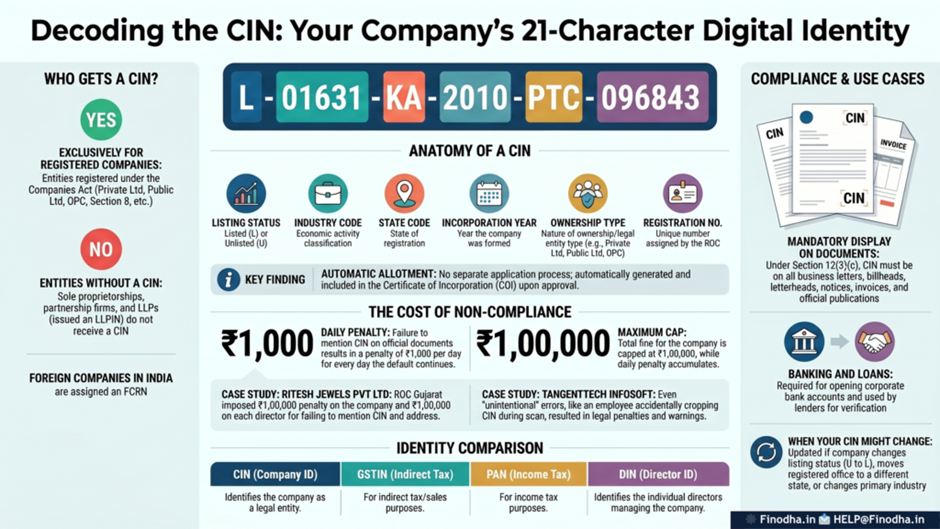
For example, a CIN looks like L01631KA2010PTC096843 can be understood in six meaningful parts:
Section 1 – Listing status: Indicates whether the company is listed or unlisted Section 2 – Industry code: Shows the nature of business activity Section 3 – State code: Represents the state where the company is registered Section 4 – Year of incorporation: Mentions the year the company was formed Section 5 – Ownership type: Identifies the form of ownership (e.g., Private Limited, Public Limited) Section 6 – Registration number: The unique number assigned to the company by the ROC
*CIN is not just a number—it is a coded identity that reveals key details about a company’s legal and business structure.
Breakdown the structure
A Corporate Identification Number (CIN) is a 21-character alphanumeric code that is divided into six distinct parts, and each part conveys specific information about a company. This can be better understood with the example below:
U – 12345 – DL – 2020 – PLC – 098765
Breakdown of CIN structure:
First character (U/L)– Showing Listing status: The first letter indicates whether the company is listed or unlisted. “L” represents a listed company on BSE/NSE, while “U” represents an unlisted company.
Next 5 digits – Showing Industry code: This five-digit number represents the company’s industry classification, assigned by the Registrar of Companies (ROC) based on its business activity.
Next 2 letters – Showing State code: This part shows the state in which the company is registered. For example, DL refers to Delhi, Maharashtra is "MH", Tamil Nadu is "TN", Madhya Pradesh will be "MP", and Gujarat will be "GJ".
Next 4 digits – Showing Year of incorporation: These digits indicate the year in which the company was incorporated, such as 2020 in this example.
Next 3 letters – Showing Type of company/ownership: This section defines the nature of the company. For instance, PLC stands for Public Limited Company, while other codes represent different types such as private companies.
Last 6 digits – Showing Registration number: This is the unique registration number assigned to the company by the ROC.
*A CIN works like a structured identity code for a company - each segment provides specific information about its listing status, industry, location, year of incorporation, type, and registration details.
Abbreviation in CIN number
These are the abbreviations that appear in the CIN's sections 5:
Company Type Code
Full Form
Common Use / Meaning
FLC
Financial Lease Company (Public Limited)
Specialized financial institutions
FTC
Foreign Subsidiary Company (Private Limited)
Indian subsidiaries of multinational companies (e.g., Google India Pvt. Ltd.)
GAP
General Association Public
Trade associations, industry bodies
GAT
General Association Private
Trade associations, industry bodies
GOI
Government of India Owned Companies
PSUs like ONGC, BHEL, SBI, LIC
NPL
Not-for-Profit License Company (Section 8 Company)
NGOs, educational trusts, foundations, professional bodies
State electricity boards, DISCOMs, state undertakings
ULL
Unlimited Liability Public Company
Rare: mainly older registrations or professional setups
ULT
Unlimited Liability Private Company
Rare: mainly older registrations or professional setups
CIN vs LLPIN vs FCRN
Type
Used For
CIN
Companies
LLPIN
LLPs
FCRN
Foreign companies
How CIN is issued (process)
Getting a Corporate Identification Number (CIN) is part of registering your company with the Ministry of Corporate Affairs. Just follow these basic steps:
Choose a company name
Prepare documents (MOA, AOA, etc.)
Apply for incorporation through SPICe+ form on MCA portal
DIN (for directors) is allotted during this process (if not already available)
Submit application with fees
Once approved:
The Registrar of Companies issues Certificate of Incorporation
CIN is automatically generated and mentioned in it.
*You do not need to apply for a Corporate Identification Number (CIN) separately. It is automatically assigned when your company is incorporated by the Ministry of Corporate Affairs through the Registrar of Companies.
Once your company is approved, the CIN is mentioned in the Certificate of Incorporation (COI), which serves as proof of your company’s legal existence.
How to Check / Track CIN?
The CIN of any company can be easily found online. Visit the official website of the Ministry of Corporate Affairs to find the CIN. The website allows you to search for the following –
Registration number of the company
Name of the existing company or name of the Limited Liability Partnership (LLPs use LLPIN, not CIN)
Active or inactive CIN
Name of the LLP or the old company (LLPs use LLPIN, not CIN)
After the required details are filled in, you need to enter a CAPTCHA code and then click on search.
Where to check CIN
Go to MCA website
Click “View Company Master Data”
Enter company name
Changes in Corporate Identification Number (CIN)
The CIN generally remains the same, it can change in certain situations, such as:
Change in listing status: If a company gets listed on a stock exchange or becomes unlisted, the first letter of the CIN changes (e.g., from “U” to “L” or vice versa).
Change in registered office (state-wise): If the company shifts its registered office from one state to another, the state code in the CIN changes. (No change if the office shifts within the same state.)
Change in industry or business activity: If there is a major change in the company’s primary business activity, the industry code (first 5 digits) in the CIN may be updated.
How CIN fits into the bigger system (In broader concept)
Corporate Compliance System in India, It is a part of Company registration, ROC filings and Legal identity tracking.
Penalty
As per Section 12(3)(c) of the Companies Act, 2013, every company is required to print its Corporate Identity Number (CIN) on all important official documents such as business letters, invoices, notices, and other publications. This CIN acts like the company’s unique identification number.
If a company fails to include its CIN on these documents, then under Section 12(8) of the Act, the company must pay a penalty of ₹1,000 for each day the default continues.
However, the law also sets a limit. The total penalty cannot exceed ₹1,00,000, no matter how long the company continues to miss adding the CIN.
Even minor omissions (like missing CIN on letterheads) are treated as technical non-compliance and can attract penalties.
MCA imposes penalty for companies’ failure to mention CIN on documents
Let’s understand this with real MCA adjudication cases:
Case 1: Tangenttech Infosoft Private Limited.
Tangenttech Infosoft Private Limited, a company based in Ahmedabad, filed certain documents on the MCA portal. However, in some documents, the company did not mention its CIN and registered office address, which is mandatory under Section 12(3)(c) of the Companies Act, 2013.
This mistake was noticed by the Registrar of Companies during routine verification.
Issue in this case
As per the Companies Act, every company must mention its CIN and registered office address on all official documents.
But in this case, the company failed to include these details in:
Board Resolution (2017)
Letter attached with ADT-1
Letter attached with ADT-2 (2021)
This was treated as a non-compliance, and the company along with its officers became liable for penalty under Section 12(8).
Action taken by Authorities:
The Regional Director (NWR), Ahmedabad directed the ROC to take action.
The ROC issued a notice on 17.09.2021 for non-compliance.
Initially, the company did not respond to the notice.
Later:
A hearing notice was issued on 25.11.2021
Hearing was fixed for 05.01.2022, but adjourned
Final hearing took place on 23.03.2022
Company’s Response
During the hearing, the company (through its Company Secretary) stated that:
The company follows the law and had no intention of ignoring compliance requirements.
The missing CIN and registered office address happened by mistake when an employee scanned the document.
The letterhead did have the CIN and address, but the employee scanned it incorrectly, leaving out that part.
The company has filed other documents with the Registrar of Companies (ROC) that correctly include the CIN and registered office address, as required under Section 12(1) of the Companies Act, 2013.
The company secretary explained that the error was unintentional, caused by a scanning mistake, and that the company has otherwise complied with the law in its filings. Also the company secretary asked the Adjudicating Officer to consider the company’s financial struggles and losses due to COVID-19 before giving any penalty order.
The Presenting Officer pointed out that in some documents (like the board resolution of 28.12.2017 and a letter dated 23.02.2021 filed with ADT-2), the company did not include its CIN number and registered office address on the letterhead, which is required by law.
He explained that this is a violation of Section 12(3)(c) of the Companies Act, 2013, and therefore attracts penalties under Section 12(8).
However, in other filings (like MGT-7 in 2019), the company did mention the CIN and address correctly.
So, the issue was not constant but occasional.
Based on these facts, the Registrar of Companies (acting as Adjudicating Officer) concluded that the company and its officers had indeed violated the law in those specific cases and are liable for penalties.
The company secretary asked for leniency due to financial hardship, but the authorities found that the company had failed to follow the rule of mentioning CIN and address on certain documents, which counts as a violation and makes them liable for penalty.
Before deciding the penalty, the Registrar of Companies looked at three things:
Whether the company gained unfair advantage.
Whether investors lost money.
Whether the mistake was repeated.
The Presenting Officer said there was no clear proof of unfair gain or investor loss, and such things are hard to measure in this case.
He also noted that the company’s balance sheet showed it was not a “small company,” so it could not get the benefit of reduced penalties under Section 446B.
After considering all facts, the Registrar of Companies decided that the company and its directors had violated Section 12(3)(c) of the Companies Act, 2013.
Therefore, he imposed penalties on the company and its directors, stating that the punishment was fair and matched the seriousness of the failure.
The officer checked if there was unfair gain, investor loss, or repeated mistakes. Finding violations in specific documents, and since the company isn’t a “small company,” he imposed penalties on the company and its directors.
The Adjudicating order (Final Order)
The Registrar of Companies decided that the company and its directors violated Section 12(3)(c) of the Companies Act, 2013.
A penalty of ₹1,000 each was imposed on the company and its five directors (total ₹6,000).
The company was told to immediately fix the mistake and update its registered office details with the Registrar.
The penalty must be paid online within 90 days, and proof of payment filed with the Registrar.
The company and directors can appeal the order within 60 days to the Regional Director in Ahmedabad.
If the penalty is not paid within 90 days:
The company can be fined between ₹25,000 and ₹5,00,000.
The defaulting directors can face up to 6 months in jail or fines between ₹25,000 and ₹1,00,000, or both.
The order warned that prosecution will be filed if payment is not made, without any further notice.
With this, the adjudication notice was closed.
In short: The company and its directors were fined ₹6,000 total, told to correct the mistake, pay within 90 days, or face heavier fines/jail.
Case 2: RITESH JEWELS PRIVATE LIMITED
[(CIN: U52393GJ2009PTC057924) Date of final hearing- 06.03.2024]
In this case, the Registrar of Companies (ROC), Gujarat, took action against M/S Ritesh Jewels Private Limited for not following the rules under Section 12(3)(c) of the Companies Act, 2013.
As per the law, every company must mention its CIN (Corporate Identification Number) and registered office address on all official documents like letterheads, invoices, notices, etc. However, this company failed to do so.
Because of this mistake:
The company violated the legal requirement.
Both, the company and its directors were held responsible for this non-compliance.
Even after receiving official notices and being given chances to explain their side, the company did not respond properly. Due to this, the ROC proceeded with the penalty under Section 454 of the Companies Act.
The authority clearly stated that:
Not knowing the law is not an excuse.
Directors and officers must ensure that the company follows all legal requirements.
Penalty imposed:
₹1,00,000 on the company
₹1,00,000 each on two directors (Mr. Ritesh Jayendrabh Adeshara and Ms. Minaben Jayendrabhai Adeshara)
This case shows that even small mistakes like not mentioning the CIN and registered office address can lead to heavy penalties. It also highlights that directors have a duty to ensure full compliance with the law.
# From both cases, we’ve learned that compliance isn’t just paperwork—it’s a legal duty. Even small mistakes, like missing the CIN or address, can cause serious financial and legal trouble for the company and its directors.
Difference between CIN and Other numbers
Many people get confused between CIN and other registration numbers, but each one is used for a different purpose.
CIN (Corporate Identification Number): (Company identity) -This is like the identity card of a company. It shows that the company is legally registered with the Ministry of Corporate Affairs.
DIN (Director Identification Number): (Director identity) - This is the identity of a director, which is used for all compliance and legal filings related to the company, such as appointments, resignations, and disclosures. It helps the government track and verify the details of directors across companies.
GSTIN: (Sales tax (GST)) - This is used when a company deals with GST (tax on goods and services). It is only for tax purposes.
PAN: (Income Tax) - This is used for income tax purposes of the company.
TAN: (TDS/TCS tax) - This is used when a company deducts or collects tax at source (TDS/TCS).
LLPIN: (LLP identity) - This is like the identity card of LLP.
Conclusion
In this article, we learned about the CIN (Corporate Identification Number), which is like the official identity of a company in India. It is automatically given when a company is registered and must be mentioned on all important documents to maintain transparency and follow legal rules.
We also covered important points such as what a CIN number is, why it is important, who gets it, how it is issued, and the penalties for not using it properly. Along with this, we discussed a couple of real cases where companies faced issues for not mentioning their CIN on official documents.
So, by reading this article, you now have a clear and practical understanding of CIN and its role in company compliance.
In simple terms, a CIN is not just a number—it helps the government and the public identify a company easily. Once you understand how it works, things like checking company details, following compliance rules, and doing proper verification become much easier.
We hope this article helps you understand CIN in a simple way and gives you the right and reliable information for your needs.
Disclaimer: The information in this article is for general purposes only and may not fit your personal situation. It is not legal, financial, or professional advice, and you should not rely on it as such. Before making any decisions, consider if this information applies to you and, if needed, get advice from a professional. The information is correct at the time of publication. While we have tried to ensure it is accurate, Finodha.in is not responsible for any loss or damage caused by using this information.
At Finodha.in, We serve a number of clients who need assistance/guide for various regulatory compliances including setting up business in India, company formation in India, income tax return filling, bookkeeping, accounting, GST and auditing. If you require any guidance for any professional service, we are here to serve you! You can also book a free consultation with us!
Join with us today! We shall be happy to assist you, and in case you require our services, please feel free to contact us at the below mentioned email details: – help@finodha.in.
Question. How can I get Company registration in India?
Answer. To get company registration in India, you must apply online through the MCA portal, complete the SPICe+ (INC-32) form, and obtain a Certificate of Incorporation (COI) from the Registrar of Companies (ROC).
Question. CIN number is mandatory for a Company?
Answer. yes, It is mandatory for the Company because it is the Identity of the Company.
Question. Is there any difference between Company registration number and CIN number?
Answer. Yes, there is a difference — Company Registration Number is the number you get when the company is registered, while the Corporate Identity Number (CIN) is the unique identification number assigned by the Registrar of Companies (ROC) after incorporation.
Question. How do I open my CIN number?
Answer. You don’t open a CIN; it is automatically assigned at incorporation, and you can check it on your Certificate of Incorporation or search it on the MCA portal.
Question. How would I download a Company CIN number?
Answer. You can't download the CIN itself, but you can download your Certificate of Incorporation or company master data from the MCA portal, which contains your CIN.
Question. Can two companies have a same CIN number?
Answer. No, As we know CIN is a unique identification number issued by the ROC at the time of incorporation. so two companies can never have the same CIN number.
Question. Is CIN mandatory to be mentioned on the invoices, bills, and receipts of a company?
Answer. Yes, It is mandatory to be mentioned on the invoices, bills, and receipts of a company.
Question. How to apply for CIN?
Answer. There is no separate process to apply for a CIN. It is automatically generated at the time of incorporation.
Question. How to read a CIN number?
Answer. There is no separate process to apply for it. The CIN is automatically generated at the time of incorporation by the Registrar of Companies (ROC).
Question. Who is eligible for a CIN number?
Answer. Yes, your statement is correct — only companies registered in India under the Companies Act, 2013 are eligible for a CIN number.
Question. Is CIN allotted to LLP?
Answer. No, CIN is not allotted to LLP.
Question. Are CIN and GST the same?
Answer. CIN and GST are different. The Corporate Identity Number (CIN) is a company identity number issued by the Registrar of Companies under the Companies Act, 2013, while the Goods and Services Tax Identification Number (GSTIN) is issued under GST law for tax purposes.
Question. What is CIN verification?
Answer. CIN verification is the process of validating a company’s identity and registration details using its unique CIN.
Question. Where to use the CIN Number?
Answer. The CIN number is a unique identity number of the company, and it must be mentioned on all official documents, filings, and communications.
Question. Is CIN mandatory for all companies?
Answer. Yes, a CIN is mandatory for all companies registered in India under the Companies Act, 2013.
Question. Can a sole proprietorship or partnership have a CIN?
Answer. No, a sole proprietorship or partnership cannot have a Corporate Identity Number (CIN).
Question. What happens if a company does not mention its CIN?
Answer. Failing to mention the CIN is a violation of Section 12(3), and the penalty is imposed under Section 12(8) of the Act.
Question. Can I verify a company’s authenticity using CIN?
Answer. Yes — you can verify a company’s authenticity using its CIN through the MCA portal, which shows the company’s registration details, status, and compliance records.
Question. How long does it take to get a CIN?
Answer. CIN is issued immediately upon approval of incorporation. The total incorporation process may take 5–10 working days depending on approvals.
Question. What documents are required for CIN registration?
Answer. No separate documents are required to obtain a CIN. The CIN is automatically allotted upon company incorporation. However, certain documents are required for company registration, during which the CIN is issued.
Question. What are the fees for CIN registration in India?
Answer. A Corporate Identification Number (CIN) is not registered separately and does not have any separate government fee. it is automatically generated at the time of incorporation.
Question. Can a foreign company obtain a CIN in India?
Answer. Yes, Foreign companies registered under the Companies Act (having a place of business in India) are assigned a CIN or FCRN (Foreign companies are assigned FCRN (Foreign Company Registration Number), not a standard CIN) upon registration with ROC.
Question. Can a company change its CIN?
Answer. CIN is not manually altered, but it may change automatically by the Registrar of Companies when the company’s type, state of registration, or industry classification changes.
Question. How can I know my corporate ID?
Answer. Your CIN is printed on the Certificate of Incorporation and can be verified anytime on the MCA portal.
Question. What is the purpose of CIN?
Answer. The main purpose of a CIN is to provide basic information about a company, such as its type, year of incorporation, listing status (listed or unlisted), and the state in which it is registered, among other details.
Question. How to find CIN number online?
Answer. You can find a CIN online through the MCA portal by searching the company name in the “View Company Master Data” section.
Question. Are CIN and PAN number the same?
Answer. No, CIN and PAN both are completely different number. CIN is the identity of company and PAN is the identity of the individuals.
Question. What is a 21 digit CIN number?
Answer. A Corporate Identification Number (CIN), such as L12345MH2020PLC123456, is a 21-character alphanumeric code and not a 21-digit numeric number. In India, CINs are always a combination of letters and numbers.
Question. Is CIN number equal to GST number?
Answer. No, a Corporate Identification Number (CIN) and a GST number are completely different.
Question. How to get GST from CIN?
Answer. You cannot get GST directly from CIN. You must search GSTIN separately using the company name or PAN on the GST portal.
Question. Who is eligible for CIN number?
Answer. CIN is allotted only to companies registered under the Companies Act, such as Private Limited, Public Limited, OPC, Section 8, government companies, and certain foreign companies registered in India.
— Finodha Making Compliance Affordable
Video Explanation:
We’re Available: If you need clarity on your specific compliance requirement, you can explore our detailed service pages or connect with our team:
📞 +91-8512022044 📩 help@finodha.in
We'll handle the paperwork while you focus on building your business; If you have any questions to ask; contact us now.
Important Keywords: Private Limited Company PAN Card, Company PAN application, Form 94 PAN, PAN Form 94, PAN application for company, Company PAN card documents, Company PAN card fees, Company PAN application process, How to apply for company PAN, New PAN forms 2026, PAN rules 2026, Income-tax Act 2025 PAN, Income-tax Rules 2026 PAN, Track PAN application status.
Words: 3,324, Read time: 18 minutes.
Table of Contents
Overview
One of the major updates came into effect on 1 April 2026, when the PAN application process in India changed significantly under the Income-tax Act, 2025 and the Income-tax Rules, 2026. These changes affect how PAN is applied for, which forms are used, what documents are required, and when PAN must be quoted.
For example, the earlier Forms 49A and 49AA have been replaced with new PAN application forms. The requirements and procedures for proving identity, address, and date of birth or incorporation have also been updated.
These changes are particularly important for Private Limited Companies, NRIs, resident but not ordinarily resident (RNOR) individuals, foreign nationals, and foreign companies that have taxable income, investments, or other financial activities in India.
In this guide, we will explain the latest rules for a Private Limited Company PAN Card, including the applicable PAN application form, documents required, important changes from 1 April 2026, and the process for applying for or updating a company's PAN.
Key points to remember for New PAN Application Form
From 1 April 2026, Forms 93, 94, 95 and 96 are used for fresh PAN applications, while CR-01 and CR-02 are used for changes or corrections in existing PAN data.
Only the new PAN forms will be accepted from 01.04.2026 onwards. Old forms will not be accepted after 31.03.2026. This applies to both new PAN applications and change/correction (CR) requests. Applications pending as on 31 March 2026 will continue to remain valid and do not need to be submitted again under the new forms. Existing PAN numbers also remain valid.
The documents required for PAN application depend on the type of applicant. For an Indian company, the prescribed documents include proof of identity, address and date of incorporation, as applicable under Rule 158.
In Form 94 & 96, details of RA/AR are mandatory.
Contact details of applicant and RA/AR (if applicable) are mandatory.
What is a PAN Card for a Private Limited Company?
A Permanent Account Number (PAN) is a unique 10-character alphanumeric, because PAN contains both letters and numbers issued by the Income Tax Department to a Private Limited Company. The PAN may be provided through a physical PAN card or an e-PAN.
A Private Limited Company has its own PAN, which is different from the PAN of its directors and shareholders. This is because the company has a separate legal identity from the individuals who own or manage it. The company's PAN helps the Income Tax Department identify the company and keep track of its tax and financial activities.
The company's PAN helps connect its important tax records, including income-tax returns, tax payments, TDS/TCS details, tax demands, certain financial transactions, and communication with the Income Tax Department. It also helps the tax authorities match information received from different sources and identify possible cases of tax evasion.
A company's PAN is also important for many business and financial activities. It is commonly required for opening a company bank account, filing income-tax returns, claiming TDS credits, carrying out certain financial transactions, and completing various tax and financial compliances.
Understanding the 10 Characters of a Company PAN
A typical PAN may look like AAA CP 1234A.
PAN Image
Each character in a PAN has a specific purpose:
First three characters – "AAA": These are alphabetic characters forming a series that can range from AAA to ZZZ.
Fourth character – "C": This identifies the status/category of the PAN holder. For a company, the fourth character is "C".
Fifth Character – Represents the first letter of the company's/ Firm's name.
Next four characters – "1234": These are sequential numbers ranging from 0001 to 9999.
Last character – "A": This is an alphabetic check character used as part of the PAN's structure.
Therefore, in a PAN such as AAACP1234A, the letter "C" in the fourth position indicates that the PAN belongs to a company.
Note: The PAN structure is the same whether the company is a Private Limited Company or another type of company. The fourth character "C" indicates that the PAN holder is a company; it does not specifically mean "Private Limited Company."
i.e. The alphabet ‘F’ represents Firm, ‘T’ represents Trust, , ‘H’ for HUF, ‘P’ for Individual, ‘C’ for Company etc.
Legal Framework – PAN for private limited company
The Permanent Account Number (PAN) framework is mainly governed by Section 262 of the Income-tax Act, 2025. It explains who is required to obtain PAN, who can apply for it, how PAN is allotted, and the situations in which PAN or Aadhaar must be quoted or authenticated.
The detailed procedure for applying for PAN is provided under Rule 158 of the Income-tax Rules, 2026. It also specifies the documents that need to be submitted with the applicable PAN application form, such as proof of identity,proof of address, and proof of date of birth or incorporation.
Rule 159 specifies certain transactions and activities where PAN is required to be quoted. In certain cases, a person who does not have PAN may submit a declaration in Form 97 instead. Form 97 is a declaration used in certain specified transactions by persons who do not have PAN and is generally not available to companies or firms.
The law also provides a penalty for non-compliance. Under Section 467 of the Income-tax Act, 2025, the Assessing Officer may impose a ₹10,000 penalty for failure to comply with Section 262. A ₹10,000 penalty may also apply for certain cases involving false, missing, or unauthenticated PAN or Aadhaar details in prescribed documents.
Why PAN is required for Private Limited Company?
A private limited company is a separate legal entity, which means the company has its own identity in the eyes of law, separate from its directors and shareholders. Just as an individual has a personal PAN, the company also needs a separate PAN in its own name.
Form No. 94 is used to provide the company's details to the Income Tax Department for applying for its PAN.
Once the PAN is allotted, it is used to identify the company for tax and financial purposes. It helps the Income Tax Department keep track of the company's income-tax returns, tax payments, TDS/TCS, tax notices and certain financial transactions.
Aasaan shabdon mein: Company ka PAN uski tax identity ke roop mein kaam karta hai. Is PAN se Income Tax Department ko easily identify hota hai ki kaunse tax records aur financial transactions company se related hain. At the same time, these records remain separate from the personal tax records of the company's directors and shareholders.
Documents required for private limited companies PAN card
From 1 April 2026, an Indian Private Limited Company applying for a new PAN needs to use Form 94 under the Income-tax Rules, 2026. You need to provide documents that show the company's identity, address, and date of incorporation.
Before applying, keep these documents and details ready:
Certificate of Incorporation/Registration
Proof of the company's address
Proof of date of incorporation
CIN/registration number, where applicable
Details and prescribed documents of the authorised/representative person, where applicable
Note: Always check the latest requirements in Form 94 and the applicable Income-tax Rules before submitting the application, as document requirements may vary depending on the application method and circumstances.
PAN Application Forms Before March 31, 2026 and After April 1, 2026
The PAN application forms have changed from 1 April 2026 under the new Income-tax Rules, 2026. The form to be used depends on whether the applicant is an individual or a non-individual entity and whether the applicant is Indian or foreign.
Applicant Type
Before 1 April 2026
From 1 April 2026
Indian Individual
Form 49A
Form 93
Indian Non-Individual Entity (including Private Limited Company)
Form 49A
Form 94
Foreign Individual
Form 49AA
Form 95
Foreign Non-Individual Entity
Form 49AA
Form 96
For a Private Limited Company: If an Indian Private Limited Company is applying for a new PAN on or after 1 April 2026, it should use Form 94.
Important: These new forms apply to fresh PAN applications made from 1 April 2026. Existing PAN numbers issued under the earlier system remain valid and do not need to be replaced merely because the new PAN forms have been introduced.
For an Indian Private Limited Company applying for a new PAN from 1 April 2026, the prescribed application form is Form 94.
Steps to apply for a Private Limited Company PAN card
Follow the below given steps to apply online:
Visit the authorised PAN portal – Apply online through Protean or UTIITSL. For domestic companies and LLPs, PAN can also be applied for through the Common Application Form (CAF) of the MCA, where applicable.
Select Form 94 – From 1 April 2026, Indian companies use Form 94 for a new PAN application.
Enter company details – Provide the company's name, date of incorporation, CIN/registration number, registered office address, and other required details.
Submit documents – Provide the Certificate of Incorporation and other documents required under the current PAN application process.
Verify and pay – Check the details, complete the required declaration/verification, and pay the applicable fee.
Submit and track – Complete any required document submission process and save the acknowledgement number to track the application.
Receive PAN – After successful processing, the company will receive its e-PAN and/or physical PAN card, depending on the option selected.
Note: The instant e-PAN facility is intended for eligible individual applicants, not companies.
How to Track PAN Application Status?
After submitting your PAN application, you can track its status online through Protean or UTIITSL.
Visit the Income Tax Department’s PAN services page and select “Track PAN Application Status.”
Choose Protean or UTIITSL, depending on where you applied.
Enter your application type and acknowledgement/reference number.
Submit the details to view your application status.
The status will show whether your PAN is under process, allotted, dispatched, or requires further action.
Fees for applying for a company PAN card
The PAN application fee depends on whether you want a physical PAN card or only an e-PAN, and on the method used to submit the application.
If you want a Physical PAN Card
If you choose to receive a physical PAN card at an Indian address, the fee is:
₹107 (including applicable taxes) when the application is submitted at a PAN Centre or through online physical mode.
₹101 (including applicable taxes) when the application is submitted online through paperless modes such as e-KYC & e-Sign, e-Sign scanned based or DSC scanned based.
The e-PAN is also sent to the email ID provided in the application, where applicable.
If you want only an e-PAN
If you do not need a physical PAN card, you can choose to receive only the e-PAN by email. In this case:
₹72 (including applicable taxes) for applications submitted at a PAN Centre or through online physical mode.
₹66 (including applicable taxes) for applications submitted online through paperless modes.
In this option, providing an email ID is mandatory, and no physical PAN card is dispatched.
Simply said: If your Private Limited Company needs a physical PAN card, the fee is generally ₹101–₹107, depending on the application method. If you only need the e-PAN, the fee is generally ₹66–₹72.
If a foreign communication address is used, the fee is higher because of the additional overseas dispatch charges.
The above amounts are based on the current PAN service-provider fee structure and may change depending on the application mode, delivery option and applicable taxes.
When is PAN Required for Certain High-Value Transactions?
PAN is required to be quoted for certain specified transactions under Rule 159 of the Income-tax Rules, 2026. In applicable cases, Aadhaar may be used or authenticated as permitted under the Income-tax Act and Rules. such as:
Cash deposits or withdrawals of ₹10 lakh or more in a financial year.
Opening a current account or cash credit account with a bank or other specified financial institution.
Buying, selling, gifting or entering into a joint development agreement for immovable property where the amount exceeds ₹20 lakh or the stamp valuation exceeds ₹20 lakh.
Buying or selling a motor vehicle or motorcycle worth more than ₹5 lakh. Tractors are excluded from this requirement.
Making a cash payment of more than ₹1 lakh to a hotel, restaurant or certain venues/services for a bill or event.
Conclusion
Understanding the new PAN process is now important for every business! The new PAN framework under the Income-tax Act, 2025 and Income-tax Rules, 2026 has introduced a more streamlined process for fresh PAN applications. From 1 April 2026, Indian companies applying for a new PAN use Form No. 94, replacing the earlier Form 49A for this category. Existing PANs, however, continue to remain valid.
For a Private Limited Company, understanding these changes is important because PAN acts as the company's tax identity and is used for various tax and financial compliances.
We hope this guide has helped you understand the latest PAN rules, Form No. 94, required documents and PAN application process for a Private Limited Company in simple terms.
If you think we have missed any important point about the new PAN framework or if you have any questions, feel free to reach out to us at help@finodha.in. Your questions and suggestions can also help us make this guide more useful for other business owners and professionals.
Question. What documents are required for Form No. 94?
Answer. For Form 94, the applicant generally needs to provide proof of identity, proof of address and proof of date of incorporation, along with other prescribed details and documents. The exact requirements are specified under Rule 158 of the Income-tax Rules, 2026.
Question. Can the communication address be different from the office address?
Answer. Yes, however in such case the applicant has to submit the proof of address for such communication address.
Question. What is PAN and why is it required?
Answer. PAN (Permanent Account Number) is a unique 10-character number issued by the Income Tax Department to identify a company or individual for tax purposes. It is important for filing income-tax returns, paying taxes, TDS/TCS compliance, maintaining tax records and carrying out certain financial transactions.
Question. What are the new PAN card forms introduced in 2026?
Answer. Forms 93, 94, 95, and 96 have been introduced by the Income Tax Department for new PAN applications. These forms, which are intended for various applicant categories, take the place of the previous Forms 49A and 49AA.
Question. Which PAN form should businesses and organisations use?
Answer. For fresh PAN applications, Indian companies and other non-individual entities incorporated or formed in India generally use Form 94.
Answer. No. Forms 93, 94, 95, or 96, depending on the applicant category, should now be used for new PAN applications. Current PAN cards are still valid and don’t need to be replaced.
Question. Where can I complete the official PAN card form download?
Answer. You can access the applicable PAN forms through the Income Tax Department's official PAN services and submit PAN applications through authorised service providers such as Protean eGov Technologies Limited and UTIITSL.
Question. What is the business PAN format?
Answer. A business PAN is a 10-character alphanumeric number. For a company, the fourth character is generally “C”, which indicates that the PAN holder is a company.
Question. Which forms should be used for PAN application in 2026?
Answer. Under the Income-tax Rules, 2026, four new forms have been introduced for fresh PAN applications. Indian individuals need to use Form No. 93, while Indian companies and other entities incorporated or formed in India need to use Form No. 94. Foreign individuals use Form No. 95, and foreign entities use Form No. 96. For an Indian Private Limited Company, the applicable form for applying for a new PAN from 1 April 2026 is Form No. 94.
Question. What happens if a PAN application is rejected?
Answer. If a PAN application is rejected, the applicant can check why it was rejected, fix the mistake or provide the missing information/documents, and apply for fresh PAN application again.
Question. How to apply for a PAN card for a private limited company in India?
Answer. You can apply for a company or individual PAN through authorised PAN service providers such as Protean or UTIITSL. From 1 April 2026, an Indian Private Limited Company must use Form No. 94, submit the required details and documents, pay the applicable fee, and complete the verification process to obtain PAN.
Question. Best online platforms to apply for a private limited company PAN card?
Answer. There are two online platforms: (i.e. Protean or UTIITSL) to apply for a private limited company PAN card.
Question. How can I track my PAN application status?
Answer. You can track your PAN application status online through Protean or UTIITSL by entering your acknowledgement number or other required application details. The status will show the current stage of your PAN application and whether any further action is required.
Question. How do I know if a PAN is individual or company?
Answer. You can identify whether a PAN belongs to an individual or a company by checking the 4th character of the PAN number. In a company PAN, the 4th character is “C”, while “P” represents an individual.
Question. Can a company or individual have two PANs?
Answer. No, a person or company cannot legally have more than one PAN. If more than one PAN is allotted, the extra PAN should be surrendered, as having multiple PANs may attract a penalty.
Question. What is the difference between an individual PAN card and a company PAN card?
Answer. One of the main differences between an individual PAN and a company PAN is that an individual PAN belongs to a person and is used for their personal tax and financial activities. A company PAN belongs to the company and is used for its own tax, banking and financial activities.
Question. Does a Private Limited Company have a separate PAN?
Answer. Yes. A Private Limited Company has a separate PAN because, under the law, a company is treated as a separate legal entity from its directors and shareholders.
Question. Which documents are required for a business PAN card?
Answer. The documents required under Rule 158 for filing Form No. 94 include: -Certificate of Incorporation/Registration, -proof of the company’s address, and -other prescribed documents and details required under the PAN application process.
Question. Where can I apply for a PAN online?
Answer. you can visit the two website for apply a PAN online i.e. Protean or UTIITSL.
Question. What are the fees for applying for a company PAN card?
Answer. The PAN application fee for an Indian address is generally ₹107 for a physical PAN card and ₹72 for e-PAN only, including applicable GST. *The exact fee may vary depending on the application and delivery option selected.
Question. How can a company correct its PAN details?
Answer. From 1 April 2026, Form CR-02 is prescribed for changes or corrections in PAN data of non-individual entities. This is different from Form 94, which is used for a fresh PAN application.
The CBDT's April 2026 order confirms CR-01 for individuals and CR-02 for non-individuals.
We’re Available: If you need clarity on your specific compliance requirement, you can explore our detailed service pages or connect with our team:
📞 +91-8512022044 📩 help@finodha.in
We'll handle the paperwork while you focus on building your business; If you have any questions to ask; contact us now.
Important Keywords: Registrar of Companies, Registrar of Companies India, What is ROC, ROC Filing, ROC Office, ROC Functions, ROC Meaning, ROC under Companies Act, Registrar of Companies Functions, MCA and ROC, Annual ROC Filing, ROC Registration, ROC Jurisdiction, ROC Office List, ROC Filing Due Date, ROC Penalty.
Words: 4,288, Read time: 23 minutes.
Table of Contents
Overview
Most people think the Registrar of Companies (ROC) only registers companies, but its role is much bigger than that. The ROC is the government authority under the Ministry of Corporate Affairs (MCA) that looks after companies throughout their entire journey—from their incorporation to their closure.
In this article, we will understand the ROC in a broader and simpler way. We will explain how it maintains company records, monitors whether companies follow the Companies Act, 2013, takes action against companies that fail to comply with the law, and helps ensure transparency and accountability in India's corporate sector. By the end of this guide, you will have a clear understanding of what the ROC does and why it plays such an important role for every company in India.
What is ROC?
Many people believe that the Ministry of Corporate Affairs (MCA) directly registers every company in India. However, that's not exactly how the process works.
Under the Companies Act, 2013, every company is registered through the Registrar of Companies (ROC), a government office functioning under the MCA. While Section 3 of the Act lays down the requirements for forming a company, the ROC examines the incorporation documents, verifies whether all legal requirements have been fulfilled, and issues the Certificate of Incorporation if everything is in order.
The ROC's job does not end with company registration. It also maintains the company's official records, monitors compliance with the Companies Act, 2013, records important changes such as directors or registered office, and takes action against companies that fail to comply with the law.
Since one office cannot manage companies across the entire country, the Central Government has established multiple ROC offices across different States and Union Territories. The ROC that regulates your company depends on the location of your registered office. For example, a company registered in Noida comes under ROC Uttar Pradesh-II, while a company registered in Mumbai falls under ROC Mumbai-I.
All ROC offices function under the supervision of a Regional Director (RD), who ensures that the provisions of the Companies Act, 2013 are implemented properly within their respective regions.
What is the Role of the Registrar of Companies (ROC)?
Here are the broader roles of the ROC:
Company Registration
This is the most well-known function. The ROC examines incorporation documents, registers companies and LLPs, and issues the Certificate of Incorporation.
Corporate Compliance Regulator
After a company is incorporated, the ROC continuously monitors whether it complies with the Companies Act, 2013. This includes:
Annual financial statement filings
Annual return filings
Event-based filings (e.g., appointment of directors, change of registered office, allotment of shares)
Other statutory compliances
Custodian of Public Corporate Records
The ROC maintains a public database of companies, including:
Company incorporation details
Directors and KMP details
Registered office
Charges on company assets
Financial statements
Annual returns
This information promotes transparency and helps investors, banks, creditors, regulators, and the public verify a company's legal status.
Regulatory and Enforcement Authority
The ROC has the power to:
Issue notices to defaulting companies.
Seek explanations and documents.
Impose penalties where the law permits.
Initiate adjudication proceedings for certain defaults.
Recommend prosecution in cases involving offences under the Companies Act.
Inspection, Inquiry, and Investigation
Where the Companies Act authorizes it, the ROC can:
Inspect company books and records.
Conduct inquiries into a company's affairs.
Order or recommend investigations when there are indications of fraud, misconduct, or serious non-compliance.
Protecting Stakeholders
The ROC's role is not limited to regulating companies. It also protects the interests of:
Shareholders
Creditors
Investors
Employees
The general public
It does this by ensuring companies disclose accurate information and comply with legal requirements.
Administration of Corporate Law
The ROC administers many provisions of the Companies Act, 2013 by:
Registering statutory documents.
Recording corporate changes.
Maintaining legal records.
Ensuring procedural compliance.
Strike-off and Dissolution
The ROC can remove the name of a company from the register when it is eligible for strike-off or has failed to comply with legal requirements, subject to the provisions of the Companies Act, 2013.
What the ROC is not?
It is equally important to understand the ROC's limits:
It does not decide company disputes between shareholders.
It does not conduct statutory audits.
It does not regulate the securities market (that is the role of Securities and Exchange Board of India).
It does not handle direct tax matters (those are administered by the Income Tax Department).
Functions of the Registrar of Companies (ROC)
The following are the major functions of the Registrar of Companies (ROC):
Incorporation of Companies
One of the primary functions of the ROC is to register companies incorporated under the Companies Act, 2013. Before granting incorporation, the ROC examines the documents filed by the promoters to ensure they comply with the provisions of the Act.
Once all legal requirements are satisfied, the ROC:
Approves the incorporation of the company.
Issues the Certificate of Incorporation.
Allots a Corporate Identity Number (CIN).
Enters the company's details in the official register maintained by the Ministry of Corporate Affairs (MCA).
This gives the company a separate legal identity and allows it to commence its legal existence.
Approval of Company Name
The ROC examines proposed company names to ensure they comply with the Companies Act, 2013 and the Companies (Incorporation) Rules, 2014.
Before approving a name, the ROC checks whether:
The proposed name is unique.
It is not identical or too similar to an existing company or LLP.
It does not violate the Emblems and Names (Prevention of Improper Use) Act or applicable trademark laws.
It is not undesirable or prohibited under the Companies Act.
If the proposed name does not satisfy these conditions, the ROC may reject the application and require the applicant to choose another name.
Maintaining the Register of Companies
The ROC maintains the official register of companies incorporated within its jurisdiction.
This register contains important information such as:
Company name and CIN.
Registered office address.
Directors and Key Managerial Personnel (KMP).
Share capital details.
Charges created on company assets.
Annual returns.
Financial statements.
Other statutory filings.
Maintaining these records helps ensure transparency and creates an authentic database of registered companies in India.
Monitoring Statutory Compliance
The ROC continuously monitors whether companies comply with the Companies Act, 2013 and the rules made thereunder.
It ensures companies file statutory documents within the prescribed timelines, including:
Annual Returns.
Financial Statements.
Appointment and resignation of directors.
Allotment of shares.
Change in registered office.
Charges, resolutions, and other event-based filings.
Where companies fail to comply with legal requirements, the ROC may issue notices, seek explanations, or initiate proceedings as permitted under the law.
Administration of Corporate Law
The ROC is responsible for administering several provisions of the Companies Act, 2013 within its jurisdiction.
Its responsibilities include:
Registering statutory documents.
Recording changes in company information.
Examining applications submitted under various provisions of the Act.
Ensuring that companies comply with procedural requirements prescribed by law.
In this way, the ROC acts as the primary authority responsible for implementing corporate law at the field level.
Approving and Recording Corporate Changes
Throughout the life of a company, several changes may take place that require filing with or approval from the ROC, depending on the applicable legal provisions.
These changes may include:
Change in company name.
Change of registered office.
Appointment, resignation, or change in designation of directors.
Increase or reduction of authorised share capital.
Allotment of shares.
Alteration of the Memorandum of Association (MOA) or Articles of Association (AOA), where applicable.
Conversion of one type of company into another.
The ROC verifies these filings and updates the official records accordingly.
Maintaining Public Corporate Records
The ROC serves as the official repository of corporate information.
Many documents filed with the ROC can be accessed by investors, banks, financial institutions, creditors, professionals, government authorities, and members of 123 the public upon payment of the prescribed fee, wherever applicable.
This promotes transparency and enables stakeholders to verify important information before dealing with a company.
Inspection, Inquiry, Investigation, and Enforcement
The ROC has powers under the Companies Act, 2013 to inspect company records, conduct inquiries, and, in appropriate cases, initiate or recommend investigations where there are indications of non-compliance or misconduct.
Where violations of the Companies Act are identified, the ROC may:
Issue notices.
Call for information or documents.
Initiate adjudication proceedings for specified defaults.
Impose penalties where authorised by law.
File complaints or recommend prosecution for offences requiring court action.
These powers help ensure that companies comply with legal requirements and maintain proper corporate governance.
Striking Off and Dissolution of Companies
The ROC also plays an important role when a company ceases to carry on business.
Subject to the provisions of the Companies Act, 2013, the ROC may:
Strike off the name of a company that is eligible for removal from the register.
Process applications for voluntary strike-off filed by companies.
Publish the necessary notices and complete the statutory procedure before removing the company's name from the register.
Once the company's name is struck off, it ceases to exist as a legal entity, except for limited purposes permitted under law.
Promoting Corporate Transparency and Accountability
Beyond regulatory functions, the ROC contributes to maintaining confidence in India's corporate system.
By ensuring timely disclosures, maintaining authentic public records, enforcing statutory compliance, and taking action against defaulting companies, the ROC helps:
Protect shareholders and creditors.
Promote responsible corporate governance.
Improve transparency in business operations.
Strengthen trust in the corporate sector.
In this way, the ROC acts as an important link between companies, the Government, investors, and the public.
Filing is mandatory every year in ROC?
Yes, Every company registered under the Companies Act, 2013 must file its Annual Return and Financial Statements with the Registrar of Companies (ROC) every year, even if the company has not conducted any business during the financial year.
What is ROC Filing Due Date for 2026?
The due dates for AOC-4 and MGT-7/MGT-7A are not fixed, as they depend on the actual date of the Annual General Meeting (AGM). The table below assumes that the company holds its AGM on 30 September 2026, which is the last permissible date for most companies following the financial year ending on 31 March 2026.
Filing Form
Timeline
Illustrative Due Date
DPT-3
On or before 30 June every year
30 June 2026
Annual General Meeting (AGM)
On or before 30 September 2026 (for most companies)
30 September 2026
ADT-1
Within 15 days of the AGM
15 October 2026
AOC-4 (Financial Statements)
Within 30 days of the AGM
30 October 2026
MGT-7 / MGT-7A (Annual Return)
Within 60 days of the AGM
29 November 2026
MGT-14(where applicable)
Within 30 days of passing the applicable Board or Shareholders' Resolution
Depends on the date of the resolution
Note: One person companies (OPCs) are not required to hold an AGM. Therefore, the due date for filing AOC-4 is calculated separately under the Companies Act, 2013 and is generally within 180 days from the close of the financial year.
What is the Penalty for Non-Filing ROC Forms?
Every company registered under the Companies Act, 2013 is required to file various ROC forms within the prescribed due dates. If a company fails to file these forms on time, it may have to pay additional filing fees and may also face penalties or other legal consequences under the Act.
If a company fails to file certain ROC forms within the prescribed due date, the Ministry of Corporate Affairs (MCA) imposes an additional filing fee in accordance with the Companies (Registration Offices and Fees) Rules. For delayed filing of the Annual Return (Section 92) and Financial Statements (Section 137), an additional fee of ₹100 per day is payable from the day following the due date until the actual date of filing.
Apart from the additional filing fee, delayed ROC filings not only increase a company's compliance costs but may also affect its compliance status and attract regulatory action in cases of continued default. Therefore, every company should file all ROC forms within the prescribed timelines to avoid unnecessary expenses and ensure smooth compliance with the Companies Act, 2013.
List of Registrar of Companies (ROC) Offices and Their Jurisdictions in India
Every company in India is assigned to a Registrar of Companies (ROC) based on its registered office address. Since one ROC cannot manage companies across the entire country, the Ministry of Corporate Affairs (MCA) has established multiple ROC offices, each responsible for specific States, Union Territories, or districts.
The table below will help you easily identify which ROC office has jurisdiction over your company.
State / Union Territory
ROC Office
Jurisdiction
Delhi (NCT)
ROC NCT of Delhi-I (South Delhi)
South Delhi, South West Delhi, New Delhi, South East Delhi and East Delhi
ROC NCT of Delhi-II (Central Delhi)
Central Delhi, West Delhi, North Delhi, North West Delhi, North East Delhi and Shahdara
Haryana
ROC Haryana (Chandigarh)
Entire State of Haryana
Uttar Pradesh
ROC Uttar Pradesh-I (Kanpur)
Most districts of Uttar Pradesh, mainly eastern and central regions
ROC Uttar Pradesh-II (Noida)
Agra, Aligarh, Baghpat, Bulandshahr, Etah, Firozabad, Gautam Buddha Nagar, Ghaziabad, Hapur, Hathras, Kasganj, Mainpuri, Mathura, Meerut, Muzaffarnagar, Saharanpur and Shamli
Assam, Meghalaya, Manipur, Mizoram, Nagaland, Tripura and Arunachal Pradesh
Puducherry
ROC Puducherry
Union Territory of Puducherry
Jammu & Kashmir & Ladakh
ROC Jammu
Both Union Territories
How do you know which ROC your company comes under?
You don't have to choose your ROC office yourself. It is automatically determined based on the registered office address of your company at the time of incorporation.
For example:
If your registered office is in Noida, your company comes under ROC Uttar Pradesh-II (Noida).
If your registered office is in Mumbai, your company falls under ROC Mumbai-I.
If your registered office is in Jaipur, your company is regulated by ROC Jaipur.
Similarly, if your company changes its registered office to another State or to an area that falls under a different ROC, you may be required to complete the prescribed legal procedure under the Companies Act, 2013 before the jurisdiction is changed.
Why is ROC Important?
The Registrar of Companies (ROC) makes sure companies operate according to the law. It registers companies, keeps their official information up to date, checks whether they follow the Companies Act, 2013, and takes legal action against companies that do not comply.
Why are there multiple ROC offices?
Having separate ROC offices across India makes the administration of company law more efficient. Instead of one office handling millions of companies nationwide, each ROC manages companies within its assigned jurisdiction.
This helps in:
Faster processing of company registrations and filings.
Better monitoring of legal compliance.
Efficient handling of inspections, notices, and regulatory actions.
Improved record management for companies within each region.
Quick Note: The ROC office responsible for your company is determined solely by the location of your registered office, not by where your directors live, where your business operates, or where your customers are located.
Who has to deal with ROC?
Here are the list of companies which deals with ROC are:
Private Limited Company
Public Company
OPC
Section 8 Company
Producer Company
Nidhi Company
Foreign Company
LLP (to a limited extent under LLP law)
Common ROC Forms
Here are the following forms:
INC-20A
ADT-1
AOC-4
MGT-7
DIR-12
PAS-3
INC-22
SH-7
Note: Now the most ROC filings are made electronically through the MCA portal.
Conclusion
In this article, we have discussed everything you need to know about the Registrar of Companies (ROC) under the Ministry of Corporate Affairs (MCA). We explained the meaning, role, importance, and functions of the ROC, along with the legal provisions governing its powers under the Companies Act, 2013.
We also covered important topics such as the ROC's role in company registration, maintaining public records, monitoring statutory compliance, approving and recording corporate changes, conducting inspections and inquiries, striking off companies, annual ROC filing requirements, due dates, penalties for non-compliance, and the jurisdiction of various ROC offices across India.
We hope this article has helped you gain a clear understanding of the Registrar of Companies (ROC) and its role in regulating companies in India. Whether you are a business owner, company director, professional, student, investor, or someone interested in company law, this guide can serve as a useful reference for understanding the ROC's functions, compliance requirements, and its importance in ensuring corporate transparency and accountability.
Disclaimer:The information in this article is for general purposes only and may not fit your personal situation. It is not legal, financial, or professional advice, and you should not rely on it as such. Before making any decisions, consider if this information applies to you and, if needed, get advice from a professional. The information is correct at the time of publication. While we have tried to ensure it is accurate, Finodha.in is not responsible for any loss or damage caused by using this information.
If you have any questions or notice anything missing in this article, you can contact/email me athelp@finodha.in. You can also share your queries, and I will update the article to include any missing points, making it a complete guide for everyone.
Disclaimer: The information in this article is for general knowledge purposes only and should not be considered legal, tax, or professional advice.
Hi, Go On, Tell Us What You Think about the Registrar of Companies (ROC)! Did we miss something to explain in this Article? Come on! Tell us what you think about our article in the comment/e-mail section.
FAQs: Get answers to all your queries!
Question. What is the Registrar of Companies (ROC)?
Answer. The Registrar of Companies (ROC) is a government office under the Ministry of Corporate Affairs (MCA) that registers companies in India, maintains their official records, and ensures they are compliant with the provisions of the Companies Act, 2013.
Question. What are the main functions of the ROC?
Answer. The main functions of the Registrar of Companies (ROC) are: -Registers companies and issues the Certificate of Incorporation (COI). -Approves company names before a company is incorporated. -Maintains official records of all registered companies. -Ensures companies follow the provisions of the Companies Act, 2013. -Receives and records important filings such as annual returns, financial statements, and other forms filed with the MCA. -Takes action against companies that do not comply with the law. -Allows the public to access certain company records to promote transparency.
Question. Who controls the Registrar of Companies (ROC) in India?
Answer. The Registrar of Companies (ROC) is controlled by the Ministry of Corporate Affairs (MCA), Government of India. The MCA oversees and supervises the functioning of all ROC offices across the country.
Question. How do I find the ROC jurisdiction of my company?
Answer. You can find the ROC jurisdiction of your company in the following ways: -Check your Certificate of Incorporation (COI). -Search for your company on the MCA portal. -Check your Corporate Identity Number (CIN).
These three methods will help you identify which Registrar of Companies (ROC) office has jurisdiction over your company.
Question. Can the ROC reject a company incorporation application?
Answer. Yes. The Registrar of Companies (ROC) can reject a company incorporation application if it does not comply with the requirements of the Companies Act, 2013 or the applicable MCA rules.
Question. What is a Corporate Identity Number (CIN), and who issues it?
Answer. A Corporate Identity Number (CIN) is a unique 21-character identification number given to every company registered in India. It is issued by the Registrar of Companies (ROC) at the time of incorporation and is used to identify the company in all official records and MCA filings.
Question. How much does it cost to register a company in India?
Answer. The cost of registering a company in India depends on the type of company you choose. Generally, the cost of registering a Private Limited Company ranges between ₹6,000 and ₹15,000.
Question. How long does it take to register a company in India?
Answer. It usually takes around 7 to 15 working days to register a company in India.
Question. Is ROC filing mandatory for every company every year?
Answer. Yes. Every company registered under the Companies Act, 2013 is required to file annual ROC returns every year, regardless of whether it is actively doing business or has earned any income.
Question. What happens if a company fails to file ROC forms on time?
Answer. If a company does not file its ROC forms on time, it may have to pay late fees, face penalties, and deal with legal action.
Question. Are companies required to file Board Resolutions with the ROC?
Answer. No. Not every Board Resolution has to be filed with the ROC. Only specific Board Resolutions that are required under the Companies Act, 2013 must be filed with the ROC within the prescribed time limit.
Question. Are ROC records available to the public?
Answer. Yes. Certain ROC records are available to the public through the Ministry of Corporate Affairs (MCA) portal.
Question. Can a company change its ROC jurisdiction?
Answer. Yes, a company can change its ROC jurisdiction from one ROC to another.
Question. What is the difference between the ROC and the Ministry of Corporate Affairs (MCA)?
Answer. The MCA makes the rules for companies in India, while the ROC works under the MCA to register companies and maintain their official records.
Question. Does every State in India have its own ROC office?
Answer. No. Every State does not have its own ROC office. Instead, one ROC office may serve more than one State or Union Territory. The ROC office that handles your company is based on the location of your registered office.
Question. Can the ROC strike off a company from the register?
Answer. Yes. If a company stops doing business or does not follow the legal requirements, the ROC can remove its name from the official register of companies.
Question. What is the difference between ROC filing and annual filing?
Answer. The main difference between ROC filing and annual filing is that ROC filing includes both annual filings and event-based filings, whereas annual filing is only a type of ROC filing.
It means, all annual filings are ROC filings, but not all ROC filings are annual filings.
We’re Available: If you need clarity on your specific compliance requirement, you can explore our detailed service pages or connect with our team:
📞 +91-8512022044 📩 help@finodha.in
We'll handle the paperwork while you focus on building your business; If you have any questions to ask; contact us now.