Important Keywords: Notification No. 23/2024 – Central Tax: Seeks to provide waiver of late fee for late filing of NIL FORM GSTR-7, Section 128 CGST Act 2017, NOTIFICATION No. 23/2024–Central Tax,
Words: 444; Read time: 2 minutes.
Table of Contents
[TO BE PUBLISHED IN THE GAZETTE OF INDIA, EXTRAORDINARY, PART II, SECTION 3, SUB-SECTION (ii)] GOVERNMENT OF INDIA MINISTRY OF FINANCE (DEPARTMENT OF REVENUE) CENTRAL BOARD OF INDIRECT TAXES AND CUSTOMS
New Delhi, dated the 8th October, 2024.
Notification No. 23/2024 – Central Tax: Seeks to provide waiver of late fee for late filing of NIL FORM GSTR-7
S.O (E). In exercise of the powers conferred by section 128 of the Central Goods and Services Tax Act, 2017 (12 of 2017) (hereafter in this notification referred to as the said Act), and in supersession of the notification of the Government of India in the Ministry of Finance (Department of Revenue), Central Board of Indirect Taxes and Customs published in the Gazette of India, Extraordinary, Part II, section 3, sub-section (i) vide number
G.S.R. 366(E), dated the 1 June, 2021 (No.22/2021-Central Tax), except as respects things done or omitted to be done before such supersession, the Central Government, on the recommendations of the Council, hereby waives the amount of late fee payable under section 47 of the said Act by any registered person, required to deduct tax at source under the provisions of section 51 of the said Act, for failure to furnish the return in FORM GSTR-7 for the month of June, 2021 onwards, by the due date, which is in excess of an amount of twenty-five rupees for every day during which such failure continues:
Provided that the total amount of late fee payable under section 47 of the said Act by such registered person for failure to furnish the return in FORM GSTR-7 for the month of June, 2021 onwards, by the due date, shall stand waived which is in excess of an amount of one thousand rupees:
Provided further that the total amount of late fee payable under section 47 of the said Act by the registered person, who fails to furnish the return in FORM GSTR-7 for a month by the due date, where the total amount of central tax deducted at source in the said month is nil, shall stand waived.
2. This notification shall come into force on the 1st day of November, 2024.
[No.CBIC-20006/20/2023-GST] (Raghavendra Pal Singh) Director
Frequently Asked Questions (FAQs)
Q1: What is Notification No. 23/2024 – Central Tax about?
Answer: Notification No. 23/2024 – Central Tax, issued by the Ministry of Finance (CBIC) on October 8, 2024, provides a waiver of late fees for delayed filing of NIL FORM GSTR-7. This waiver is applicable to taxpayers required to deduct tax at source (TDS) under section 51 of the CGST Act, 2017, ensuring relief from unnecessary penalties. The notification takes effect from November 1, 2024. For expert GST compliance solutions, visit: Finodha GST Compliance.
Q2: What is FORM GSTR-7, and who needs to file it?
Answer:GSTR-7 is a monthly return form that needs to be filed by registered persons required to deduct tax at source (TDS) under section 51 of the CGST Act. This includes: Government departments, local authorities, and notified entities making payments under a contract where TDS is applicable. Deductors who need to report TDS details, claim TDS credits, and deposit deducted tax. If you need help with GST return filing, check out: Finodha GST Return Filing.
Q3: What does the late fee waiver mean for taxpayers?
Answer: The notification ensures that: If FORM GSTR-7 is not filed by the due date, the late fee is capped at ₹25 per day. The total maximum late fee is restricted to ₹1,000 per return. For NIL GSTR-7 returns (where no TDS is deducted), the entire late fee is waived. This change reduces the compliance burden and prevents excessive penalties. For seamless GST TDS compliance, consult a GST expert at: Finodha GST Experts.
Q4: What was the previous rule for late fees on delayed GSTR-7 filing?
Answer: Before Notification No. 23/2024 – Central Tax, the late fee under Section 47 of the CGST Act was ₹200 per day (₹100 CGST + ₹100 SGST) without any cap. This created a significant penalty burden, especially for entities filing NIL returns. The new amendment reduces late fees and completely waives them for NIL returns, benefiting taxpayers significantly. For expert assistance in GST return filing, visit: Finodha GST Services.
Q5: From when is this late fee waiver applicable?
Answer: The notification comes into effect from November 1, 2024. However, it applies retrospectively to GSTR-7 returns from June 2021 onwards. This means any pending returns with excessive late fees will benefit from the reduced cap or waiver. For complete GST compliance support, reach out at: Finodha GST Compliance.
Q6: How can I file my NIL GSTR-7 return and avoid penalties?
Answer: To avoid penalties and comply with Notification No. 23/2024 – Central Tax, you can: Log in to the GST portal and select FORM GSTR-7. Enter the relevant tax deduction details (if any). If no tax was deducted, select ‘NIL Return’ and file it. Submit using DSC or EVC before the due date to avoid late fees. To simplify GST return filing, consider using Finodha’s expert-led GST services: File Your GST Returns Now
Q7: How does this waiver benefit taxpayers?
Answer: The key benefits of Notification No. 23/2024 – Central Tax include: ✅ Relief for NIL GSTR-7 filers – No unnecessary penalties. ✅ Reduction in compliance costs – Late fees capped at ₹1,000 (earlier unlimited). ✅ Encouragement for timely filing – Motivates taxpayers to comply without fear of excessive penalties. Get expert guidance from Finodha GST professionals at: Finodha GST Expert Services.
Q8: Where can I get expert help for GST return filing and compliance?
Answer: If you need professional assistance with GST return filing, TDS compliance, or any GST-related queries, you can consult Finodha's team of GST experts at: 👉 GST Compliance Services 👉 Online GST Registration 👉 GST Return Filing For further guidance, reach out to Finodha – your trusted GST partner.
Conclusion
Notification No. 23/2024 – Central Tax significantly reduces the burden on taxpayers, ensuring that NIL GSTR-7 filers are not penalized unfairly. It encourages timely compliance while making the GST system more transparent and taxpayer-friendly. For hassle-free GST services, visit Finodha.in today! 🚀
Download PDF: Notification No. 23/2024 – Central Tax
Important Keywords: Notification No. 22/2024 – Central Tax: Seeks to notify the special procedure under section 148 of the CGST Act for rectification of demand orders issued for contravention of section 16(4) of the said Act., Section 148 CGST Act 2017, Section 73, Section 74, Section 107, Section 108,
Words: 1,002; Read time: 5 minutes.
Table of Contents
[TO BE PUBLISHED IN THE GAZETTE OF INDIA, EXTRAORDINARY, PART II, SECTION 3, SUB- SECTION (ii)] GOVERNMENT OF INDIA MINISTRY OF FINANCE (DEPARTMENT OF REVENUE) CENTRAL BOARD OF INDIRECT TAXES AND CUSTOMS
New Delhi, dated the 8th October, 2024.
Notification No. 22/2024 – Central Tax: Seeks to notify the special procedure under section 148 of the CGST Act for rectification of demand orders issued for contravention of section 16(4) of the said Act.
S.O (E).— In exercise of the powers conferred under the section 148 of the Central Goods and Services Tax Act, 2017 (12 of 2017) (hereinafter referred to as the said Act), the Central Government, on the recommendations of the Council, hereby notifies the following special procedure for rectification of order,
to be followed by the class of registered persons (hereinafter referred to as the said person), against whom any order under section 73 or section 74 or section 107 or section 108 of the said Act has been issued confirming demand for wrong availment of input tax credit, on account of contravention of provisions of sub-section (4) of section 16 of the said Act, but where such input tax credit is now available as per the provisions of sub-section (5) or sub-section (6) of section 16 of the said Act, and where appeal against the said order has not been filed, namely:–
The said person shall file, electronically on the common portal, within a period of six months from the date of issuance of this notification, an application for rectification of an order issued under section 73 or section 74 or section 107 or section 108 of the said Act, as the case may be, confirming demand for wrong availment of input tax credit, on account of contravention of provisions of sub-section (4) of section 16 of the said Act, but where such input tax credit is now available as per the provisions of sub-section (5) or sub-section (6) of section 16 of the said Act, and where appeal against the said order has not been filed.
The said person shall, along with the said application, upload the information in the proforma in
Annexure A of this notification.
The proper officer for carrying out rectification of the said order shall be the authority who had issued such order, and the said authority shall take a decision on the said application and issue the rectified order, as far as possible, within a period of three months from the date of the said application.
Where any rectification is required to be made in the order referred to in paragraph 1 and, the said authority has issued a rectified order thereof, then the said authority shall upload a summary of the rectified order electronically –
in FORM GST DRC-08, in cases where rectification of an order issued under section 73 or section 74 of the said Act is made; and
in FORM GST APL-04, in cases where rectification of an order issued under section 107 or section 108 of the said Act is made.
The rectification is required to be made only in respect of demand of such input tax credit which has been alleged to be wrongly availed in contravention of provisions of sub-section (4) of section 16 of the said Act, but where such input tax credit is now available as per the provisions of sub-section (5) or sub-section (6) of the said section 16.
Where such rectification adversely affects the said person, the principles of natural justice shall be followed by the authority carrying out such rectification.
AnnexureA
Proforma to be uploaded by the registered person along with the application for rectification of order under special procedure for rectification of order notified under section 148 of the Central Goods and Services Tax Act, 2017 (12 of 2017)
Basic Details:
GSTIN:
Legal Name:
Trade Name, if any:
Order in respect of which rectification application has been filed:
Order Reference Number:
Order Date:
Details of demand confirmed in the said order:
(Amount in Rs.)
Sr. No.
Financial Year
IGST
CGST
SGST
CESS
Total Tax including Cess
Interest
Penalty
1
2
3
4
5
6
7
8
9
2017-18
2018-19
2019-20
2020-21
2021-22
2022-23
Total
Out of the amount mentioned in the Table in serial number 2 above:
the details of the demand confirmed in the said order, of the input tax credit wrongly availed on account of contravention of sub-section (4) of section 16, which is now eligible as per sub-section
(5) of section 16 of the Central Goods and Services Tax Act, 2017 (12 of 2017) (the said Act):
(Amount in Rs.)
Sr. No.
Financial Year
IGST
CGS T
SGST
CESS
Total Tax including Cess
Interest
Penalty
1
2
3
4
5
6
7
8
9
2017-18
2018-19
2019-20
2020-21
Total
and/or
the details of the demand confirmed in the said order of the input tax credit wrongly availed on account of contravention of sub-section (4) of section 16, other than that mentioned in (a) above, which is now eligible as per sub-section (6) of section 16 of the said Act:
(Amount in Rs.)
Sr. No.
Financial Year
IGST
CGS T
SGST
CESS
Total Tax including Cess
Interest
Penalty
1
2
3
4
5
6
7
8
9
2017-18
2018-19
2019-20
2020-21
2021-22
2022-23
Total
Signature of authorised signatory Name/Designation Email address Mobile No.
[No. CBIC-20006/20/2023-GST] (Raghavendra Pal Singh) Director
Frequently Asked Questions (FAQs)
Q1: What is Notification No. 22/2024 – Central Tax?
Answer: Notification No. 22/2024 provides a special procedure under Section 148 of the CGST Act, 2017 for rectifying demand orders related to wrong availment of ITC under Section 16(4). Businesses that were previously denied ITC but are now eligible under Sections 16(5) or 16(6) can apply for rectification. 📌 Understand ITC compliance with Finodha
Q2: Who is eligible to apply for rectification under this notification?
Answer: Any registered taxpayer who has: ✔️ Received a demand order under Sections 73, 74, 107, or 108 for wrongful ITC claims under Section 16(4). ✔️ Not filed an appeal against the order. ✔️ ITC eligibility under Sections 16(5) or 16(6). 📌 Ensure accurate GST return filing with Finodha
Q3: What is the deadline for filing the rectification application?
Q4: How should the rectification application be filed?
Answer: ✔️ Electronically via the GST portal. ✔️ Attach Annexure A (proforma with demand details). ✔️ Submit supporting documents validating the claim under Sections 16(5) or 16(6). 📌 File your GST application smoothly with Finodha
Q5: What is Annexure A, and why is it important?
Answer: Annexure A is a mandatory proforma that taxpayers must submit with their rectification request. It contains: ✔️ GSTIN & Business details. ✔️ Demand order details (order number, date, financial year). ✔️ Breakdown of wrongly availed ITC. ✔️ Revised ITC eligibility details under Section 16(5) or 16(6). 📌 Get expert assistance in ITC rectification with Finodha
Q7: What happens after the rectification request is approved?
Answer: ✔️ The officer will issue a rectified order. ✔️ Summary will be uploaded in FORM GST DRC-08 (for Section 73 & 74 cases) or FORM GST APL-04 (for Section 107 & 108 cases). 📌 Avoid GST penalties with expert tax guidance from Finodha
Q8: What if rectification is denied?
Answer: If rectification is denied: 🚨 The original demand order remains valid. 🚨 The taxpayer must pay the demanded tax, interest, and penalties. 🚨 Natural justice principles will be followed before issuing a rejection. 📌 Need help with GST appeals? Contact Finodha
Q9: How does this notification impact businesses?
Answer: Businesses that previously lost ITC due to late claims under Section 16(4) can now recover eligible ITC under Sections 16(5) or 16(6), reducing tax liability. 📌 Optimize your GST claims with Finodha
Q10: What steps should businesses take now?
Answer: ✔️ Review past ITC claims and demand orders. ✔️ Check eligibility for rectification under Sections 16(5) or 16(6). ✔️ Submit applications before the deadline. ✔️ Seek expert GST advisory for compliance. 📌 Get tailored GST compliance support from Finodha
Download PDF: Notification No. 22/2024 – Central Tax
Important Keywords: Notification No. 21/2024 – Central Tax: Seeks to notify date under sub-section (1) of Section 128A of CGST Act, Section 128A CGST Act 2017, Notification No. 21/2024–Central Tax, Section 75 CGST Act 2017, Section 73 CGST Act 2017,
Words: 1179; Read time: 6 minutes.
Table of Contents
[To be published in the Gazette of India, Extraordinary, Part II, Section 3, Sub-section (ii)] Government of India Ministry of Finance (Department of Revenue) Central Board of Indirect Taxes and Customs
New Delhi, the 8th October, 2024
Notification No. 21/2024 – Central Tax: Seeks to notify date under sub-section (1) of Section 128A of CGST Act.
S.O.....(E).–In exercise of the powers conferred by sub-section (1) of section 128A of the Central Goods and Services Tax Act, 2017 (12 of 2017) (the said Act), the Central Government, on the recommendations of the Council, hereby notifies the respective date specified in Column (3) of the Table below, as the date up to which payment for the tax payable as per the notice, or statement, or the order referred to in clause (a) or clause (b) or clause (c) of the said section, as the case may be, can be made by the class of registered person specified in the corresponding entry in column (2) of the said Table, namely:–
Table
Sl. No.
Class of registered person
Date upto which payment for the tax payable as per the notice or statement or the order referred to in clause (a) or clause (b) or clause (c) of section 128A of the said Act, as the case may be, can be made for waiver of interest, or penalty, or both, under the said section.
(1)
(2)
(3)
1
Registered persons to whom a notice or statement or order, referred to in clause (a) or clause (b) or clause (c) of section 128A of the said Act, has been issued.
31.03.2025
2
Registered persons to whom a notice has been issued under sub-section (1) of section 74, in respect of the period referred to in sub-section (1) of section 128A of the said Act, and an order is passed or required to be passed by the proper officer in pursuance of the direction of the Appellate Authority, or Appellate Tribunal, or a court, in accordance with the provisions of sub-section (2) of section 75, for determination of the tax payable by such person, deeming as if the notice were issued under sub-section (1) of section 73 of the said Act.
Date ending on completion of six months from the date of issuance of the order by the proper officer redetermining tax under section 73 of the said Act.
2. This notification shall come into effect from the 1st day of November, 2024.
[No. CBIC-20006/20/2023-GST] (Raghavendra Pal Singh) Director
Q1: What is Notification No. 21/2024 – Central Tax?
Answer: This notification, issued under Section 128A of the CGST Act, provides deadlines for registered taxpayers to pay their pending tax dues while availing waiver of interest and penalties. The notification specifies two key deadlines for different categories of taxpayers. 📌 Get professional GST compliance assistance from Finodha
Q2: Who can benefit from this notification?
Answer: The notification applies to two main categories of registered taxpayers: ✔️ Those who have received a notice, statement, or order under Section 128A – must pay by 31st March 2025. ✔️ Those whose cases fall under Section 74 (fraudulent tax evasion cases) but are re-determined under Section 73 – must pay within six months from the revised order. 📌 File your GST returns on time with Finodha
Q3: What is the deadline for payment under this notification?
Answer: 31st March 2025 → For taxpayers with pending dues under Section 128A. Six months from tax redetermination under Section 73 → For taxpayers previously under Section 74 but later reclassified. 📌 Consult Finodha for tax settlement strategies
Q4: How does this affect businesses with GST disputes?
Answer: Businesses with ongoing GST disputes can now: ✔️ Settle outstanding tax dues without incurring additional penalties. ✔️ Avoid long legal battles by opting for re-determination under Section 73. ✔️ Gain clarity on compliance obligations moving forward. 📌 Get expert legal assistance for GST disputes at Finodha
Q5: How does this notification impact taxpayers under Section 74?
Answer: If a taxpayer was originally issued a notice under Section 74 (fraudulent tax evasion) but is later reclassified under Section 73, they can now settle dues within six months of receiving the revised tax order. 📌 Understand tax dispute resolution with Finodha
Q6: What happens if a taxpayer misses the deadline?
Answer: If a taxpayer fails to pay within the deadline, they will: 🚨 Lose the waiver of interest and penalty benefits. 🚨 Face additional interest and penalties as per GST laws. 🚨 Risk legal enforcement actions by tax authorities. 📌 Avoid penalties with expert tax filing support
Q7: How does this notification benefit small businesses?
Answer: Small businesses with outstanding GST liabilities can: ✔️ Clear dues with minimal financial burden. ✔️ Improve compliance ratings for future transactions. ✔️ Avoid costly legal disputes with tax authorities. 📌 Optimize your GST payments with Finodha
Q8: Does this apply to GST-registered e-commerce businesses?
Answer: Yes, e-commerce sellers with pending GST disputes can avail of the waiver benefits under Section 128A by making payments before the deadline. 📌 Ensure e-commerce GST compliance with Finodha
Q9: How can businesses prepare for this deadline?
Answer: Businesses should: ✔️ Review outstanding GST notices and tax statements. ✔️ Consult a tax expert to determine eligibility for waivers. ✔️ Plan timely payments to avoid last-minute issues. 📌 Get tailored GST compliance strategies from Finodha
Q10: Where can businesses find the official notification?
🚀 Notification No. 21/2024 – Central Tax provides a one-time opportunity for taxpayers to clear their dues with waived penalties and interest. Businesses and individuals must act before 31st March 2025 to take full advantage of this relief measure. 📌 Need expert GST guidance? Finodha is here to help! 🚀
Important Keywords: Notification No. 20/2024 – Central Tax: Seeks to make amendments (Second Amendment 2024) to the CGST Rules 2017, Section 164 CGST Act 2017, Section 73 CGST Act 2017, Section 74 CGST Act 2017, Section 39 CGST Act 2017, NOTIFICATION No. 20/2024 – Central Tax.
Words: 8,551; Read time: 45 minutes.
Table of Contents
GOVERNMENT OF INDIA MINISTRY OF FINANCE (DEPARTMENT OF REVENUE) CENTRAL BOARD OF INDIRECT TAXES AND CUSTOMS
New Delhi, the 8th October, 2024
Notification No. 20/2024 – Central Tax: Seeks to make amendments (Second Amendment 2024) to the CGST Rules, 2017
[TO BE PUBLISHED IN THE GAZETTE OF INDIA, EXTRAORDINARY, PART II, SECTION 3, SUB-SECTION (i)]
G.S.R... (E). –In exercise of the powers conferred by section 164 of the Central Goods and Services Tax Act, 2017 (12 of 2017), the Central Government, on the recommendations of the Council, hereby makes the following rules further to amend the Central Goods and Services Tax Rules, 2017, namely: —
(1) These rules may be called the Central Goods and Services Tax (Second Amendment) Rules, 2024.
(2) Save as otherwise provided in these rules, they shall come into force on the date of their publication in the Official Gazette.
In the Central Goods and Services Tax Rules, 2017 (hereinafter referred to as the said rules), in rule 36, in sub-rule (3), after the words “suppression of facts”, the words and figures “under section 74” shall be inserted.
In the said rules, in rule 46, with effect from 1st day of November, 2024,–
after clause (s), the second proviso shall be omitted;
in the third proviso, for the words “Provided also that in the case of”, the words “Provided further that in the case of” shall be substituted;
In the said rules, after rule 47, the following rule shall be inserted with effect from the 1st day of November, 2024, namely:-
“47A. Time limit for issuing tax invoice in cases where recipient is required to issue invoice.– Notwithstanding anything contained in rule 47, where an invoice referred to in rule 46 is required to be issued under clause (f) of sub-section (3) of section 31 by a registered person, who is liable to pay tax under sub-section (3) or sub-section (4) of section 9, he shall issue the said invoice within a period of thirty days from the date of receipt of the said supply of goods or services, or both, as the case may be.”.
In the said rules, , in rule 66, in sub-rule (1), after the word, letters and figure “FORM GSTR-7”, the words “, on or before the tenth day of the month succeeding the calendar month,” shall be inserted with effect from the 1st day of November, 2024.
In the said rules, in rule 86, in sub-rule (4B), in clause (b), the words, brackets and figures “in contravention of sub-rule (10) of rule 96,” shall be omitted.
In the said rules, in rule 88B, in sub-rule (1), after the word and figures “or section 74”, the words, figures and letter “or section 74A” shall be inserted with effect from the 1st day of November, 2024.
In the said rules, in rule 88D, in sub-rule (3), after the words and figures “or section 74”, the words, figures and letter “or section 74A” shall be inserted with effect from the 1st day of November, 2024.
In the said rules, in rule 89,–
in sub-rule (4),–
in clause (B), the words, brackets, figures and letters “other than the input tax credit availed for which refund is claimed under sub-rules (4A) or (4B) or both” shall be omitted;
in clause (C), the words, brackets, figures and letters “, other than the turnover of supplies in respect of which refund is claimed under sub- rules (4A) or (4B) or both” shall be omitted;
in clause (E), for the long line beginning with the word “excluding” and ending with the words “during the relevant period”, the words “excluding the value of exempt supplies other than zero-rated supplies during the relevant period” shall be substituted;
sub-rules (4A) and (4B) shall be omitted;
in sub-rule (5), in the Explanation, in clause (a), the words, brackets, figures and letters “ other than the input tax credit availed for which refund is claimed under sub-rules (4A) or (4B) or both” shall be omitted.
In the said rules, in rule 96, sub-rule (10) shall be omitted.
In the said rules, in rule 96B, in sub-rule (1), for the words and figures “section 73 or 74” the words, figures and letters “section 73 or section 74 or section 74A” shall be substituted with effect from the 1st day of November, 2024.
In the said rules, in rule 121, for the words and figures “proceedings under section 73 or, as the case may be, section 74”, the words, figures and letter “proceedings under section 73 or section 74 or section 74A, as the case may be,” shall be substituted with effect from 1st day of November, 2024.
In the said rules, in rule 142 with effect from the 1st day of November, 2024,––
in sub-rule (1),––
in clause (a), after the words and figures “or section 74”, the words, figures and letter “or section 74A” shall be inserted;
in clause (b), after the words and figures “of section 74”, the words, brackets, figures and letter “or sub-section (3) of section 74A” shall be inserted;
in sub-rule(1A), after the words and figures “of section 74”, the words, brackets, figures and letter “or sub-section (1) of section 74A” shall be inserted;
in sub-rule (2), for the words, brackets and figures “or, as the case may be, tax, interest and penalty in accordance with the provisions of subsection (5) of section 74”, the words, brackets, figures and letters “or clause (i) of sub-section (8) of section 74A, as the case may be, or tax, interest and penalty in accordance with the provisions of subsection (5) of section 74 or clause (i) of sub-section (9) of section 74A” shall be substituted;
in sub-rule (2B), after the words and figures “or section 74”, the words, figures and letter “or section 74A” shall be inserted;
for sub-rule (3), the following sub-rule shall be substituted, namely: ––
“(3) Where the person chargeable with tax makes payment of tax and interest under sub-section (8) of section 73 or under clause (ii) of sub-section (8) of section 74A, as the case may be, or tax, interest and penalty under sub-section (8) of section 74 or under clause (ii) of sub-section (9) of section 74A, as the case may be, within the period specified therein,
or where the person concerned makes payment of the amount referred to in sub-section (1) of section 129 within seven days of the notice issued under sub- section (3) of that Section but before the issuance of order under the said sub-section (3), he shall intimate the proper officer of such payment in FORM GST DRC-03 and the proper officer shall issue an intimation in FORM GST DRC-05 concluding the proceedings in respect of the said notice.”;
in sub-rule (4), after the words and figures “of section 74”, the words, brackets, figures and letters “or sub-section (6) of section 74A” shall be inserted.
in sub-rule (5), after the words and figures “or section 74”, the words, figure and letters “or section 74A” shall be inserted.
In the said rules, after rule 163, the following rule shall be inserted with effect from the 1st day of November, 2024, namely: -
“164. Procedure and conditions for closure of proceedings under section 128A in respect of demands issued under section 73.– (1) Any person who is eligible for waiver of interest, or penalty, or both in respect of a notice or a statement mentioned in clause (a) of sub-section (1) of section 128A, may file an application electronically in FORM GST SPL-01 on the common portal, providing the details of the said notice or the statement, as the case may be, along with the details of the payments made in FORM GST DRC-03 towards the tax demanded.
Any person who is eligible for waiver of interest, or penalty, or both, in respect of orders mentioned in clauses (b) and (c) of sub-section (1) of section 128A, may file an application electronically in FORM GST SPL 02 on the common portal, providing the details of the said order, along with the details of the payments made towards the tax demanded:
Provided that the payment towards such tax demanded shall be made only by crediting the amount in the electronic liability register against the debit entry created by the said order:
Provided further that if the payment towards such tax demanded has been made through FORM GST DRC-03, an application in FORM GST DRC-03A, as prescribed in sub-rule (2B) of rule 142, shall be filed by the said person for credit of the said amount in the Electronic Liability Register against the debit entry created for the said demand, before filing the application in FORM GST SPL 02.
Where the notice or statement or order mentioned in sub-section (1) of section 128A includes demand of tax, partially on account of erroneous refund and partially for other reasons, an application under sub-rule (1) or sub-rule (2) may be filed only after payment of the full amount of tax demanded in the said notice or statement or order, on or before the date notified under the said sub-section.
Where the notice or statement or order mentioned in sub-section (1) of section 128A includes demand of tax, partially for the period mentioned in the said sub-section and partially for the period other than that mentioned in the said sub-section, an application under sub-rule (1) or sub- rule (2) may be filed only after payment of the full amount of tax demanded in the said notice or statement or order, on or before the date notified under the said sub-section.
The amount payable under sub-rule (1) or sub-rule (2) shall be the amount that remains payable, after deducting the amount not payable in accordance with sub-section (5) or sub-section (6) of section 16, from the amount payable in terms of the notice or statement or order under section 73, as the case may be.
Any person who wishes to file an application under sub-rule (1) or sub-rule (2), may do so within a period of three months from the date notified under sub-section (1) of section 128A:
Provided that where an application in FORM GST SPL-02 is to be filed in cases referred to in the first proviso to sub-section (1) of section 128A, the time limit for filing the said application shall be six months from the date of communication of the order of the proper officer redetermining such tax under section 73.
The application under sub-rule (1) or sub-rule (2) shall be accompanied by documents evidencing withdrawal of appeal or writ petition, if any, filed before any Appellate Authority, or Tribunal or Court, as the case may be, to establish that the applicant is eligible for the waiver of interest or penalty or both, in terms of section 128A:
Provided that where the applicant has filed an application for withdrawal of an appeal or writ petition filed before the Appellate Authority or Appellate Tribunal or a court, as the case may be, but the order for withdrawal has not been issued by the concerned authority till the date of filing of the application under sub-rule (1) or sub-rule (2),
the applicant shall upload the copy of such application or document filed for withdrawal of the said appeal or writ petition along with the application under sub-rule (1) or sub-rule (2), and shall upload the copy of the order for withdrawal of the said appeal or writ petition on the common portal, within one month of the issuance of the said order for withdrawal by the concerned authority.
Where the proper officer is of the view that the application made in FORM GST SPL-01 or FORM GST SPL-02 is liable to be rejected as not being eligible for waiver of interest, or penalty, or both, as per section 128A, he shall issue a notice on the common portal to the applicant in FORM GST SPL-03 within three months from the date of receipt of the said application and shall also give the applicant an opportunity of being heard.
On receiving the notice under sub-rule (8), the applicant may file a reply to the said notice on the common portal in FORM GST SPL-04, within a period of one month from the date of receipt of the said notice.
If the proper officer is satisfied that the applicant is eligible for waiver of interest and penalty as per section 128A, he shall issue an order in FORM GST SPL-05 on the common portal accepting the said application and concluding the proceedings under section 128A.
In cases where the order in FORM GST SPL-05 is issued by the proper officer under sub-rule (10).–
in respect of an application filed in FORM GST SPL-01 pertaining to a notice or statement referred to in clause (a) of sub-section (1) of section 128A, the summary of order in FORM GST DRC-07 as per sub-rule (5) of rule 142 shall not be required to be issued by the proper officer, in respect of the said notice or statement;
in respect of an application filed in FORM GST SPL-02 pertaining to an order referred to in clause (b) or clause (c) of sub-section (1) of section 128A, the liability created in the part II of Electronic Liability Register, shall be modified accordingly.
If the proper officer is not satisfied with the reply of the applicant, the proper officer shall issue an order in FORM GST SPL-07 rejecting the said application.
(a) In cases where notice in FORM GST SPL-03 has not been issued, the proper officer shall issue the order under sub-rule (10) within a period of three months from the date of receipt of the application in FORM GST SPL-01 or FORM GST SPL-02, as the case may be.
(b) In cases where notice in FORM GST SPL-03 has been issued, the proper officer shall issue the order in sub-rule (10) or sub-rule (12) within a period of three months from the date of receipt of reply of the applicant in FORM GST SPL-04, or within a period of four months from the date of issuance of notice in FORM GST SPL-03 where no reply is received from the applicant.
Explanation.– For the purposes of this sub-rule, in cases referred to in the proviso to sub-rule (7), the time period from the date of filing of the application under sub-rule (1) or sub-rule (2) till the date of submission of the order for withdrawal of the appeal or the writ, as the case may be, shall not be included while calculating the time period under clause (a) or clause (b) of this sub-rule.
If no order is issued by the proper officer within the time limit specified in sub-rule (13), then the application in FORM GST SPL-01 or FORM GST SPL-02, as the case may be, shall be deemed to be approved and the proceedings shall be deemed to be concluded.
(a) In cases where no appeal is filed against the order in FORM GST SPL-07 within the time period specified in sub-section (1) of section 107, the original appeal, if any, filed by the applicant against the order mentioned in clause (b) or clause (c) of sub-section (1) of section 128A, and withdrawn for filing the application in FORM GST SPL-02 in accordance with sub-section (3) of section 128A, shall be restored.
In cases where an appeal is filed against the order in FORM GST SPL-07 for rejection of application for waiver of interest, or penalty, or both, if—
the appellate authority has held that the proper officer has wrongly rejected the application for waiver of interest, or penalty, or both, in FORM GST SPL-07, the said appellate authority shall pass an order in FORM GST SPL-06 on the common portal accepting the said application and concluding the proceedings under section 128A; or
the appellate authority has held that the proper officer has rightly rejected the application for waiver of interest, or penalty, or both, in FORM GST SPL-07, the original appeal, if any, filed by the applicant against the order mentioned in clause
(b) or clause (c) of sub-section (1) of section 128A, and withdrawn for filing the application in FORM GST SPL-02 in accordance with sub-section (3) of section 128A, shall be restored, subject to condition that the applicant files an undertaking electronically on the portal in FORM GST SPL-08, within a period of three months from the date of issuance of the order by the appellate authority in FORM GST APL-04, that he has neither filed nor intends to file any appeal against the said order of the Appellate Authority.
In cases where the taxpayer is required to pay an additional amount of tax liability as per the second proviso to sub-section (1) of section 128A, and such additional payment is not made within the time limit specified in the said proviso, the waiver of interest, or penalty, or both, under the said section as per the order issued in FORM GST SPL-05 or FORM GST SPL-06, if any, shall become void.
In cases where the taxpayer is required to pay any amount of interest, or penalty, or both, in respect of any demand pertaining to erroneous refund or on account of demand pertaining to the period other than the period mentioned in sub-section (1) of section 128A, and the details of such amount have been mentioned in FORM GST SPL-05 or FORM GST SPL-06, the applicant shall pay the said amount of interest, or penalty, or both, within a period of three months from the date
of issuance of the order in FORM GST SPL-05 or FORM GST SPL-06, as the case may be, and where the said amount is not paid within the said time period, the waiver of interest, or penalty, or both, under section 128A as per the order issued in FORM GST SPL-05 or FORM GST SPL-06, shall become void.
Explanation.– For the purposes of this rule, the proper officer for issuance of order under this rule,–
in cases where the application for waiver of interest, or penalty, or both is made with respect to a notice or statement mentioned in clause (a) of sub-section (1) of section 128A, shall be the proper officer for issuance of order as per section 73; and
in cases where the application for waiver of interest, or penalty, or both, is made with respect to an order mentioned in clause (b) or clause (c) of sub-section (1) of section 128A, shall be the proper officer referred to in section 79 of the Act.”.
In the said rules, for FORM GST REG-20, the following form shall be substituted, namely: -
Form GST REG-20
[See rule 22(4)]
Reference No.- ZA260821000033A Date: DD/MM/YYYY
To
<Taxpayer Name>
<Taxpayer Address>
GSTIN/ UIN: <GSTIN number>
Show Cause Notice No.: <SCN number> Date: DD/MM/YYYY
Order for Dropping the Proceedings for Cancellation of Registration
This has reference to your reply filed vide ARN------------- dated in response to the show cause notice referred to
above. Upon consideration of your reply and/or submissions made during hearing, the proceedings initiated for cancellation of registration stands vacated for the following reasons:
<<text>> Or
This is in reference to Notice issued in REG-31 vide Reference Number <SCN number> dated DD/MM/YYYY for contravention of provisions of rule 10A of the Central Goods Services Tax Act, 2017 (12 of 2017).
Since you have furnished the valid details of bank account on the common portal in the system, the proceedings initiated for cancellation of registration are hereby dropped.
Or
This is in reference to Notice issued in REG-31 vide Reference Number <SCN number> dated DD/MM/YYYY, for contravention of the provisions of clause (b) or clause (c) of sub-section (2) of section 29 of the Central Goods ServicesTax Act, 2017 (12 of 2017). Since you have filed all the pending returns which were due on the date of issue of the aforesaid notice, and have made payment of self-assessed tax, the proceedings initiated for cancellation of registration are hereby dropped.
Suspension of the registration stands revoked with effect from DD/MM/YYYY
Signature
< Name of the Officer>
Designation Jurisdiction Place:
Date:”.
In the said rules, in FORM GST REG-31, after paragraph 6, the following shall be inserted, namely: -
“OR
SUSPENSION DUE TO VIOLATION OF RULE 10A
It has been noticed that as per the provisions of rule 10A, requiring you to furnish the details of bank account within thirty days from the grant of registration, you have not furnished the valid details of bank account within thirty days from the date of grant of registration.
The discrepancies or anomalies prima facie indicate contravention of the provisions of the Central Goods and Services Tax Act, 2017 (12 of 2017) and the rules made thereunder, such that if not explained satisfactorily, shall make your registration liable to be cancelled.
Considering that the above discrepancies or anomalies are grave and pose a serious threat to interest of revenue, as an immediate measure, your registration stands suspended, with effect from the date of this communication, in terms of rule 21A.
Accordingly, you are requested to furnish the valid details of bank account on the common portal or submit a reply to the jurisdictional tax officer within thirty days from the receipt of this notice, providing explanation to the above stated discrepancy or anomaly or contravention. Any possible misuse of your credentials on GST common portal, by any person, in any manner, may also be specifically brought to the notice of jurisdictional officer.
The suspension of registration shall be lifted after you furnish the valid details of bank account on the common portal within stipulated time.
You may please note that your registration may be cancelled in case you fail to furnish the valid details of bank account on the common portal within stipulated time or fail to furnish a reply within the stipulated time.
OR
It has been noticed that as per the provisions of rule 10A, requiring you to furnish the details of bank account within thirty days from the grant of registration. The information regarding bank account details furnished by you are not matching with the details available with bank.
These discrepancies or anomalies prima facie indicate contravention of the provisions of the Central Goods and Services Tax Act, 2017(12 of 2017) and the rules made thereunder, such that if not explained satisfactorily, shall make your registration liable to be cancelled.
Considering that the above discrepancies or anomalies are grave and pose a serious threat to interest of revenue, as an immediate measure, your registration stands suspended, with effect from the date of this communication, in terms of rule 21A.
Accordingly, you are requested to furnish the valid details of bank account on the common portal or submit a reply to the jurisdictional tax officer within thirty days from the receipt of this notice, providing
explanation to the above stated discrepancy or anomaly or contravention. Any possible misuse of your credentials on GST common portal, by any person, in any manner, may also be specifically brought to the notice of jurisdictional officer.
The suspension of registration shall be lifted after you furnish the valid details of bank account on the common portal within stipulated time.
You may please note that your registration may be cancelled in case you fail to furnish the valid details of bank account on the common portal within stipulated time or fail to furnish a reply within the stipulated time.
OR
SUSPENSION DUE TO VIOLATION OF RULE 21
It has been noticed that as per the provisions of clause (h) or clause (i) of rule 21, requiring you to file return under sub-section (1) of section 39, have not furnished for a continuous period of six months or for a continuous period of two quarters.
These discrepancies or anomalies prima facie indicate contravention of the provisions of the Central Goods and Services Tax Act, 2017(12 of 2017) and the rules made thereunder, such that if not explained satisfactorily, shall make your registration liable to be cancelled.
Considering that the above discrepancies or anomalies are grave and pose a serious threat to interest of revenue, as an immediate measure, your registration stands suspended, with effect from the date of this communication, in terms of sub-rule (2A) of rule 21A.
Accordingly, you are requested to file return under sub-section (1) of section 39 on the common portal or submit a reply to the jurisdictional tax officer within thirty days from the receipt of this notice, providing explanation to the above stated discrepancy or anomaly or contravention. Any possible misuse of your credentials on GST common portal, by any person, in any manner, may also be specifically brought to the notice of jurisdictional officer.
The suspension of registration shall be lifted after you file the returns under sub-section (1) of section 39 on the common portal.
You may please note that your registration may be cancelled in case you fail to file returns under sub- section (1) of section 39 on the common portal within stipulated date or fail to furnish a reply within the stipulated time.”
In the said rules, in FORM GSTR-9, in the table, in Pt. III, in serial number 8, for serial number A and the entries relating thereto, the following serial number and entries shall be substituted, namely: -
“A
ITC as per GSTR-2B (table 3 thereof)
<Auto>
<Auto>
<Auto>
<Auto>”.
In the said rules, in FORM GST APL-01, with effect from the 1st day of November, 2024.–
in entry number 15,–
in clause (a), in the Table, in the first column relating to “Particulars”, in item (b) relating to “pre-deposit”, for the brackets, letters, words and figures “(b) Pre- deposit(10% of disputed tax /cess but not exceeding Rs. 25 crore each in respect of CGST, SGST or cess or not exceeding Rs.50 crore in respect of IGST and Rs. 25
crore in respect of cess)”, the brackets, letters, words, and figures “(b) Pre- deposit (10% of disputed tax /cess but not exceeding Rs. 20 crore each in respect of CGST, SGST, cess, and not exceeding Rs. 40 crore in respect of IGST)” shall be substituted;
in clause (b), in the opening portion, for the brackets, words, figures and letters “ (pre-deposit 10% of disputed tax and cess but not exceeding Rs. 25 crore each in respect of CGST, SGST or cess or not exceeding Rs.50 crore in respect of IGST and Rs. 25 crore in respect ofcess)”, the brackets, words, figures and letters “(pre- deposit 10% of disputed tax and cess but not exceeding Rs. 20 crore each in respect of CGST, SGST, cess, and not exceeding Rs. 40 crore in respect of IGST)” shall be substituted.
In the said rules, in FORM GST APL-05, with effect from the 1st day of November, 2024,–
in entry number 14,–
in clause (a), in the Table, in the first column relating to “Particulars”, in item (b) relating to “pre-deposit”, for the brackets, letter, words and figures “(b) Pre- deposit(20% of disputed tax /cess but not exceeding Rs. 50 crore each inrespect of CGST, SGST or cess or not exceeding Rs.100 crore in respect of IGST and Rs. 50 crore in respect of cess)”, the brackets, letters, words and figures “(b) Pre- deposit (10% of disputed tax /cess but not exceeding Rs. 20 crore each in respect of CGST, SGST, cess, and not exceeding Rs. 40 crore in respect of IGST)” shall be substituted;
in clause (b), for the opening portion, the following shall be substituted, namely: -
“(b) Details of payment of admitted amount and pre-deposit of 10% of the disputed tax and cess but not exceeding Rs. 20 crore each in respect of CGST, SGST, cess and not exceeding Rs. 40 crore in respect of IGST.”.
In the said rules, in FORM GST INS-01, in paragraph (C), for the words and figures “section 179, 181, 191 and 418 of the Indian Penal Code”, the words, figures and brackets “section 214, 216, 227 and sub-section
(3) of section 318 of the Bharatiya Nyaya Sanhita, 2023 (45 of 2023)” shall be substituted.
In the said rules, in FORM GST DRC-01A, with effect from the 1st day of November, 2024, ––
in the heading, after the figures and brackets “73(5)/74(5)”, the figures, letters, and brackets “/74A (8)/ 74A (9)” shall be inserted;
in PART A , ––
in the subject, after the words, figures and brackets “section 73(5)/section 74(5)”, the figures, letters and brackets “/74A (8)/ 74A(9)” shall be inserted;
in the first paragraph, after the words, figures and brackets “under section 73(5) / 74(5)”, the figures, letters and brackets “/74A (8)/ 74A(9)” shall be inserted;
after the fourth paragraph, the following shall be inserted, namely: ––
“OR
You are hereby advised to pay the amount of tax as ascertained above along with the amount of applicable interest in full by ……., failing which Show Cause
Notice will be issued under sub-section (1) of section 74A read with clause (i) of sub-section (5) of the said section.
OR
You are hereby advised to pay the amount of tax as ascertained above along with the amount of applicable interest and penalty in full by ……., failing which Show Cause Notice will be issued under sub-section (1) of Section 74A read with clause (ii) of sub-section (5) of the said section.”
in PART B, in the first paragraph, after the words, figures and brackets “under section 73(5) / 74(5)”, the figures, letters and brackets “/74A (8)/ 74A (9)” shall be inserted.
In the said rules, after FORM SBY-06, the following forms shall be inserted with effect from the 1st day of November, 2024, namely: -
“
FORM GST SPL – 01
[See rule 164(1)]
Application for waiver of interest or penalty or both under section 128A
in respect of a notice or a statement mentioned in clause (a) of sub-section (1) of the said section
Reference No.
Date:
Table 1
S. No.
Particulars
1
a
GSTIN/Temporary ID/UIN
b
Legal Name of the Business (As mentioned in PAN No.)
c
Mobile Number
d
Email Address
e
Address
f
Jurisdiction
Table 2
2
S. No.
Details of the notice
1
Notice / Statement No
2
Date of issuance of notice/ statement
3
Section under which notice/ statement is issued
Drop down
4
Whether any writ petition is filed against the notice/ statement before High Court/ Supreme Court
Drop down
5
If Yes in ‘4’, whether the order for withdrawal of writ petition is issued?
Drop down
6
Whether notice/ statement involves demand of erroneous refunds
Drop down
Table 3
3
Financial Yea r
Amount demanded in notice/ statement (A)
Out of amount mentioned in (A), demand pertaining only to ITC which has been denied solely on account of contravention of section 16(4) and not on any other grounds, and which has now become eligible as per section 16(5) or section 16(6), if any. (B)
IGST
CGST
SGST
CESS
Total Tax including Cess
Interest
Penalty
IGST
CGST
SGST
CESS
Total Tax including Cess
1
2
3
4
5
6
7
8
9
10
11
12
13
TOTAL
(Amount in Rs.)
Table 4
4
Amount paid through DRC -03
Payment Reference No.
IGST
CGST
SGST
CESS
Total Tax including Cess
1
2
3
4
5
6
<Auto>
<Auto>
<Auto>
<Auto>
<Auto>
<Auto>
<Auto>
<Auto>
<Auto>
<Auto>
TOTAL
<Auto>
<Auto>
<Auto>
<Auto>
<Auto>
Notification No. 20/2024 – CT: Second Amendment 2024 15
Table 7
7
Upload required documents
Self-certified copy of notice/ statement
Proof of payment made through FORM GST DRC 03
Proof of withdrawal of writ petition or application filed for withdrawal of writ petition (if the order for withdrawal has not been issued) (where applicable)
Any other document (please specify)
Signature of authorised signatory Name/Designation
Email address Mobile No.
Instructions:
In entries 1 to 6 of Table 2, the details of the notice/ statement against which the application under section 128A is filed needs to be filled in by the applicant.
In case the notice/ statement is available on the common portal, Application Reference Nnumber of the same needs to be filled. If the same is not available on the portal, the reference number of the manually issued notice/ statement needs to be filled.
In entry 3 of Table 2, the applicant has to choose the option ‘section 73’ from the dropdown, if the notice/ statement is issued under section 73 at the first instance, and the option ‘section 74 read with Section 75(2)’ in case the notice was initially issued under section 74 and was later deemed to be issued under section 73, based on the order of the Appellate Authority/ Appellate Tribunal or Court as per section 75(2).
In Table 3A, columns 2 to 8 will be auto filled, in case the notice/ statement is available on the common portal. If the same is not available on the portal, the details of the same are to be manually filled by the applicant.
While calculating the amount deductible on account of not being payable in accordance with sub-section (5) or sub-section (6) of section 16, from the amount payable in terms of the notice or statement or order under section 73, as the case may be, applicant is required to ensure that such amount is deducted only where Input Tax Credit has been denied solely on account of contravention of section 16(4) and not on any other grounds.
FORM GST SPL -02
[See rule 164(2)]
Application for waiver of interest or penalty or both under section 128A, in respect of an order mentioned in clause (b) or clause (c) of sub-section (1) of the said section
Reference No.
Table 1
S. No.
Particulars
Remarks
1
a
GSTIN/Temporary ID/UIN
b
Legal Name of the Business (As mentioned in PAN No.)
<Auto>
c
Mobile Number
<Auto>
d
Email Address
<Auto>
e
Address
<Auto>
f
Jurisdiction
<Auto>
Table 2
2.
S.No.
Details of the demand order
1
Demand Order No
2
Date of issuance of order
3
Section under which order is issued
Drop down
4
Whether any appeal or writ petition is filed against order before the Appellate Authority/ Appellate Tribunal/ High Court/ Supreme Court
Drop down
5
If Yes in ‘4’, whether the order for withdrawal of appeal or writ petition is issued ?
Drop down
6
Whether demand order involves demand of erroneous refunds
Drop down
Table 3
(Amount in Rs.)
3
Financial Year
Amount demanded in the order (A)
Out of the amount mentioned in (A), demand pertaining only to ITC which has been denied solely on account of contravention of section 16(4) and not on any other grounds, and which has now become eligible as per section 16(5) or section 16(6) (B)
IGST
CGST
SGST
CESS
Total Tax including Cess
Interest
Penalty
IGST
CGST
SGST
CESS
Total Tax including Cess
1
2
3
4
5
6
7
8
9
10
11
12
13
TOTAL
Table 4
4
Amount paid through payment Facility against demand order mentioned in Table 3 [including those paid through FORM GST DRC-03 and later adjusted through filing an application in FORM GST DRC - 03A]
Credit entry Reference No.
Reference number of FORM GST DRC- 03 (where applicable)
Reference number of FORM GST DRC- 03A (where applicable)
IGST
CGST
SGST
CESS
Total Tax including Cess
1
2
3
4
5
6
7
8
<Auto>
<Auto>
<Auto>
<Auto>
<Auto>
<Auto>
<Auto>
<Auto>
<Auto>
<Auto>
Total
<Auto>
<Auto>
<Auto>
<Auto>
<Auto>
Table 5
5
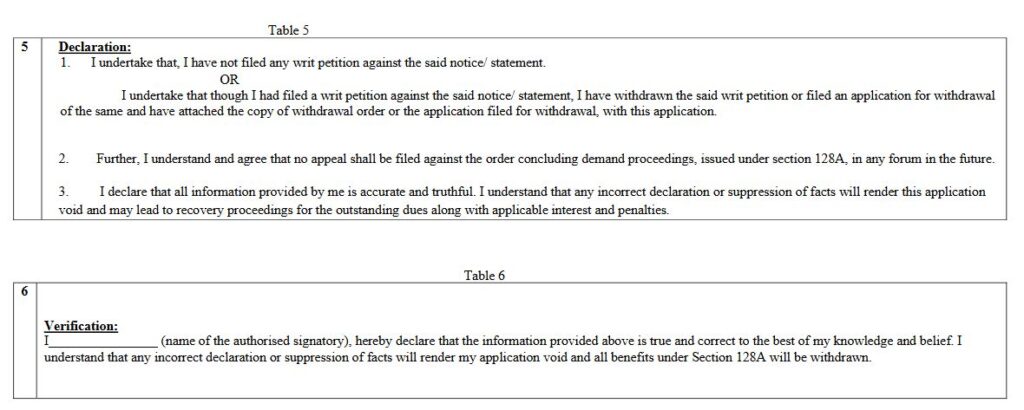
Declaration: 1. I undertake that, I have not filed any appeal or writ petition against the said order. OR I undertake that though I had filed an appeal / writ petition against the said order, I have withdrawn the said appeal/ writ petition (or) I have filed an application for withdrawal of the same and have attached the copy of withdrawal order or the application filed for withdrawal, with this application. 2. Further, I understand and agree that no appeal shall be filed against the order concluding demand proceedings, issued under section 128A in any forum in the future.
3. I also undertake that on issue of an order concluding demand proceedings issued under section 128A, no writ shall be filed against the order mentioned in Table 2 of this form. 4. If an application is filed/ has been filed by the department against the order mentioned in Table 2 or if any proceedings are initiated under sub-section (1) of section 108 against the said order, and the Appellate Authority or the Appellate Tribunal or the court or the Revisional Authority, as the case may be, issues an order enhancing my tax liability, I undertake to pay the additional amount of tax payable within three months from the date of the said order of the Appellate Authority or the Appellate Tribunal or the court or he Revisional Authority, as the case may be, as per second proviso to sub-section (1) of section 128A. 5. I declare that all information provided by me is accurate and truthful. I understand that any incorrect declaration or suppression of facts will render this application void and lead to recovery proceedings for the outstanding dues along with applicable interest and penalties
Table 6
6
Verification: I________________ (name of the authorised signatory), hereby declare that the information provided above is true and correct to the best of my knowledge and belief. I understand that any incorrect declaration or suppression of facts will render this application void and the benefits provided under section 128A will not be valid
Table 7
7
Upload required documents
Self-certified copy of the order
Proof of withdrawal of appeal / writ petition or application filed for withdrawal of appeal/ writ petition (if the order for withdrawal has not been issued) (where applicable)
Proof of payment made towards demand / paid through FORM GST DRC-03 and adjusted through FORM GST DRC-03A.
Any other document (please specify)
Signature of authorized signatory Name/Designation………….. Email address………………. Mobile No……………….
Instructions:
In columns 1 to 6 of Table 2, the details of the order against which the application under section 128A is filed needs to be filled in by the applicant.
In case the order is available on the common portal, ARN number of the same needs to be filled. If the same is not available on the portal, the order number of the manually issued order needs to be filled.
In Table 3, columns 2 to 8 will be auto filled, in case the order is available on the common portal. If the same is not available on the portal, the details of the same are to be manually filled in by the applicant.
Similarly, the reference number of the credit entry (made in ELR- Part II) needs to be filled in column 1 of Table 4. In case the payment intended to be made towards the said demand order was originally paid through FORM GST DRC-03, and later adjusted through filing an application in FORM GST DRC - 03A, the reference numbers of the same are to be filled in columns 2 and 3, and the rest of the columns will be auto-filled.
While calculating the amount deductible on account of not being payable in accordance with sub-section (5) or sub-section (6) of section 16, from the amount payable in terms of the notice or statement or order under section 73, as the case may be, applicant is required to ensure that such amount is deducted only where ITC has been denied solely on account of contravention of section 16(4) and not on any other grounds.
FORM GST SPL -03
[See rule 164(8)]
Notice in response to an application filed under Section 128A
Date:
Reference No.:
To
GSTIN of applicant …………………………… Legal Name of applicant ……………………… Address of applicant …………………………
Reference No. of FORM GST SPL -01 or FORM GST SPL -02 ………… dated ……………
Subject: Notice in response to application filed under section 128A-regarding
Whereas, you have submitted an application under section 128A, declaring your outstanding dues and seeking waiver of interest and penalty in the FORM GST SPL-01/ FORM GST SPL-02 bearing reference no……………dated ………….
Upon verification of your application and the details provided therein, your application is liable to be rejected for the following reasons:
[Reason 1]
[Reason 2]
OR/ AND
In this regard, it appears that the amount of tax is short paid by you as given below:
Demand details (A)
Demand paid through FORM GST DRC 03 (in case of notice/ statement) or by crediting electronic liability register in case of orders
Out of amount mentioned in (A), demand pertaining only to ITC which has been denied solely on account of contravention of section 16(4) and not
Demand Short Paid
on any other grounds, and which has now become eligible as per section 16(5) or section 16(6), if any.
Notic e id/ Orde r id No.
Financi al Period
IGS T
CGS T
SGS T
CES S
Total Tax includin g Cess
IGS T
CGS T
SGS T
CES S
Total Tax includin g Cess
IGS T
CGS T
SGS T
CES S
Total Tax includin g Cess
IGS T
CGS T
SGS T
CES S
Total Tax includin g Cess
1
2
3
4
5
6
7
8
9
10
11
12
13
14
15
16
17
18
19
20
21
22
Drop down
Drop down
You are hereby required to show cause, along with necessary documents in FORM GST SPL-04, to support your claim, as to why your application no……….. dated …….. should not be rejected.
You are also granted an opportunity for a personal hearing on [date and time] at [venue]. You may appear in person or through an authorized representative to present your case.
Legal Name of the applicant…………………………… Address of applicant …………………………
Reference No of FORM GST SPL-03: ……. Dated …..
Subject: Reply to the notice issued in respect of application filed under section 128A.
Sir/Madam,
This is in reference to the notice issued in FORM GST SPL-03 vide no …………… dated.................... from your
office.
The reply is as under:
Enclosures:
The following documents in respect of payment proof or additional submissions are enclosed for your reference:
Document 1: [Taxpayer's Document 1]
Document 2: [Taxpayer's Document 2]
Document 3: [Taxpayer's Document 3]
Verification:
I hereby solemnly affirm and declare that the information given hereinabove are true and correct to the best of my knowledge and belief and nothing has been concealed therefrom.
[Signature of Authorised Signatory] [Name of the of authorised signatory]
[Designation/Status]
[Date]
FORM GST SPL -05
[See rule 164 (10)]
Order for conclusion of proceedings as per section 128A
Reference No. ……
Date:
To,
GSTIN of applicant …………………………… Legal Name of applicant …………………………… Address of applicant …………………………
Reference No. of FORM GST SPL-01/ FORM GST SPL-02 …………….. dated ……………
Subject: Order for approval of application submitted under Section 128A
This has reference to your application with reference no. …… dated ….. furnishing details/ information and documents in support of your request for availing the benefit of waiver of interest or penalty or both under section 128A.
OR
This has reference to your application with reference no. …… dated ….. , and your reply in FORM GST SPL-04 with reference no. …… dated …… furnishing details/ information/ submission and documents in support of your request for availing the benefit of waiver of interest or penalty or both under section 128A .
Upon verification of the details provided in your application and the reply, where applicable, waiver of interest or penalty or both under section 128A, is allowed as under:
Demand Notice/ Demand Order Details:
Order No/ Notice No.:
Date of order/ Notice:
Financi al Year
Amount demanded in the notice/ statement/ order against which application under section 128A was filed (A)
Out of the amount mentioned in (A), demand pertaining only to ITC which has been denied solely on account of contraventi on of section 16(4) and not on any other grounds, and which has now become eligible as per section 16(5) or section 16(6)
Amount already paid towards the said notice/ statement/ order
Amount of interest and penalty waived as per section 128A
Remaining amount of interest and penalty, payable, if any, by the applicant (in cases referred to in sub-rule(3) and sub-rule (4) of rule 164)
Place of Suppl y(PoS)
Act
Tax includi ng cess
Intere st
Penalt y
Fe e
Othe rs
Tax including cess
Place of Suppl y(PoS)
Act
Tax includi ng cess
Intere st
Penalt y
Fe e
Othe rs
Intere st
Penalt y
Intere st
Penalt y
1
2
3
4
5
6
7
8
9
10
11
12
13
14
15
16
17
18
19
20
CGS T
CGS T
SGS T
SGS T
IGS T
IGS T
Cess
Cess
TOTAL
TOTAL
CGS T
CGS T
SGS T
SGS T
IGS T
IGS T
Cess
Cess
TOTAL
TOTAL
[Signature] [Name of the Tax Officer]
[Designation] [Jurisdiction] [Address]
Notes -
Any incorrect declaration or suppression of facts will render this approval void and may lead to recovery proceedings for the outstanding dues along with applicable interest and penalties.
FORM GST SPL -06
[See Rule 164 (15)(b)(i)]
Order for conclusion of proceedings as per section 128A
Reference No. ……
Date:
To,
GSTIN of applicant …………………………… Legal Name of applicant …………………………… Address of applicant …………………………
Name of the authorised representative -
Reference No. of FORM GST SPL-01/ FORM GST SPL-02 …………….. dated ……………
Reference No. of FORM GST SPL-07 ……………… dated ………….
Reference No. of FORM GST APL-01 ……………… dated ………….
Subject: Order for approval of application submitted under section 128A
This has reference to your appeal with reference no. …… dated ….. furnishing details/ information/ prayer and documents in support of your request for availing the benefit of waiver of interest or penalty or both under section 128A.
Upon verification of the details provided in your application and the reply, where applicable, waiver of interest or penalty or both under section 128A, is allowed as under:
Demand Notice/ Demand Order Details:
Order No/ Notice No.:
Date of order/ Notice:
Financi al Year
Amount demanded in the notice/ statement/ order against which application under section 128A was filed (A)
Out of the amount mentioned in (A), demand pertaining only to ITC which has been denied solely on account of contraventi on of section 16(4) and not on any other grounds, and which has now become eligible as per section 16(5) or section 16(6)
Amount already paid towards the said notice/ statement/ order
Amount of interest and penalty waived as per section 128A
Remaining amount of interest and penalty, payable, if any, by the applicant (in cases referred to in sub-rule(3) and sub- rule (4) of rule164)
Place of Suppl y (PoS)
Act
Tax includi ng cess
Intere st
Penalt y
Fe e
Othe rs
Tax including cess
Place of Suppl y (PoS)
Act
Tax includi ng cess
Intere st
Penalt y
Fe e
Othe rs
Intere st
Penalt y
Intere st
Penalt y
1
2
3
4
5
6
7
8
9
10
11
12
13
14
15
16
17
18
19
20
CGS T
CGS T
SGS T
SGS T
IGS T
IGS T
Cess
Cess
TOTAL
TOTAL
CGS T
CGS T
SGS T
SGS T
IGS T
IGS T
Cess
Cess
TOTAL
TOTAL
[Signature] [Name of the Appellate Authority]
[Designation] [Jurisdiction]
Notes -
Any incorrect declaration or suppression of facts will render this approval void and may lead to recovery proceedings for the outstanding dues along with applicable interest and penalties.
FORM GST SPL -07
[See rule 164(12)]
Order for Rejection of Application submitted under section 128A
Reference No. ……..
Date:
To,
GSTIN of applicant …………………………… Legal Name of applicant …………………………… Address of applicant …………………………
Reference is invited to:
Particulars
Reference No.
Dated
Application in FORM GST SPL -01/ FORM GST SPL-02
Show Cause Notice in FORM GST SPL -03:
Reply to the Show Cause Notice in FORM GST SPL -04:
Subject: Order for Rejection of Application submitted under section 128A
This has reference to your application with reference no. …… dated ….. furnishing details/ information and documents in support of your request for availing the benefit of waiver of interest and penalty under section 128A.
The notice referred to above was issued to you to explain the reasons as to why the said application should not be rejected, for which you had furnished reply dated ……/ no reply was furnished by you.
Introduction:
Submissions, if any:
Conclusion:
Based on the verification your application with reference no............. dated …… filed under section
128A, is hereby rejected.
Summary of rejection:
Order id/ SCN id
Reason for rejection
<Drop Down> Options in <Drop Down>Full payment not made Payment made after the date notified in Section 128A.Notice/ Order pertaining to sections other than section 73.Appeal/ writ petition filed before Appellate Authority/ Appellate Tribunal/ High Court/ Supreme Court not withdrawn Others, please specify.
Reference No of FORM GST APL-04 passed with reference to FORM GST SPL-07 specified at serial number 5 above: ……. dated …..
Reference number of appeal filed originally but subsequently withdrawn …… dated …….
Subject: Undertaking submitted in respect of Rule 164(15)(b)(ii).
Sir/Madam,
I hereby undertake not to file an appeal against the order of the appellate authority bearing reference number …… dated …., as specified at serial number 6 above, and accordingly I pray for restoration of my appeal filed vide reference number …… dated …. as specified at serial number 7 above.
I hereby solemnly affirm and declare that the information given hereinabove are true and correct to the best of my knowledge and belief and nothing has been concealed therefrom.
[Signature of authorised signatory] [Name of the of authorised signatory]
[Designation/Status] [No. CBIC-20006/20/2023-GST] (Raghavendra Pal Singh)
Director Note: The principal rules were published in the Gazette of India, Extraordinary, Part II, Section 3, Sub-section (i) vide number G.S.R. 610(E), dated the 19th June, 2017 No. 3/2017-Central Tax, dated the 19th June, 2017 and were last amended vide notification number G.S.R. 376 (E), dated the 10th July 2024 No. 12/2024 -Central Tax, dated the 10th July 2024.
Q1: What is Notification No. 20/2024 – Central Tax?
Answer: Notification No. 20/2024 – Central Tax introduces the Second Amendment to the CGST Rules, 2017, bringing changes to: ✔️ Invoice issuance deadlines for specific transactions. ✔️ New rules for tax refunds and credit adjustments. ✔️ Changes in compliance and penalty structures. ✔️ Increased accountability in GST audits. 📌 Stay compliant with expert GST guidance from Finodha
Q2: What are the key changes in tax invoice issuance rules?
Answer: 🔹 A new Rule 47A has been inserted, requiring taxpayers under Section 9(3) and 9(4) of CGST Act (Reverse Charge Mechanism) to issue invoices within 30 days from the date of supply receipt. 🔹 This amendment ensures timely documentation and prevents tax evasion by delaying invoice issuance. 📌 Learn more about GST invoicing best practices
Q3: How does this amendment affect tax refunds under GST?
Answer: The notification modifies Rule 89, particularly affecting refund claims on Input Tax Credit (ITC): ✔️ Certain clauses on ITC eligibility for refunds have been removed. ✔️ Refund computation now excludes the value of exempt supplies (except zero-rated supplies). ✔️ Taxpayers claiming ITC refunds must follow stricter compliance guidelines. 📌 Optimize your GST refunds with Finodha’s expert services
Q4: What are the new compliance deadlines introduced in this notification?
Answer: 🔹 Rule 66 amendment requires filing FORM GSTR-7 on or before the 10th of the following month for tax deductions at source (TDS). 🔹 Delayed filings may attract penalties. 📌 Ensure timely GST filings with Finodha
Q5: How do these changes impact businesses under GST?
Answer: 🔹 Businesses must update invoice issuance timelines for Reverse Charge Mechanism (RCM) transactions. 🔹 Refund eligibility has been redefined, impacting sectors relying on input tax credit refunds (e.g., exporters and service providers). 🔹 New penalties and stricter compliance rules for delayed tax payments. 📌 Get professional GST compliance support
Q6: Are there any changes in GST penalty rules?
Answer: Yes. The notification modifies Rule 142, adding references to Section 74A, expanding the scope of penalties for fraud, tax evasion, and misreporting. 📌 Avoid GST penalties with Finodha’s expert advisory
Q7: How does this notification affect GST-registered e-commerce platforms?
Answer: E-commerce platforms must: ✔️ Ensure compliance with the new tax invoice issuance rules under Reverse Charge Mechanism (RCM). ✔️ Adhere to stricter refund claim policies for input tax credit adjustments. ✔️ Implement system changes for auto-calculations of ITC and TDS filings. 📌 Get tailored GST solutions for e-commerce businesses
Q8: Are there any new forms introduced in this amendment?
Answer: Yes. The notification introduces FORM GST SPL-01, SPL-02, SPL-03, SPL-04, SPL-05, and SPL-07 to manage waiver of interest and penalty under Section 128A. 📌 Stay updated with the latest GST form changes
Q9: When will the changes under Notification No. 20/2024 be effective?
Q10: How can businesses prepare for these new GST rule changes?
Answer: 🔹 Update GST invoicing and record-keeping processes. 🔹 Ensure refund claims align with new eligibility criteria. 🔹 Adopt automated GST compliance tools for timely tax filings. 🔹 Consult GST experts for risk assessment and compliance checks. 📌 Get your GST compliance strategy ready with Finodha
Conclusion
🚀 Notification No. 20/2024 – Central Tax introduces key amendments to CGST Rules, 2017, impacting invoice issuance, refund eligibility, and penalty structures. Businesses must align their compliance processes before 1st November 2024 to avoid penalties. 📌 Need expert GST assistance? Consult Finodha today! 🚀
Important Keyword: Free On Board, FOB Shipping Terms, FOB Origin vs Destination, Intenational Shipping, International Shipping.
Table of Contents
Introduction to Free On Board (FOB)
Free On Board (FOB) is a crucial term in the realm of international shipping and trade, representing an essential part of Incoterms, which are internationally recognized standard trade terms. In essence, FOB indicates the point at which the responsibility and risk of loss or damage to goods transfers from the seller to the buyer. Understanding the intricacies of FOB is vital for both sellers and buyers as it can significantly impact shipping costs, legal liability, and overall trading negotiations.
In scenarios where FOB is utilized, the seller’s responsibilities include delivering goods to a specified location, usually a port, and ensuring they are loaded onto the transportation vessel. Once the goods are on board, the obligation shifts to the buyer, who assumes responsibility for all subsequent costs and risks associated with the cargo. This transition of risk is particularly significant as it affects insurance arrangements, transportation decisions, and payment terms. For instance, if goods are damaged during shipping, the buyer must account for these losses if the FOB term specifies shipment as the transfer point.
Moreover, understanding Free On Board terms can mitigate misunderstandings in trading relationships and facilitate smoother transaction processes. Regardless of whether one is engaging in domestic or international trade, knowing how FOB operates aids in making informed decisions about shipping strategies, negotiations, and potential liabilities. Various factors merit consideration, such as the distinction between FOB origin and FOB destination, as these details influence pricing, risk management, and logistics management. Therefore, gaining a comprehensive understanding of Free On Board principles is imperative for stakeholders in the trade industry, ensuring effective communication and smooth operations throughout the supply chain.
What Does Free On Board (FOB) Mean?
Free On Board (FOB) is a shipping term widely used in international trade that indicates when the responsibility for goods transfers from the seller to the buyer. This term defines the specific point at which the seller fulfills their part of the shipping process and signifies the commencement of the buyer's obligations. In practical terms, FOB is often followed by a location, such as "FOB shipping point" or "FOB destination," which clarifies the transfer point during the shipment process.
The origins of the term date back to maritime trade, where ships would transport goods to ports. Under FOB shipping point, the seller's responsibility ends when the goods are loaded onto the vessel, and the buyer assumes all risks and costs thereafter. Conversely, under Free On Board destination, the seller retains responsibility for the goods until they reach the buyer's specified location. This distinction is crucial for traders to determine liability throughout the shipping process.
In addition to its application in shipping, Free On Board is important in contractual agreements, influencing shipping costs, insurance during transportation, and the allocation of risks. By understanding Free On Board, parties involved in trade can navigate their responsibilities effectively, ensuring that both buyers and sellers are aware of their obligations. Consequently, knowledge of Free On Board terminology not only smooths the transaction process but also protects both parties from potential disputes arising from misunderstandings about liability and costs associated with transport.
The Importance of FOB in Trade Agreements
Free On Board (FOB) terms play a pivotal role in international trade agreements. This Incoterm specifies the moment at which the responsibility and risk are transferred from the seller to the buyer. Understanding FOB is essential for traders because it helps clarify financial liability and defines the duties that both parties must fulfill during the shipping process. For instance, under FOB terms, the seller is responsible for all costs and risks up to the point where the goods are loaded on the vessel at the designated port. Once the goods are on board, the responsibilities shift to the buyer, who then oversees transportation and bears any associated risks.
The utilization of FOB in trade contracts is crucial for effective risk management. Since Free On Board clearly delineates the point of transfer of responsibility, it mitigates potential disputes between buyers and sellers regarding loss or damage of goods during transit. Notably, having clear Free On Board terms allows both parties to tailor their insurance coverage according to their specific risks and responsibilities. As a result, traders can make informed decisions regarding how best to protect their investments while keeping costs manageable.
Additionally, FOB terms enhance transparency in international trade agreements. When both parties understand the implications of FOB, they can work together more efficiently, leading to smoother transactions. The clear stipulation of responsibilities minimizes misunderstandings and potential conflicts that could arise during the shipping process. Therefore, trade agreements that incorporate Free On Board are more likely to be successful, as they provide a structured framework for both buyers and sellers to follow.
Understanding FOB Origin vs FOB Destination
Free On Board (FOB) is a crucial phrase in international trade, defining the point at which the responsibility and ownership of goods transfer from the seller to the buyer. This transfer can occur either at the origin or destination, leading to two primary types: FOB Origin and FOB Destination.
FOB Origin implies that the buyer assumes ownership of the goods as soon as they leave the seller's premises. Consequently, the buyer bears all risk and shipping costs from that point onward. For example, if a manufacturer in Los Angeles sells machinery to a retailer in New York under FOB Origin terms, the seller is responsible for the goods until they are loaded onto the shipping vessel. Once the machinery is onboard, the buyer takes on all responsibilities. This situation can lead to complications if the goods are damaged during transit, as the buyer will handle any claims.
In contrast, FOB Destination indicates that the seller retains ownership and risk until the goods reach the buyer's specified destination. For instance, if the same machinery is sold under FOB Destination terms, the seller must ensure that it arrives safely in New York before the title transfers to the buyer. Once the equipment is delivered, all responsibility shifts to the buyer. This arrangement can provide more security for the buyer, as they are not liable for potential damages that may occur during transit.
Understanding the nuances of FOB Origin and FOB Destination is essential for traders, as these terms can significantly impact shipping costs, risk management, and overall transactional obligations. By clearly acknowledging these differences, both sellers and buyers can navigate their shipping responsibilities with greater confidence.
Advantages of Using FOB Terms
Utilizing Free On Board (FOB) terms offers several advantages in the realm of international trade, particularly concerning risk management, clarity of responsibilities, and cost efficiencies. One significant benefit is improved risk management for both buyers and sellers. Under FOB terms, the seller maintains responsibility for the goods until they are loaded onto the vessel at the port of shipment. This arrangement minimizes the seller's liability once the goods are placed on board, thereby transferring risk to the buyer during transit. This clarity is crucial, as it enables traders to make informed decisions regarding cargo insurance and other risk mitigation strategies.
Another key advantage of using FOB terms is the clear delineation of responsibilities between the trading parties. The seller's obligations conclude once the goods are loaded, allowing for straightforward cooperation and negotiation processes. Buyers can confidently plan for delivery and logistics without the complexities that might arise from ambiguous contracts. This clarity can lead to stronger relationships between parties, fostering trust and collaboration, which are essential elements in successful trade negotiations.
Moreover, FOB terms can result in potential cost savings for both parties involved in the transaction. By utilizing this approach, companies can take advantage of competitive shipping rates due to their established relationships with local transport providers. For sellers, FOB eliminates the need for additional shipping costs that can arise from complicated logistics, while buyers can negotiate the most favorable shipping options available. This advantageous pricing dynamic can ultimately help maintain profit margins and enhance the overall efficiency of the transaction.
In summary, the use of FOB terms in international trade provides traders with enhanced risk management, clarity in responsibilities, and the potential for significant cost savings, making it a preferable choice for many transactions. By understanding these benefits, traders can better navigate international markets and establish effective operational practices.
Disadvantages and Risks Associated with FOB
While Free On Board (FOB) agreements provide various benefits in shipping and trade, they also present several disadvantages and risks that traders should carefully consider. One significant concern is the possibility of unexpected shipping costs. When ownership of the goods transfers to the buyer once they are loaded onto the shipping vessel, any unforeseen charges incurred during transit or storage can lead to disputes over who is responsible for these costs. These additional expenses can erode profit margins and complicate financial planning.
Furthermore, liability concerns can arise under FOB terms. Once the goods are on board, the buyer typically assumes all risk related to loss or damage during transport. If an incident occurs, such as an accident at sea or damage due to rough weather, the buyer must navigate the claims process with the shipping company, which can be time-consuming and complex. This shift in liability can also make buyers hesitant to engage in FOB shipments, especially if they lack experience in managing transport-related risks.
Complications in international transactions also pose a significant risk for traders using FOB agreements. Differences in regulations, customs processes, and import tariffs between countries can lead to delays and potential legal issues. In cases where the seller is more familiar with the transportation process and local laws, they may experience challenges when dealing with foreign buyers who may not fully understand the risks involved. This knowledge gap can lead to misunderstandings, disputes, and financial losses.
In addition to these challenges, using FOB can complicate communication between parties. Precise coordination is essential, as any miscommunication regarding the timing of shipment or documentation may result in delays, penalties, or damaged relationships with suppliers and customers alike. For traders, weighing these disadvantages and risks against the benefits of FOB agreements is crucial for making informed decisions about their shipping strategies.
FAQ: Common Questions About FOB
Free On Board (FOB) is an essential term in the world of trade and shipping, specifically relating to the responsibilities of buyers and sellers. Below are some frequently asked questions to help clarify this concept.
What is the liability under FOB terms? Under FOB terms, the liability and responsibility for goods transition from the seller to the buyer once the goods are loaded onto the vessel at the port of shipment. This means that if any damage or loss occurs during transit after loading, the buyer assumes full responsibility. Conversely, any incidents that happen before the goods are on board fall under the seller’s liability. Understanding these liabilities is crucial for parties involved in international trade to mitigate risks.
How do I determine the correct FOB terms for my transaction? Choosing the correct FOB terms involves several factors, including the specific needs of both the buyer and the seller. Traders should carefully review the contract of sale, identifying the agreed-upon FOB point. It is advisable to initiate discussion prior to shipping to ensure both parties have a mutual understanding of responsibilities regarding insurance, freight charges, and risks associated with transport. Consulting with a freight forwarder or legal advisor can also provide significant clarity in making the right decision.
What should I do if my goods are damaged in transit? If goods arrive damaged under FOB terms, the first step is to document the damage immediately. This includes taking photographs and gathering any shipping documents. Depending on the procurement of insurance, the next action would be to file a claim with the insurance provider if coverage is applicable. It is essential to consult the shipping contract and liaise with the carrier as well, since the proper procedures for claiming damages should be adhered to for a more efficient resolution.
Real-Life Example of FOB in Action
Consider a scenario involving an Indian exporter of textiles located in Ahmedabad who has secured a contract with a retailer in the United States. The agreed shipping term is Free On Board (FOB) at the port of Mumbai. Here, the FOB agreement specifies that the Indian exporter is responsible for all costs and risks until the goods are loaded onto the shipping vessel at the designated port. This requires the exporter to manage various logistics, such as packaging, transportation to the port, and export customs clearance.
To successfully execute this transaction, the exporter coordinates with a local freight forwarder to arrange for the transport of their goods from the factory to the Mumbai port. The goods are carefully packaged to prevent damage during transit. Upon arrival at the port, the exporter undertakes the customs clearance processes, ensuring all necessary documents are in order. Once the textiles are loaded onto the vessel, ownership and risk are transferred to the American retailer.
This exchange highlights a quintessential aspect of FOB terms: the clear demarcation of responsibilities. The Indian exporter is accountable for expenses such as transportation, handling, and loading at the port of origin, while the American retailer incurs the costs associated with ocean freight and insurance from that point onwards. Consequently, the FOB shipping method empowers Indian exporters by granting them greater control over logistics up until the loading stage, allowing for more effective decision-making in the trade process.
By utilizing FOB terms, the Indian exporter mitigates potential losses, as they are not liable for the goods once they are aboard the vessel. This real-life example underscores the importance of understanding Free On Board terms in international trade, especially how it shapes the logistics, costs, and responsibilities inherent in cross-border transactions.
Conclusion: Key Takeaways on FOB
Understanding Free On Board (FOB) is crucial for traders and businesses engaged in international shipping. FOB terms establish the responsibilities and risks associated with the transportation of goods, thereby facilitating smoother transactions between buyers and sellers. One of the primary insights gleaned from this exploration is that the definition of FOB can significantly influence the cost allocation, insurance expectations, and logistics management between parties involved.
It has become evident that distinguishing between FOB Origin and FOB Destination holds substantial importance. Under FOB Origin, the buyer assumes responsibility and risk once the goods leave the seller's premises, which requires them to prepare for potential shipping issues. Conversely, FOB Destination transfers those responsibilities to the seller until the goods reach the buyer’s specified location. This differentiation impacts negotiations, insurance arrangements, and overall costs, thereby affecting both parties’ operational strategies.
Another important aspect to consider is the significance of clear communication and documentation within FOB agreements. Properly documenting the terms and expectations not only serves to protect both parties in case of disputes but also ensures compliance with regulations and standards across various jurisdictions. Understanding these factors aids traders in making informed decisions and helps mitigate risks associated with international trade.
In conclusion, grasping the nuances of FOB is not merely an academic exercise but a practical necessity for successful trading operations. The implications of FOB on logistics, financial responsibilities, and risk management cannot be overstated. Each trader should prioritize familiarizing themselves with FOB terms and apply this knowledge diligently to enhance their trading practices and foster better relationships with freight providers and partners.