Important Keywords: Corporate Identification Number (CIN) in India, What is CIN, CIN full form, CIN under Companies Act 2013, CIN structure explained, How to find CIN number, CIN vs GSTIN vs PAN, Importance of CIN number, CIN for companies in India, MCA CIN search, ROC CIN details, CIN registration process, CIN legal requirements India.
Words: 4,652, Read time: 25 minutes.
Table of Contents
Overview
"A Corporate Identification Number (CIN) is a 21-character unique code assigned to every company registered in India & CIN is more than a number — it’s the DNA that defines a company’s identity."
Just like DNA reveals the true identity of an individual, the CIN unveils the legal identity of a company. In this article, we will explore how this unique code is far more than just a registration detail; it’s the blueprint that tells you who the company is, how it is structured, and where it belongs in the corporate ecosystem. With a CIN, you can decode essential information about any registered business. In this article, we’ll explore how CIN works, why it matters, and how it serves as the DNA of corporate existence. Let’s begin the decoding journey….
Do not confuse the Corporate Identification Number (CIN) with the Challan Identification Number (CIN), which is a 20-digit code used for tax payments.
Don’t get confused—they may sound similar, but they are used for completely different purposes.
- Corporate Identification Number (CIN): A 21-digit code given to every company by the Registrar of Companies (ROC) through the Ministry of Corporate Affairs (MCA) at the time of incorporation. It works like a company’s ID card, helping people check its basic details.
- Challan Identification Number (CIN): A 20-digit code used when you pay taxes. It is generated by the Income Tax Department and acts like a payment receipt number to track your tax payment.
Now, we will discuss the Corporate Identification Number (CIN) in this article.
What is Corporate Identification Number (CIN)?
As per Section 7(3) of the Companies Act, 2013, once a company is incorporated, the Registrar of Companies (ROC) assigns a Corporate Identification Number (CIN) to the company. This CIN is also mentioned on the Certificate of Incorporation.
The CIN is a unique identification code issued to every company in India by Registrar of Companies (ROC) through the Ministry of Corporate Affairs (MCA) portal. It serves as the official identity of the company and must be mentioned in almost all official documents and communications. Every company is required to print its name, registered office address, and CIN, along with contact details such as telephone number, fax (if any), email, and website (if available), on all business letters, billheads, letterheads, notices, and other official publications.
The CIN is not just a legal formality—it is essential for building trust and ensuring smooth business transactions. Understanding CIN is crucial for legal compliance, transparency, and efficient business operations in India. It is a key identifier that plays an important role in a company’s interactions with regulatory authorities, clients, and financial institutions.
Importance of Corporate Identification Number
The Corporate Identification Number (CIN) is far more than just a code- It plays multiple roles in a company. It works like an ID card for a company.
- Unique Identity: Just like no two people can share the same Aadhaar number, no two companies can share the same CIN. It helps to clearly identify and track a company.
- Transparency: The CIN tells you what type of company it is, which industry it belongs to, and where it is registered. This makes it easier for investors, clients, and regulators to trust the company.
- Compliance: Regulators use the CIN to check if a company is following all the legal rules and filing requirements. It’s a way to keep companies accountable.
- Official Use: The CIN must be printed on all important documents like letterheads, invoices, notices, and e-filings. This shows professionalism and builds credibility.
*The CIN is not just a number—it’s the company’s official identity, helping with trust, compliance, and smooth business operations.
When Do You Need a CIN Number?
A CIN is required in many common business situations, such as:
- Opening a current bank account in the company’s name
- Signing important agreements, contracts, or legal documents
- Filing annual returns and other statutory compliances with ROC
- Applying for government licences, registrations, or permits
- Communicating or dealing with government departments
- Approaching banks or financial institutions for loans or credit facilities
- Applying for a business loan, whether online or offline
- Mentioning it on company documents like invoices, letterheads, and official filings
Banks and lenders often use the CIN to check a company’s details, compliance history, and overall credibility before approving a loan.
Who does not require a CIN?
A CIN is not required for all types of businesses in India. It is issued only to companies that are registered under the Companies Act. Therefore, the following types of entities do not receive a CIN:
- Sole proprietorships
- Partnership firms
- Limited Liability Partnerships (LLPs) – they receive an LLPIN instead (
- NGOs registered as societies or trusts
- Small or unregistered businesses
In simple terms, only companies registered under the Companies Act are issued a CIN.
Structure of Corporate Identification Number (CIN)
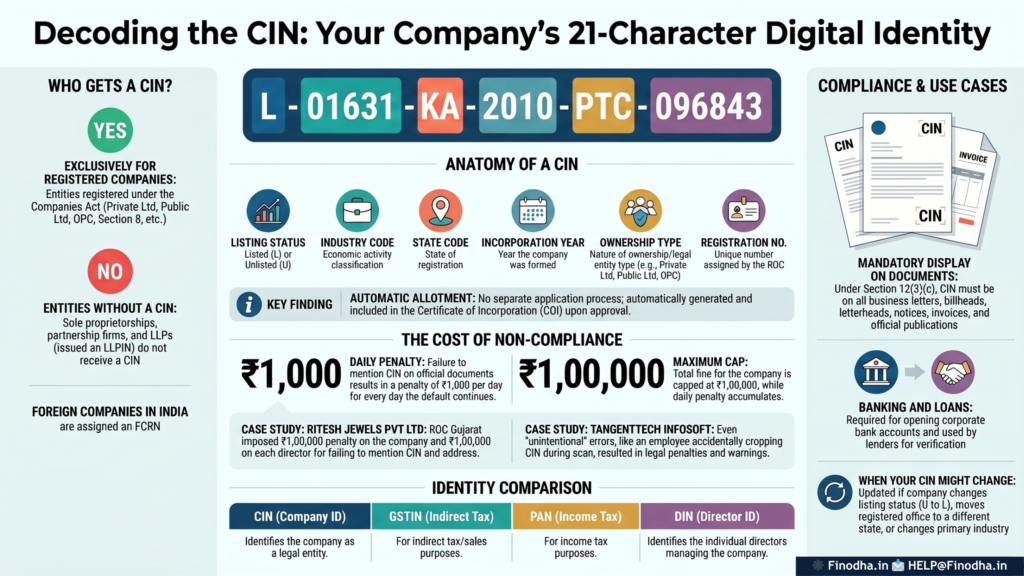
A Corporate Identification Number (CIN) is a unique 21-character alphanumeric code issued by the Registrar of Companies (ROC) to every registered company. It is structured in a way that each part of the number provides specific information about the company.
For example, a CIN looks like L01631KA2010PTC096843 can be understood in six meaningful parts:
Section 1 – Listing status: Indicates whether the company is listed or unlisted
Section 2 – Industry code: Shows the nature of business activity
Section 3 – State code: Represents the state where the company is registered
Section 4 – Year of incorporation: Mentions the year the company was formed
Section 5 – Ownership type: Identifies the form of ownership (e.g., Private Limited, Public Limited)
Section 6 – Registration number: The unique number assigned to the company by the ROC
*CIN is not just a number—it is a coded identity that reveals key details about a company’s legal and business structure.
Breakdown the structure
A Corporate Identification Number (CIN) is a 21-character alphanumeric code that is divided into six distinct parts, and each part conveys specific information about a company. This can be better understood with the example below:
U – 12345 – DL – 2020 – PLC – 098765
Breakdown of CIN structure:
- First character (U/L) – Showing Listing status: The first letter indicates whether the company is listed or unlisted. “L” represents a listed company on BSE/NSE, while “U” represents an unlisted company.
- Next 5 digits – Showing Industry code: This five-digit number represents the company’s industry classification, assigned by the Registrar of Companies (ROC) based on its business activity.
- Next 2 letters – Showing State code: This part shows the state in which the company is registered. For example, DL refers to Delhi, Maharashtra is "MH", Tamil Nadu is "TN", Madhya Pradesh will be "MP", and Gujarat will be "GJ".
- Next 4 digits – Showing Year of incorporation: These digits indicate the year in which the company was incorporated, such as 2020 in this example.
- Next 3 letters – Showing Type of company/ownership: This section defines the nature of the company. For instance, PLC stands for Public Limited Company, while other codes represent different types such as private companies.
- Last 6 digits – Showing Registration number: This is the unique registration number assigned to the company by the ROC.
*A CIN works like a structured identity code for a company - each segment provides specific information about its listing status, industry, location, year of incorporation, type, and registration details.
Abbreviation in CIN number
These are the abbreviations that appear in the CIN's sections 5:
| Company Type Code | Full Form | Common Use / Meaning |
|---|---|---|
| FLC | Financial Lease Company (Public Limited) | Specialized financial institutions |
| FTC | Foreign Subsidiary Company (Private Limited) | Indian subsidiaries of multinational companies (e.g., Google India Pvt. Ltd.) |
| GAP | General Association Public | Trade associations, industry bodies |
| GAT | General Association Private | Trade associations, industry bodies |
| GOI | Government of India Owned Companies | PSUs like ONGC, BHEL, SBI, LIC |
| NPL | Not-for-Profit License Company (Section 8 Company) | NGOs, educational trusts, foundations, professional bodies |
| OPC | One Person Company | Sole proprietors, freelancers, consultants |
| PLC | Public Limited Company | Large corporations and listed companies (NSE/BSE) |
| PTC | Private Limited Company | Startups, MSMEs, family-owned businesses, subsidiaries |
| SGC | State Government Companies | State electricity boards, DISCOMs, state undertakings |
| ULL | Unlimited Liability Public Company | Rare: mainly older registrations or professional setups |
| ULT | Unlimited Liability Private Company | Rare: mainly older registrations or professional setups |
CIN vs LLPIN vs FCRN
| Type | Used For |
|---|---|
| CIN | Companies |
| LLPIN | LLPs |
| FCRN | Foreign companies |
How CIN is Issued (Process)
Getting a Corporate Identification Number (CIN) is part of registering your company with the Ministry of Corporate Affairs. Just follow these basic steps:
- Choose a company name
- Prepare documents (MOA, AOA, etc.)
- Apply for incorporation through SPICe+ form on MCA portal
- DIN (for directors) is allotted during this process (if not already available)
- Submit application with fees
Once approved:
- The Registrar of Companies issues Certificate of Incorporation
- CIN is automatically generated and mentioned in it.
*You do not need to apply for a Corporate Identification Number (CIN) separately. It is automatically assigned when your company is incorporated by the Ministry of Corporate Affairs through the Registrar of Companies.
Once your company is approved, the CIN is mentioned in the Certificate of Incorporation (COI), which serves as proof of your company’s legal existence.
How to Check / Track CIN?
The CIN of any company can be easily found online. Visit the official website of the Ministry of Corporate Affairs to find the CIN. The website allows you to search for the following –
- Registration number of the company
- Name of the existing company or name of the Limited Liability Partnership (LLPs use LLPIN, not CIN)
- Active or inactive CIN
- Name of the LLP or the old company (LLPs use LLPIN, not CIN)
- After the required details are filled in, you need to enter a CAPTCHA code and then click on search.
Where to check CIN
- Go to MCA website
- Click “View Company Master Data”
- Enter company name
Changes in Corporate Identification Number (CIN)
The CIN generally remains the same, it can change in certain situations, such as:
- Change in listing status: If a company gets listed on a stock exchange or becomes unlisted, the first letter of the CIN changes (e.g., from “U” to “L” or vice versa).
- Change in registered office (state-wise): If the company shifts its registered office from one state to another, the state code in the CIN changes. (No change if the office shifts within the same state.)
- Change in industry or business activity: If there is a major change in the company’s primary business activity, the industry code (first 5 digits) in the CIN may be updated.
How CIN fits into the bigger system (In broader concept)
Corporate Compliance System in India, It is a part of Company registration, ROC filings and Legal identity tracking.
Penalty
As per Section 12(3)(c) of the Companies Act, 2013, every company is required to print its Corporate Identity Number (CIN) on all important official documents such as business letters, invoices, notices, and other publications. This CIN acts like the company’s unique identification number.
If a company fails to include its CIN on these documents, then under Section 12(8) of the Act, the company must pay a penalty of ₹1,000 for each day the default continues.
However, the law also sets a limit. The total penalty cannot exceed ₹1,00,000, no matter how long the company continues to miss adding the CIN.
Even minor omissions (like missing CIN on letterheads) are treated as technical non-compliance and can attract penalties.
MCA Imposes Penalty for Companies’ Failure to Mention CIN on Documents
Let’s understand this with real MCA adjudication cases:
Case 1: Tangenttech Infosoft Private Limited.
Tangenttech Infosoft Private Limited, a company based in Ahmedabad, filed certain documents on the MCA portal. However, in some documents, the company did not mention its CIN and registered office address, which is mandatory under Section 12(3)(c) of the Companies Act, 2013.
This mistake was noticed by the Registrar of Companies during routine verification.
Issue in this case
As per the Companies Act, every company must mention its CIN and registered office address on all official documents.
But in this case, the company failed to include these details in:
- Board Resolution (2017)
- Letter attached with ADT-1
- Letter attached with ADT-2 (2021)
This was treated as a non-compliance, and the company along with its officers became liable for penalty under Section 12(8).
Action taken by Authorities:
- The Regional Director (NWR), Ahmedabad directed the ROC to take action.
- The ROC issued a notice on 17.09.2021 for non-compliance.
- Initially, the company did not respond to the notice.
Later:
- A hearing notice was issued on 25.11.2021
- Hearing was fixed for 05.01.2022, but adjourned
- Final hearing took place on 23.03.2022
Company’s Response
During the hearing, the company (through its Company Secretary) stated that:
- The company follows the law and had no intention of ignoring compliance requirements.
- The missing CIN and registered office address happened by mistake when an employee scanned the document.
- The letterhead did have the CIN and address, but the employee scanned it incorrectly, leaving out that part.
- The company has filed other documents with the Registrar of Companies (ROC) that correctly include the CIN and registered office address, as required under Section 12(1) of the Companies Act, 2013.
The company secretary explained that the error was unintentional, caused by a scanning mistake, and that the company has otherwise complied with the law in its filings. Also the company secretary asked the Adjudicating Officer to consider the company’s financial struggles and losses due to COVID-19 before giving any penalty order.
- The Presenting Officer pointed out that in some documents (like the board resolution of 28.12.2017 and a letter dated 23.02.2021 filed with ADT-2), the company did not include its CIN number and registered office address on the letterhead, which is required by law.
- He explained that this is a violation of Section 12(3)(c) of the Companies Act, 2013, and therefore attracts penalties under Section 12(8).
- However, in other filings (like MGT-7 in 2019), the company did mention the CIN and address correctly.
- So, the issue was not constant but occasional.
- Based on these facts, the Registrar of Companies (acting as Adjudicating Officer) concluded that the company and its officers had indeed violated the law in those specific cases and are liable for penalties.
The company secretary asked for leniency due to financial hardship, but the authorities found that the company had failed to follow the rule of mentioning CIN and address on certain documents, which counts as a violation and makes them liable for penalty.
Before deciding the penalty, the Registrar of Companies looked at three things:
- Whether the company gained unfair advantage.
- Whether investors lost money.
- Whether the mistake was repeated.
- The Presenting Officer said there was no clear proof of unfair gain or investor loss, and such things are hard to measure in this case.
- He also noted that the company’s balance sheet showed it was not a “small company,” so it could not get the benefit of reduced penalties under Section 446B.
- After considering all facts, the Registrar of Companies decided that the company and its directors had violated Section 12(3)(c) of the Companies Act, 2013.
- Therefore, he imposed penalties on the company and its directors, stating that the punishment was fair and matched the seriousness of the failure.
The officer checked if there was unfair gain, investor loss, or repeated mistakes. Finding violations in specific documents, and since the company isn’t a “small company,” he imposed penalties on the company and its directors.
The Adjudicating order (Final Order)
- The Registrar of Companies decided that the company and its directors violated Section 12(3)(c) of the Companies Act, 2013.
- A penalty of ₹1,000 each was imposed on the company and its five directors (total ₹6,000).
- The company was told to immediately fix the mistake and update its registered office details with the Registrar.
- The penalty must be paid online within 90 days, and proof of payment filed with the Registrar.
- The company and directors can appeal the order within 60 days to the Regional Director in Ahmedabad.
- If the penalty is not paid within 90 days:
- The company can be fined between ₹25,000 and ₹5,00,000.
- The defaulting directors can face up to 6 months in jail or fines between ₹25,000 and ₹1,00,000, or both.
- The order warned that prosecution will be filed if payment is not made, without any further notice.
- With this, the adjudication notice was closed.
In short: The company and its directors were fined ₹6,000 total, told to correct the mistake, pay within 90 days, or face heavier fines/jail.
Case 2: RITESH JEWELS PRIVATE LIMITED
[(CIN: U52393GJ2009PTC057924) Date of final hearing- 06.03.2024]
In this case, the Registrar of Companies (ROC), Gujarat, took action against M/S Ritesh Jewels Private Limited for not following the rules under Section 12(3)(c) of the Companies Act, 2013.
As per the law, every company must mention its CIN (Corporate Identification Number) and registered office address on all official documents like letterheads, invoices, notices, etc. However, this company failed to do so.
Because of this mistake:
- The company violated the legal requirement.
- Both, the company and its directors were held responsible for this non-compliance.
Even after receiving official notices and being given chances to explain their side, the company did not respond properly. Due to this, the ROC proceeded with the penalty under Section 454 of the Companies Act.
The authority clearly stated that:
- Not knowing the law is not an excuse.
- Directors and officers must ensure that the company follows all legal requirements.
Penalty imposed:
- ₹1,00,000 on the company
- ₹1,00,000 each on two directors (Mr. Ritesh Jayendrabh Adeshara and Ms. Minaben Jayendrabhai Adeshara)
This case shows that even small mistakes like not mentioning the CIN and registered office address can lead to heavy penalties. It also highlights that directors have a duty to ensure full compliance with the law.
# From both cases, we’ve learned that compliance isn’t just paperwork—it’s a legal duty. Even small mistakes, like missing the CIN or address, can cause serious financial and legal trouble for the company and its directors.
Difference Between CIN and Other Numbers
Many people get confused between CIN and other registration numbers, but each one is used for a different purpose.
- CIN (Corporate Identification Number): (Company identity) -This is like the identity card of a company. It shows that the company is legally registered with the Ministry of Corporate Affairs.
- DIN (Director Identification Number): (Director identity) - This is the identity of a director, which is used for all compliance and legal filings related to the company, such as appointments, resignations, and disclosures. It helps the government track and verify the details of directors across companies.
- GSTIN: (Sales tax (GST)) - This is used when a company deals with GST (tax on goods and services). It is only for tax purposes.
- PAN: (Income Tax) - This is used for income tax purposes of the company.
- TAN: (TDS/TCS tax) - This is used when a company deducts or collects tax at source (TDS/TCS).
- LLPIN: (LLP identity) - This is like the identity card of LLP.
Conclusion
In this article, we learned about the CIN (Corporate Identification Number), which is like the official identity of a company in India. It is automatically given when a company is registered and must be mentioned on all important documents to maintain transparency and follow legal rules.
We also covered important points such as what a CIN number is, why it is important, who gets it, how it is issued, and the penalties for not using it properly. Along with this, we discussed a couple of real cases where companies faced issues for not mentioning their CIN on official documents.
So, by reading this article, you now have a clear and practical understanding of CIN and its role in company compliance.
In simple terms, a CIN is not just a number—it helps the government and the public identify a company easily. Once you understand how it works, things like checking company details, following compliance rules, and doing proper verification become much easier.
We hope this article helps you understand CIN in a simple way and gives you the right and reliable information for your needs.
Disclaimer: The information in this article is for general purposes only and may not fit your personal situation. It is not legal, financial, or professional advice, and you should not rely on it as such. Before making any decisions, consider if this information applies to you and, if needed, get advice from a professional. The information is correct at the time of publication. While we have tried to ensure it is accurate, Finodha.in is not responsible for any loss or damage caused by using this information.
At Finodha.in, We serve a number of clients who need assistance/guide for various regulatory compliances including setting up business in India, company formation in India, income tax return filling, bookkeeping, accounting, GST and auditing. If you require any guidance for any professional service, we are here to serve you! You can also book a free consultation with us!
Join with us today!
We shall be happy to assist you, and in case you require our services, please feel free to contact us at the below mentioned email details: – help@finodha.in.
click here: for GST and ITR filing!
Frequently Asked Questions!
Question. How can I get Company registration in India?
Answer. To get company registration in India, you must apply online through the MCA portal, complete the SPICe+ (INC-32) form, and obtain a Certificate of Incorporation (COI) from the Registrar of Companies (ROC).
Question. CIN number is mandatory for a Company?
Answer. yes, It is mandatory for the Company because it is the Identity of the Company.
Question. Is there any difference between Company registration number and CIN number?
Answer. Yes, there is a difference — Company Registration Number is the number you get when the company is registered, while the Corporate Identity Number (CIN) is the unique identification number assigned by the Registrar of Companies (ROC) after incorporation.
Question. How do I open my CIN number?
Answer. You don’t open a CIN; it is automatically assigned at incorporation, and you can check it on your Certificate of Incorporation or search it on the MCA portal.
Question. How would I download a Company CIN number?
Answer. You can't download the CIN itself, but you can download your Certificate of Incorporation or company master data from the MCA portal, which contains your CIN.
Question. Can two companies have a same CIN number?
Answer. No, As we know CIN is a unique identification number issued by the ROC at the time of incorporation. so two companies can never have the same CIN number.
Question. Is CIN mandatory to be mentioned on the invoices, bills, and receipts of a company?
Answer. Yes, It is mandatory to be mentioned on the invoices, bills, and receipts of a company.
Question. How to apply for CIN?
Answer. There is no separate process to apply for a CIN. It is automatically generated at the time of incorporation.
Question. How to read a CIN number?
Answer. There is no separate process to apply for it. The CIN is automatically generated at the time of incorporation by the Registrar of Companies (ROC).
Question. Who is eligible for a CIN number?
Answer. Yes, your statement is correct — only companies registered in India under the Companies Act, 2013 are eligible for a CIN number.
Question. Is CIN allotted to LLP?
Answer. No, CIN is not allotted to LLP.
Question. Are CIN and GST the same?
Answer. CIN and GST are different. The Corporate Identity Number (CIN) is a company identity number issued by the Registrar of Companies under the Companies Act, 2013, while the Goods and Services Tax Identification Number (GSTIN) is issued under GST law for tax purposes.
Question. What is CIN verification?
Answer. CIN verification is the process of validating a company’s identity and registration details using its unique CIN.
Question. Where to use the CIN Number?
Answer. The CIN number is a unique identity number of the company, and it must be mentioned on all official documents, filings, and communications.
Question. Is CIN mandatory for all companies?
Answer. Yes, a CIN is mandatory for all companies registered in India under the Companies Act, 2013.
Question. Can a sole proprietorship or partnership have a CIN?
Answer. No, a sole proprietorship or partnership cannot have a Corporate Identity Number (CIN).
Question. What happens if a company does not mention its CIN?
Answer. Failing to mention the CIN is a violation of Section 12(3), and the penalty is imposed under Section 12(8) of the Act.
Question. Can I verify a company’s authenticity using CIN?
Answer. Yes — you can verify a company’s authenticity using its CIN through the MCA portal, which shows the company’s registration details, status, and compliance records.
Question. How long does it take to get a CIN?
Answer. CIN is issued immediately upon approval of incorporation. The total incorporation process may take 5–10 working days depending on approvals.
Question. What documents are required for CIN registration?
Answer. No separate documents are required to obtain a CIN. The CIN is automatically allotted upon company incorporation. However, certain documents are required for company registration, during which the CIN is issued.
Question. What are the fees for CIN registration in India?
Answer. A Corporate Identification Number (CIN) is not registered separately and does not have any separate government fee. it is automatically generated at the time of incorporation.
Question. Can a foreign company obtain a CIN in India?
Answer. Yes, Foreign companies registered under the Companies Act (having a place of business in India) are assigned a CIN or FCRN (Foreign companies are assigned FCRN (Foreign Company Registration Number), not a standard CIN) upon registration with ROC.
Question. Can a company change its CIN?
Answer. CIN is not manually altered, but it may change automatically by the Registrar of Companies when the company’s type, state of registration, or industry classification changes.
Question. How can I know my corporate ID?
Answer. Your CIN is printed on the Certificate of Incorporation and can be verified anytime on the MCA portal.
Question. What is the purpose of CIN?
Answer. The main purpose of a CIN is to provide basic information about a company, such as its type, year of incorporation, listing status (listed or unlisted), and the state in which it is registered, among other details.
Question. How to find CIN number online?
Answer. You can find a CIN online through the MCA portal by searching the company name in the “View Company Master Data” section.
Question. Are CIN and PAN number the same?
Answer. No, CIN and PAN both are completely different number. CIN is the identity of company and PAN is the identity of the individuals.
Question. What is a 21 digit CIN number?
Answer. A Corporate Identification Number (CIN), such as L12345MH2020PLC123456, is a 21-character alphanumeric code and not a 21-digit numeric number. In India, CINs are always a combination of letters and numbers.
Question. Is CIN number equal to GST number?
Answer. No, a Corporate Identification Number (CIN) and a GST number are completely different.
Question. How to get GST from CIN?
Answer. You cannot get GST directly from CIN. You must search GSTIN separately using the company name or PAN on the GST portal.
Question. Who is eligible for CIN number?
Answer. CIN is allotted only to companies registered under the Companies Act, such as Private Limited, Public Limited, OPC, Section 8, government companies, and certain foreign companies registered in India.
—
Finodha
Making Compliance Affordable
Video Explanation
We’re Available:
If you need clarity on your specific compliance requirement, you can explore our detailed service pages or connect with our team:
📞 +91-8512022044
📩 help@finodha.in
We'll handle the paperwork while you focus on building your business; If you have any questions to ask; contact us now.
Read more interesting articles: