


Important Keywords: Form PAS-3, PAS-3 filing MCA, Return of allotment India, PAS-3 Companies Act 2013, PAS-3 due date 30 days, PAS-3 private placement 15 days, PAS-3 penalty Section 42, ROC filing PAS-3 process.
Words: 3,053, Read time: 15 minutes.
Table of Contents
Form PAS-3: Return of Allotment, Due Date, Penalty & Process:
[Pursuant to section 39(4) and 42 (9) of the Companies Act, 2013 and rule 12 and 14 of the Companies (Prospectus and Allotment of Securities) Rules, 2014]
Overview
PAS-3 is a mandatory form that companies file with the Registrar of Companies (ROC) to report the allotment of shares and update their share capital.
Whenever a company issues new shares-whether through a rights issue, private placement, bonus issue, or any other way-it must file Form PAS-3 (Return of Allotment). This is required under Section 39(4) of the Companies Act, 2013, along with Rule 12 of the Companies (Prospectus and Allotment of Securities) Rules, 2014.
Issuing shares is a common way for a company to raise funds for growth, working capital, paying off debt, or new projects. If the company needs to increase its authorized capital before issuing shares, it first files Form SH-7. In case of private placement or preferential allotment, Form MGT‑14 must be filed before PAS‑3.
At Finodha, we help companies with the entire process-from preparing board resolutions and share application forms to filing PAS-3 and issuing share certificates. We make sure all deadlines are met, so your share issuance is smooth, compliant, and stress-free.
Roadmap of Form PAS-3
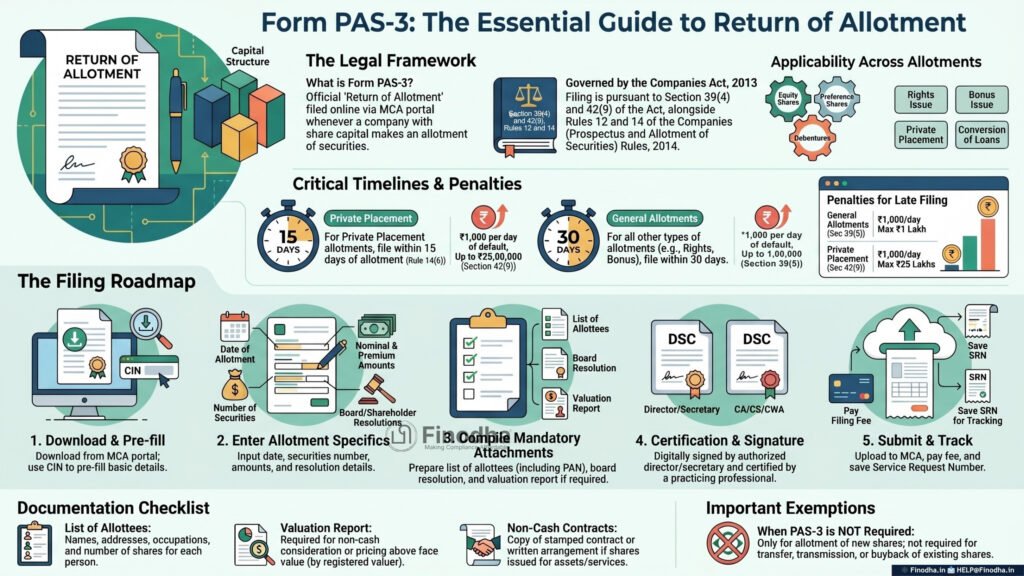
Quick Summary of PAS-3
- Purpose: Report allotment of shares
- Law: Section 39 & 42
- Due Date: 30 days / 15 days
- Filed With: ROC
- Mode: Online (MCA)
What is Form PAS-3?
As per the Companies Act, 2013 (Sections 39(4) and 42(9), along with Rule 12), filing this form is compulsory whenever a company with share capital makes any allotment of securities. When a company gives out new shares to investors, it cannot just stop there—it must inform the Registrar of Companies (ROC) about the allotment by filing Form PAS-3.
This form includes important details such as how many shares were allotted and who received them. It is filed online on the MCA portal and must be submitted within 30 days from the date of allotment.
In practical terms, PAS-3 is just a way to inform the ROC about share allotment. Through this form, the company maintains official records and reports its share allotment. It is important to remember that PAS-3 means “Return of Allotment.” It is not the name of private placement, but it is also used to report shares issued through private placement.
Filing PAS-3 is not just a procedural requirement—it is the legal recognition of share capital changes in MCA records. Without it, the allotment may be considered incomplete from a compliance standpoint.
Applicable Section & Rules of the Act
As per section 39(4) of the companies Act, 2013 says that Whenever a company issues or gives new shares to people, it must inform the Registrar of Companies (ROC) about it. It cannot keep this information private.
So, the company has to file a document called a “return of allotment” in the proper format (as prescribed by law).
As per section 42(9) of the companies Act, 2013 state that If a company doesn’t file the return of allotment on time, it has to pay a fine of ₹1,000 for each day it’s late. This fine applies to the company, promoters, and directors, but the total can’t go over ₹25 lakh.
Rule 12 of the Companies (Prospectus and Allotment of Securities) Rules, 2014.
This rule clearly mentions that Form PAS-3 is to be used here. Rule 12 lays down the process for filing this form. Let’s go through each sub-rule to understand it better.
Sub rule (1) mainly says that three basic things: Company must be file Form PAS-3 with the ROC when they issues new shares or securities, 2nd things is that must be filed this form within 30 days of allotment and 3rd is that pay the required filing fees along with the form.
Sub rule (2) says that along with the form, the company must attach a list of allottees-that is, everyone who received shares. This list should include each person’s name, address, occupation (if any), and the number of shares allotted. The person signing the form has to confirm that the list is complete and correct-no missing names, no mistakes.
Sub rule (3) says that Sometimes, the company doesn’t get money for the shares—it might get something else, like property, equipment, or services. In that case, the company must attach a copy of the contract explaining what it received. And if the deal wasn’t even written down, the company still has to give full details of the arrangement. These details are treated like a legal document under the Indian Stamp Act, and the ROC may ask the company to pay stamp duty on it.
Sub rule (4) says that If there is no written agreement, the company still needs to give full details of the deal.
These details are treated like a legal document under the Indian Stamp Act, and the ROC may ask the company to pay stamp duty on it.
Sub rule (5) says that to make sure everything is fair, the company also needs a valuation report. it shows the real value of what the company got in exchange for the shares.
Sub rule (7) says that in certain situations, when an unlisted company issues shares under Section 62(1)(c), a valuation report is also required. Until official values are fully appointed, the valuation can be done by either a SEBI-registered merchant banker or an experienced chartered accountant with at least 10 years of practice.
* Allot shares → file PAS-3 → attach allottee list → attach contract if non-cash → include valuation report → do it all within 30 days. Rule 14 of the Companies (Prospectus and Allotment of Securities) Rules, 2014]
Rule 14(6) applies specifically to private placement of securities. Therefore, the shorter time limit of 15 days for filing Form PAS-3 is applicable only in case of private placement, not for other types of allotment.
When Form PAS-3 is required to file?
- As per Section 39(4) of the Companies Act, 2013: Companies must file Form PAS‑3 to report any allotment of securities to the Registrar of Companies (ROC), except for allotments made through a SEBI-regulated public issue.
- As per Rule 14(6) of the Companies (Prospectus and Allotment of Securities) Rules, 2014: Companies making private placement allotments must file Form PAS‑3 within 15 days of the allotment.
Companies must file PAS‑3 for all allotments, including public issues, although in case of public issues, reporting requirements are also governed by SEBI regulations.
Documents Required
- List of Allottees: A complete list of all shareholders who got shares, including their names, addresses, PAN, and number of shares allotted, in the prescribed format.
- Board Resolution: Approval from the company’s board to allot the shares.
- Contract/Details for Non-Cash Allotment: If shares are issued in exchange for assets or services instead of cash, attach the agreement or details, properly stamped.
- Valuation Report: Needed when shares are issued above face value or for non-cash consideration, prepared by a registered valuer.
- Special Resolution: Shareholders’ approval, required in cases like bonus shares or preferential allotment.
Attachments
- List of allottees
- Board resolution
- Valuation report
- Contract (if non-cash)
- PAS-5 (private placement)
Step by Step Process to file Form PAS-3
For PAS-3 filing, the following step needs to be followed:-
1st. First, you need to download Form PAS‑3 from the MCA portal. PAS‑3 is the official form for filing the return of allotment.
2nd. Next, use the Pre-fill option to enter your company's CIN (Corporate Identification Number). The system will automatically fetch all company details like name, registered office, and existing capital structure. This helps reduce errors and saves time.
3rd. Then, fill in the remaining details. Provide all additional information about the share allotment, including the type and number of shares allotted, amount paid by shareholders, bonus shares if any, and the capital structure after allotment.
4th. Attach supporting documents, which may include: list of allottees, board resolution approving the allotment, valuation report (if applicable), contracts for non-cash allotments, special resolution for bonus shares (if applicable), and Form PAS‑5 records for private placements. Form PAS‑5 (record of private placement) must be maintained and attached in PAS‑3 filing.
5th. The next step is to sign the form using the Digital Signature Certificate (DSC) of an authorized person, usually a director or company secretary.
6th. Before submission, review the form carefully for any mistakes. Then submit the form and pay the required filing fee.
7th. After submission, keep the SRN (Service Request Number) safely. You will receive this number once the form is successfully submitted on the MCA portal, and it is required for future tracking or follow-up. After filing PAS‑3, ROC updates the company’s capital structure in MCA master data.
*Double-check all details and attachments before submission to avoid rejections.
What Information Required in PAS-3 Filing Form?
While filing Form PAS-3, you need to fill the below-mentioned information:
• Names, addresses, and other key details of those who have been allotted securities.
• Date of Allotment
• Corporate Identification Number (CIN)
• Share certificates issued and distinctive numbers
• Number and price of shares allotted by the company
• Nature of allotment, such as, preference shares or equity shares void of differential rights or equity shares with differential rights or debentures
• Details regarding the allotment
• SRN of Form No. MGT-14
• Details regarding consideration
• Bonus shares’ details
• Private placement details
• Capital structure of the company after considering allotment
• Company’s debt structure after considering allotment
• Premium collected during the allotment
• Board resolution details for allotment
Format of Form PAS-3
Deadline and Penalties
See the flow chart:
| Section | Applicability | Penalty (Company & Officers) | Maximum Limit |
| Section 39(5) | General allotments of shares | ₹1,000 per day of default | Up to ₹1,00,000 (1 Lakh)(Whichever is less) |
| Section 42(9) | Private placement of securities | ₹1,000 per day of default | Up to ₹25,00,000 (25 Lakh) |
*In both cases, the penalty applies to the company as well as every officer in default. However, the maximum penalty differs significantly ₹1 lakh under Section 39 and ₹25 lakh under Section 42.
Time limit
The 15-days timeline is applicable only to private placement under Rule 14(6), while all other allotments follow the 30-day timeline under Section 39(4) read with Rule 12.
Need help related to filing Form MGT-14: Drop your queries at Finodha.in
Pas-3 not required in
Form PAS-3 is NOT required in the following cases:
- Transfer of shares (covered under SH-4)
- Transmission of shares (death/insolvency)
- Buyback of shares (separate compliance)
Conclusion
Filing PAS-3 is not just a procedural requirement—it is the legal recognition of share capital changes in MCA records. Without it, the allotment may be considered incomplete from a compliance standpoint.
In this article, we have explained the key aspects of Form PAS-3 in a simple and practical manner to help companies and professionals stay compliant. If we missed anything, you can send your questions or suggestions to our email ID: help@finodha.in. we will try to improve this article and make it more helpful for everyone. Hope this article is helpful and beneficial for everyone.
Disclaimer: The information in this article is for general purposes only and may not fit your personal situation. It is not legal, financial, or professional advice, and you should not rely on it as such. Before making any decisions, consider if this information applies to you and, if needed, get advice from a professional. The information is correct at the time of publication. While we have tried to ensure it is accurate, Finodha.in is not responsible for any loss or damage caused by using this information.
At Finodha.in, We serve a number of clients who need assistance/guide for various regulatory compliances including setting up business in India, company formation in India, income tax return filling, bookkeeping, accounting, GST and auditing. If you require any guidance for any professional service, we are here to serve you! You can also book a free consultation with us!
Join with us today!
We shall be happy to assist you, and in case you require our services, please feel free to contact us at the below mentioned email details: – help@finodha.in.
click here: for GST and ITR filing!
Frequently Asked Question!
Q. What is the difference between Authorized and Paid-up capital?
A. The key difference between authorized and paid-up capital is that authorized capital represents the maximum share capital a company is allowed to issue as per its Memorandum of Association, whereas paid-up capital represents the actual amount of capital received from shareholders for the shares allotted. Authorized capital is the potential, and paid-up capital is what has actually been received.
Q. Can Shares be issued without receiving payment?
A. No, shares cannot be issued without payment, except in special cases allowed by the Companies Act.
Q. What is private Placement of shares?
A. Private placement is a method by which a company raises capital by issuing shares or debentures to a select group of people or entities, rather than offering them to the public at large. It is different from a public issue, where shares are available to anyone who wants to buy.
Q. What is a rights issue?
A. A rights issue is when a company offers new shares to its existing shareholders first, in proportion to the shares they already hold.
Example: [If you own 100 shares and the company announces a 1:2 rights issue, you can buy 50 more shares (1 new share for every 2 you hold)].
Q. Is valuation report required for all shares issues?
A. You need a valuation report only when shares are issued at a price higher than their face value or in exchange for assets/services; it’s not needed for bonus shares or rights issues at face value.
Q. What is bonus share issue?
A. Bonus shares are free extra shares given to existing shareholders from the company’s profits or reserves, as a way to reward them without paying cash.
Example: If you own 100 shares and the company announces a 1:2 bonus issue, you will get 50 additional shares for free, and your total holding becomes 150 shares.
Q. What if Authorized capital is insufficient for share issue?
A. If authorized capital is too low, the company must first increase it by a special resolution before issuing new shares.
Q. When should share certificates be issued?
A. As per Section 46 of the Companies Act, 2013: Share certificates must be given to shareholders within 2 months of allotment or transfer, as proof of their ownership.
Q. Can shares be issued to NRIs and Foreigner?
A. Yes, a company can issue shares to NRIs and foreigners, but it must follow FDI/FEMA rules and get approvals if needed.
Q. What is the deadline to file PAS-3 after share allotment?
A. Form PAS‑3 must be filed within 15 days for private placements and within 30 days for other types of share allotments.
Q. How soon should share certificate be issued after allotment?
A. As per Section 46 of the Companies Act, 2013, Share certificates must be issued to shareholders within 2 months from the date of allotment.
Q. Is stamp duty the same in all states?
A. No, stamp duty is not the same in all states in India.
Q. What is PAS-3 full form?
A. Basically PAS-3 stands for "Return of Allotment".
Q. When to file PAS-3 Form?
A. A company must file Form PAS-3 within 15 days of allotment in case of private placement, and within 30 days for other allotments.
Q. What is the purpose of the PAS-3 form?
A. the main purpose of PAS-3 form is that to inform the Registrar of Companies (RoC) about the allotment of shares, ensuring transparency and compliance.
Q. Is PAS-3 required for share transfer?
A. No, PAS‑3 is only used for the allotment of new shares, not for transfer of existing ones.
Q. Is PAS-3 required for bonus issue?
A. Yes, Form PAS‑3 must be filed even for bonus issues, since it involves allotment of shares.
Q. What is the difference between PAS-3 and PAS 4?
A. One key difference is that PAS‑3 is used to file the return of allotment of shares, whereas PAS‑4 is used for the Private Placement Offer Letter (issued to select investors before allotment).
Q. How many days pas-3 should be filed within?
A. In the case of a private placement, PAS‑3 must be filed within 15 days of allotment. In other cases, such as a general allotment of shares, it must be filed within 30 days of allotment.
Q. How to fill Form PAS-3?
A. While filing Form PAS‑3, you need to provide details of the allotment, number of shares, consideration received, particulars of the allottees, and the board resolution approving the allotment.
Q. Who is required to file PAS-3?
A. The company making the allotment of shares must file Form PAS‑3 with the Registrar of Companies (RoC).
Q. What is the penalty for late filing of pas-3?
A. If PAS-3 is filed late, the company and its officers in default (like directors) have to pay a penalty of ₹1,000 per day. The maximum penalty is ₹1 lakh in normal cases, but it can go up to ₹25 lakh in case of private placement.
Q. Is PAS-3 filed for a rights issue?
A. Yes, PAS‑3 must be filed for a rights issue, since it involves the allotment of new shares.
Q. What documents are required for right issue?
A. The following documents are required for a rights issue of shares:
-Board resolution approving the issue
-Letter of offer to shareholders
-Application forms from shareholders
-Return of allotment (Form PAS‑3) filed with the RoC.
Q. Is PAS-3 mandatory?
A. Yes, as per Section 39(4) and Section 42(9) of the Companies Act, 2013, filing Form PAS‑3 is mandatory for every allotment of shares.
Q. Do we have to apply for a rights issue?
A. No, it’s optional. Shareholders can choose to subscribe, renounce, or ignore the rights issue. The company only provides the option.
—
Finodha
Making Compliance Affordable
Video Explanation
We’re Available:
If you need clarity on your specific compliance requirement, you can explore our detailed service pages or connect with our team:
📞 +91-8512022044
📩 help@finodha.in
We'll handle the paperwork while you focus on building your business; If you have any questions to ask; contact us now.
Read more interesting articles:


