Important Keywords: How Income Tax Works in India, income tax process india, how itr works india, tax calculation process india, income tax steps india, itr filing process india.
Words: 2,380, Read time: 13 minutes.
(Last Updated: March 2026, Regulatory Context Verified: March 2026)
Table of Contents
Introduction: How Income Tax Works in India
Many individuals understand what income tax is and why it exists, but confusion usually begins when trying to understand how the system actually works in real life.
You might have noticed that most people only try to understand income tax during filing season. At that point, income, deductions, documents, and calculations all come together, making the system feel complicated.
In reality, income tax follows a structured flow.
Once this flow is understood, processes like income tax return filing online and the overall income tax return filing process become much easier to manage.
Understanding this flow also helps when navigating topics like
income tax return filing online, how to file income tax return, and choosing the right income tax filing services based on your situation.
For example, a freelancer managing multiple clients or a small business owner tracking expenses throughout the year may find this process much easier once the system is understood clearly.
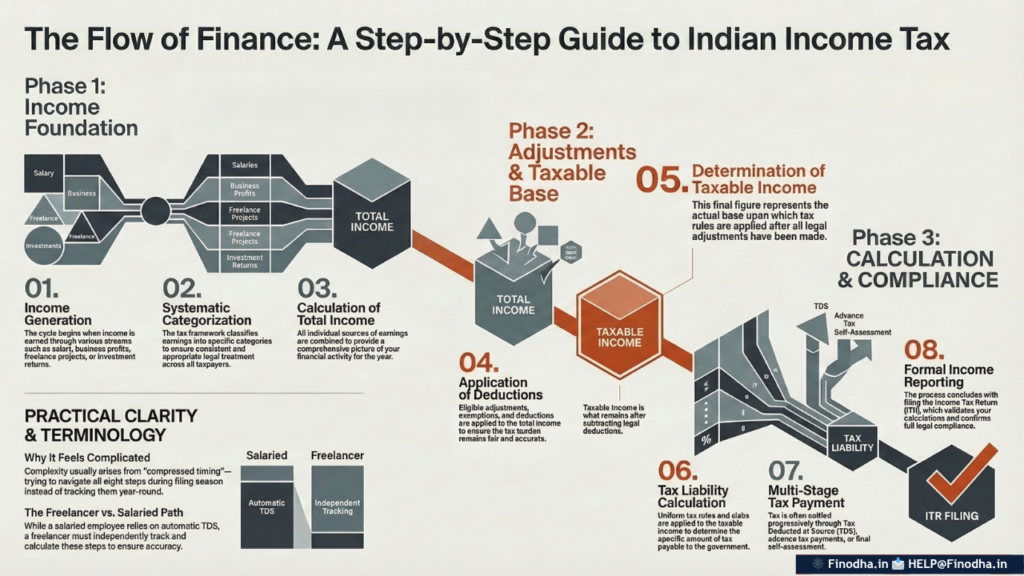
What Does “How Income Tax Works” Mean?
Understanding how income tax works means understanding the journey of income through the system — from earning to reporting.
In simple terms, the system ensures:
• income is captured correctly
• income is categorized properly
• adjustments are applied fairly
• tax is calculated consistently
• reporting is completed accurately
This structured approach maintains transparency across the system.
This step-by-step structure ensures that the system remains predictable, scalable, and consistent across millions of taxpayers.
Click here: for registration of LLP and OPC!
Quick Explanation
Income tax works as a step-by-step process where income is earned, categorized, adjusted through deductions, taxed based on applicable rules, and finally reported through an Income Tax Return.
Direct Answer
In India, income tax works through a structured system where income earned during a financial year is categorized, adjusted, taxed, and reported through an Income Tax Return, ensuring consistent compliance.
At-a-Glance Summary
| Topic | Quick Insight |
|---|---|
| What it means | Step-by-step income taxation system |
| Who it applies to | Individuals, freelancers, businesses |
| Why it exists | To ensure structured income reporting |
| When it applies | During financial year and filing |
| Why confusion happens | Multiple steps handled together |
How the Income Tax System Works in Practice
Step 1 — Income Is Earned
Income is generated through salary, business, freelance work, or investments.
You might have noticed that individuals often earn from multiple sources. The system captures all sources to ensure complete reporting.
Step 2 — Income Is Categorized
The tax framework classifies income into categories to ensure appropriate treatment.
This avoids confusion and maintains consistency across taxpayers.
Step 3 — Total Income Is Calculated
All sources are combined to determine total income.
This provides a clear picture of financial activity during the year.
You might have noticed that when income sources are scattered or not tracked properly during the year, this step becomes the first point where confusion begins.
Step 4 — Deductions and Adjustments Are Applied
Certain provisions allow reduction in taxable income based on eligibility.
This ensures fairness and accuracy in tax computation.
This is also where concepts like deductions and exemptions become important, as they directly affect how much income is considered taxable.
Step 5 — Taxable Income Is Determined
After adjustments, the remaining income becomes taxable.
This forms the base for calculating tax.
Step 6 — Tax Liability Is Calculated
Applicable rules are applied to determine tax payable.
This step ensures uniform treatment across similar income levels.
At this stage, understanding how tax is calculated becomes easier when you are familiar with the overall income tax calculation process in India.
Step 7 — Tax Is Paid
Tax may be paid through:
• tax deducted during the year
• advance tax payments
• self-assessment
Step 8 — Income Is Reported
Income is reported through the income tax return filing process, often completed using income tax return filing online platforms.
You might have noticed that once this final step is completed, the entire system connects logically.
This step confirms income, validates tax calculation, and completes compliance.
Practical Insight
You might have noticed that the system does not operate in isolation. Each step connects to the next.
Once income is tracked properly during the year, the final reporting becomes much easier.
This is why understanding the process early reduces last-minute confusion.
Income Tax Process Flow (Simplified)
| Stage | What Happens | Why It Matters |
|---|---|---|
| Income Earned | Salary, business, freelance | Forms base of taxation |
| Categorization | Income classified | Ensures correct treatment |
| Adjustments | Deductions applied | Reduces taxable portion |
| Tax Calculation | Tax determined | Creates final liability |
| Payment & Filing | ITR filed | Completes compliance |
Compliance Timeline
| Step | Activity |
|---|---|
| 1 | Income earned |
| 2 | Categorized |
| 3 | Adjusted |
| 4 | Tax calculated |
| 5 | Return filed |
Terminology Clarity
| Term | Meaning |
|---|---|
| Total Income | Combined income from all sources |
| Taxable Income | Income after deductions |
| Deduction | Reduction in taxable income |
| ITR | Income Tax Return |
| Tax Liability | Tax payable |
Government Framework / Regulatory Context
This system operates within the framework of the Income Tax Act in India.
The Income Tax Department ensures structured reporting, consistent tax calculation, and compliance monitoring.
This framework ensures that income is taxed in a predictable and transparent manner.
Real-Life Examples
Salaried Individual
A salaried employee may have tax deducted during the year. Final reporting happens through income tax return filing online, confirming total income and tax.
Freelancer
A freelancer calculates income independently and reports it through income tax return filing for freelancers, ensuring accurate declaration of earnings.
Small Business Owner
A business owner calculates profit after expenses and reports income accordingly, completing the process through structured filing.
When This System Works Well
The system works effectively when:
• income records are maintained
• compliance is timely
• understanding of steps is clear
When This System May Feel Difficult
The system may feel complex when:
• multiple income sources exist
• documentation is incomplete
• everything is done at the last moment
Common Misconception
Many people assume income tax is complicated by design.
In reality, complexity often arises from trying to understand the entire process at once instead of step by step.
Common Mistakes People Make
• ignoring record keeping
• misunderstanding income classification
• delaying filing
Decision Clarity
Understanding how income tax works helps individuals:
• reduce confusion
• plan finances better
• handle compliance confidently
It also makes it easier to approach income tax return filing online, understand ITR filing requirements, and choose suitable income tax filing services.
Once this flow becomes familiar, most compliance-related decisions become easier to understand and execute.
Seedhi si baat:
Income tax sirf ek baar ka kaam nahi hai jo filing ke time hota hai. Yeh poore saal chalne wala process hai.
Aap pehle income earn karte ho — salary, business ya freelance se. Phir system us income ko categorize karta hai, sabko jodta hai aur deductions apply karke taxable income nikalta hai.
Uske baad tax calculate hota hai aur last mein return file hota hai — jo sirf ek reporting step hai.
Problem system mein nahi hai.
Problem yeh hai ki log poora process ek hi baar mein samajhne ki koshish karte hain.
Agar step-by-step dekhenge, toh income tax actually simple lagta hai.
People Also Ask
• How does income tax work step by step?
• When is tax calculated?
• Do freelancers follow the same process?
• How is income reported?
Frequently Asked Questions (FAQs)
Question 1. How does income tax work in India?
Answer. Income tax in India works through a structured process where income is earned, categorized, adjusted using deductions or exemptions, taxed based on applicable rules, and reported through an Income Tax Return. This step-by-step system ensures that tax is calculated consistently and that individuals and businesses remain compliant with the tax framework.
Question 2. What is the first step in the income tax process?
Answer. The first step in the income tax process is earning income. This income may come from salary, business activities, freelance work, or investments. Once income is earned, it becomes the starting point for classification, calculation, and reporting within the income tax system.
Question 3. Why is income categorized in the tax system?
Answer. Income is categorized to ensure that different types of earnings are treated appropriately under tax rules. This classification helps maintain consistency, avoids confusion during reporting, and ensures that each type of income is calculated and taxed in a structured manner.
Question 4. What is total income in income tax?
Answer. Total income refers to the combined earnings from all sources before any deductions or exemptions are applied. It provides a complete view of an individual’s or business’s financial activity during the financial year and serves as the base for further tax calculations.
Question 5. What are deductions in income tax?
Answer. Deductions are provisions that allow certain amounts to be reduced from total income before calculating tax. These are based on eligibility and defined conditions within the tax framework. Deductions help ensure that tax is calculated only on the relevant portion of income.
Question 6. What is taxable income?
Answer. Taxable income is the portion of total income that remains after applying deductions and exemptions. This is the amount on which tax is calculated using the applicable rules under the income tax system. It represents the final base for determining tax liability.
Question 7. How is tax liability determined?
Answer. Tax liability is determined by applying applicable tax rules to the taxable income. The system ensures that individuals with similar income levels are treated consistently, and the final tax payable is calculated based on structured guidelines.
Question 8. When is income tax paid?
Answer. Income tax may be paid at different stages during the year. It can be deducted at the time of earning income, paid periodically as advance tax, or settled during the filing of the Income Tax Return if any balance tax remains.
Question 9. What is the role of Income Tax Return (ITR)?
Answer. The Income Tax Return is a formal document used to report income, deductions, and tax liability to the tax authority. It helps confirm that income has been declared correctly and allows the system to process and verify financial information.
Question 10. Why is filing an ITR important?
Answer. Filing an ITR ensures that income is properly reported and compliance requirements are fulfilled. It also helps maintain financial records and may be required for various financial activities such as applying for loans or verifying income history.
Question 11. Do freelancers follow the same income tax process?
Answer. Yes, freelancers follow the same overall income tax process. However, they usually calculate their income independently rather than relying on automatic deductions. They are responsible for tracking income, calculating tax, and filing returns accordingly.
Question 12. How do small businesses report income?
Answer. Small businesses report income by calculating total revenue and subtracting business-related expenses to determine profit. This profit is then considered for tax purposes and reported through the Income Tax Return process.
Question 13. What is advance tax in the income tax system?
Answer. Advance tax refers to paying tax in parts during the financial year instead of paying the entire amount at the end. It helps distribute the tax burden and ensures that tax payments are made progressively rather than in a single payment.
Question 14. What is Tax Deducted at Source (TDS)?
Answer. Tax Deducted at Source is a mechanism where tax is deducted at the time income is paid, such as salary or professional payments. The deducted tax is deposited with the government on behalf of the taxpayer.
Question 15. What happens after filing an Income Tax Return?
Answer. After filing an Income Tax Return, the tax authority processes the submitted information, verifies income details, and confirms whether the calculations are correct. This step completes the compliance cycle for that financial year.
Question 16. Why is record keeping important in income tax?
Answer. Maintaining proper financial records helps ensure accurate reporting of income and deductions. It reduces the chances of errors and makes the filing process smoother. Good record keeping also helps in case any clarification is required later.
Question 17. Can multiple income sources be reported together?
Answer. Yes, income from multiple sources can be combined and reported in a single Income Tax Return. The system is designed to capture all types of income and calculate total income before applying deductions and tax rules.
Question 18. Why does income tax feel complicated to many people?
Answer. Income tax often feels complicated because individuals usually engage with it only during filing season. At that time, multiple concepts like deductions, calculations, and documentation appear together, which can feel overwhelming without prior understanding.
Question 19. Is income tax calculated automatically?
Answer. In many cases, parts of the tax may be calculated automatically, especially when tax is deducted at source. However, individuals still need to review, confirm, and report their income correctly while filing their Income Tax Return.
Question 20. What is self-assessment tax?
Answer. Self-assessment tax is the amount paid by the taxpayer after calculating total tax liability and adjusting for any tax already paid. It ensures that the final tax obligation is cleared before completing the filing process.
Question 21. Why is income tax structured step by step?
Answer. The income tax system is structured step by step to ensure clarity, consistency, and accuracy. Each stage builds on the previous one, making the process organized and easier to verify for both taxpayers and authorities.
Question 22. What happens if income is not reported correctly?
Answer. If income is not reported correctly, it may lead to discrepancies during processing. This could require clarification or correction, which is why accurate reporting and proper record keeping are important.
Question 23. Can understanding the system reduce tax confusion?
Answer. Yes, understanding the step-by-step flow of income tax significantly reduces confusion. When individuals know how income moves through the system, compliance becomes easier and more predictable.
Question 24. Why is consistency important in taxation?
Answer. Consistency ensures that similar income levels are treated in a similar manner. This helps maintain fairness across taxpayers and ensures that the system remains predictable and structured.
Question 25. What is the final step in the income tax process?
Answer. The final step is filing the Income Tax Return, where income details, tax calculations, and payments are reported. This step completes the compliance cycle and confirms that all requirements have been fulfilled.
Related Compliance Topics
https://finodha.in/income-tax-return-filing-online/
https://finodha.in/gst-registration/
https://finodha.in/gst-return-filing/
https://finodha.in/private-limited-company/
https://finodha.in/trademark-registration/
Concept Summary
Income tax works as a structured system where income flows through stages of earning, adjustment, calculation, and reporting.
In practice, most confusion around income tax does not come from the system itself, but from trying to understand everything at once instead of step by step.
Conclusion
Once the process is understood step by step, income tax becomes easier to manage and less confusing.
This structured approach ensures that the income tax system remains consistent and manageable across different types of taxpayers.
—
Finodha
Making Compliance Affordable
Video Explanation
We’re Available:
If you need clarity on your specific compliance requirement, you can explore our detailed service pages or connect with our team:
📞 +91-8512022044
📩 help@finodha.in
We'll handle the paperwork while you focus on building your business; If you have any questions to ask; contact us now.
Read more interesting articles: