Important Keywords: Income Tax Examples India, income tax examples india, real life tax examples india, itr examples india, tax calculation example india, income tax practical cases india
Words: 2,078, Read time: 11 minutes.
(Last Updated: March 2026, Regulatory Context Verified: March 2026)
Table of Contents
Introduction: Income Tax Examples India
Understanding income tax in theory is one thing.
Understanding it in real life is where clarity actually develops.
You might have noticed that many people read about income tax concepts — like deductions, taxable income, or filing — but still feel unsure when applying them to their own situation.
This usually happens because income tax is often explained in abstract terms.
In reality, most clarity comes from seeing how the system works in practical, everyday situations.
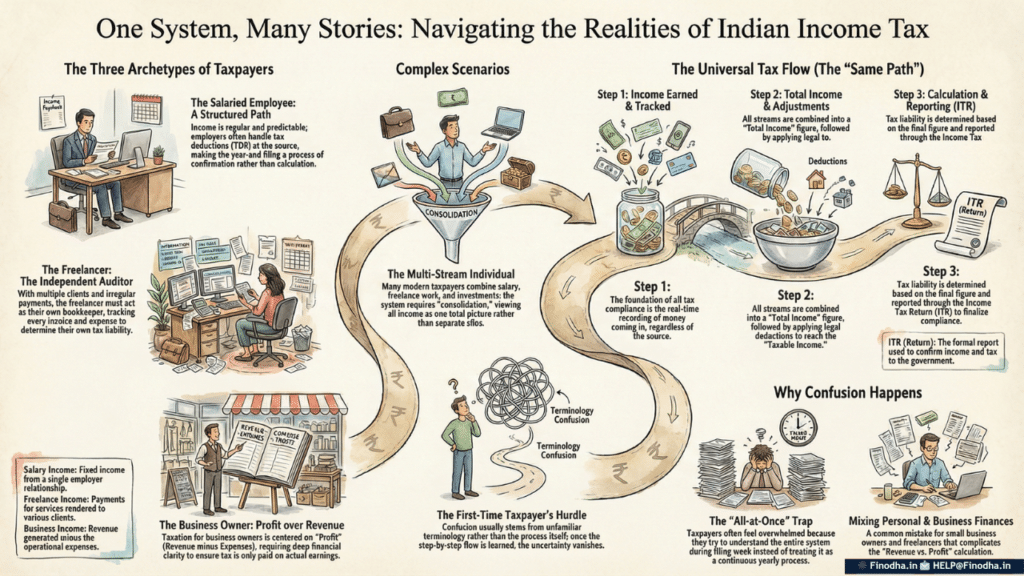
For example, a salaried employee, a freelancer, and a small business owner all interact with the same income tax system — but their experience looks different.
Understanding these differences helps make income tax more relatable and easier to manage.
What Do Real-Life Examples Mean in Income Tax?
Real-life examples help translate the income tax system into practical situations.
Instead of focusing only on rules, examples show:
• how income is earned
• how it is calculated
• how tax is applied
• how reporting happens
This makes it easier to connect concepts with actual scenarios.
Click here: for registration of LLP and OPC!
Quick Explanation
Real-life examples in income tax show how different individuals — such as salaried employees, freelancers, and business owners — earn income, calculate taxable income, and report it through the system.
Direct Answer
In India, income tax works the same in structure for everyone, but real-life examples differ based on how income is earned, managed, and reported.
At-a-Glance Summary
| Topic | Quick Insight |
|---|---|
| What it means | Practical application of income tax |
| Who it applies to | Individuals, freelancers, businesses |
| Why it matters | Helps understand real scenarios |
| When used | During income calculation & filing |
| Why confusion happens | Concepts not linked to real life |
Real-Life Examples of Income Tax in Practice
Example 1 — Salaried Individual
A salaried employee earns income from an employer.
During the year:
• salary is paid monthly
• tax may be deducted at source
• income is recorded systematically
At the end of the year:
• total income is calculated
• any additional income is added
• return is filed to confirm details
You might have noticed that salaried individuals often find tax easier to manage because much of the process is already structured.
Example 2 — Freelancer
A freelancer earns income from multiple clients.
In this case:
• income may not be deducted automatically
• earnings come at different times
• records must be maintained independently
At the end of the year:
• total income is calculated
• tax is determined
• return is filed
You might have noticed that freelancers face more confusion because they manage both income tracking and tax calculation themselves.
Example 3 — Small Business Owner
A business owner earns income through business activities.
Here:
• revenue is generated from customers
• expenses are incurred for operations
• profit is calculated
At the end of the year:
• profit becomes the basis for tax
• income is reported through filing
This example shows how income tax interacts with business operations.
Example 4 — Individual with Multiple Income Sources
An individual may earn from:
• salary
• investments
• freelance work
In such cases:
• all income sources are combined
• total income is calculated
• tax is determined
You might have noticed that multiple income sources often create confusion during reporting.
Example 5 — First-Time Taxpayer
Someone filing income tax for the first time may experience:
• unfamiliar terminology
• uncertainty about process
• confusion about documentation
However, once the system is understood step by step, the process becomes clearer.
Practical Insight
You might have noticed that income tax does not change fundamentally across cases.
What changes is:
• how income is earned
• how it is tracked
• how it is managed
The structure remains the same.
Compliance Timeline (Example-Based)
| Step | Activity |
|---|---|
| 1 | Income earned |
| 2 | Income tracked |
| 3 | Total calculated |
| 4 | Adjustments applied |
| 5 | Return filed |
Terminology Clarity
| Term | Meaning |
|---|---|
| Salary Income | Income from employment |
| Business Income | Income from business activity |
| Freelance Income | Income from services |
| Total Income | Combined income |
| ITR | Income Tax Return |
Government Framework / Regulatory Context
This system operates within the framework of the Income Tax Act in India, which defines how different types of income are classified, calculated, and reported.
When These Examples Help Most
• when learning income tax basics
• when filing returns for the first time
• when dealing with multiple income sources
When Confusion Still Happens
• lack of record keeping
• mixing personal and business income
• understanding everything at once
Common Misconception
Many people believe that income tax works differently for different people.
In reality, the structure is the same — only situations vary.
Common Mistakes People Make
• ignoring income tracking
• misunderstanding income sources
• delaying compliance
Decision Clarity
Understanding real-life examples helps individuals:
• relate concepts to their situation
• reduce confusion
• improve compliance
It also makes processes like income tax return filing online and choosing income tax filing services easier.
Seedhi si baat samajhiye:
Income tax har kisi ke liye same system follow karta hai — bas situation change hoti hai.
Salaried logon ke liye system thoda automatic hota hai, freelancers ko khud income track karni padti hai, aur business owners ko profit calculate karna padta hai.
Lekin end mein sabka process same hota hai — income jodi jaati hai, adjustments apply hote hain, tax calculate hota hai aur return file hota hai.
Confusion tab hoti hai jab hum apni situation ko system se connect nahi kar paate.
Jab real-life examples se samajhte hain, toh income tax kaafi clear lagta hai.
People Also Ask
• How does income tax apply in real life?
• Are freelancers taxed differently?
• Do salaried employees have simpler tax?
• What if multiple income sources exist?
Frequently Asked Questions
Question 1. What are real-life examples in income tax?
Answer. Real-life examples in income tax show how the tax system applies to actual situations like salaried employees, freelancers, or business owners. Instead of only explaining rules, these examples demonstrate how income is earned, calculated, adjusted, and reported, helping individuals understand how the system works in practical terms.
Question 2. Why are real-life examples important for understanding income tax?
Answer. Real-life examples make income tax easier to understand by connecting concepts to everyday situations. Many taxpayers struggle with theory, but when they see how income, deductions, and tax calculations work in real scenarios, the system becomes clearer and easier to apply.
Question 3. How does income tax apply to a salaried employee?
Answer. A salaried employee earns income through monthly salary payments. Tax may be deducted during the year, and at the end of the financial year, total income is calculated and reported through an Income Tax Return. The process is relatively structured compared to other types of taxpayers.
Question 4. How do freelancers handle income tax in real life?
Answer. Freelancers earn income from multiple clients and must track their earnings independently. Since tax is not always deducted automatically, they calculate total income, determine tax liability, and report it through the Income Tax Return process. This requires consistent record keeping throughout the year.
Question 5. How is income tax calculated for small business owners?
Answer. Small business owners calculate income by subtracting business expenses from total revenue. The resulting profit becomes the basis for taxation. This income is then reported through the income tax system, following the same structured process of calculation and reporting.
Question 6. What happens if someone has multiple income sources?
Answer. When an individual earns from multiple sources such as salary, freelance work, and investments, all income is combined to calculate total income. The system considers the overall financial picture before applying deductions and calculating tax liability.
Question 7. Is the income tax system different for different people?
Answer. The structure of the income tax system remains the same for everyone. However, the way individuals interact with the system varies based on how they earn income, such as salary, freelance work, or business operations.
Question 8. Why do freelancers find income tax more confusing?
Answer. Freelancers often find income tax more confusing because they must manage both income tracking and tax calculation themselves. Unlike salaried employees, there is no automatic system handling deductions, which increases the need for proper record keeping and understanding.
Question 9. How does income tax work for first-time taxpayers?
Answer. First-time taxpayers usually experience confusion due to unfamiliar terminology and processes. However, once they understand the step-by-step flow of earning, calculating, and reporting income, the system becomes easier to manage.
Question 10. What is the role of Income Tax Return in real life?
Answer. The Income Tax Return is used to report income, deductions, and tax liability. It acts as a final step in the process, confirming that income has been declared correctly and compliance requirements have been fulfilled.
Question 11. Why is income tracking important in real-life tax situations?
Answer. Tracking income helps ensure that all earnings are recorded accurately. Without proper tracking, individuals may face confusion during tax calculation and filing, especially when dealing with multiple income sources.
Question 12. What are common mistakes people make in real-life income tax situations?
Answer. Common mistakes include not tracking income regularly, misunderstanding income sources, mixing personal and business expenses, and delaying tax-related tasks until filing time. These issues often lead to confusion and errors.
Question 13. How do deductions affect real-life income tax calculation?
Answer. Deductions reduce the portion of total income that is considered taxable. In real-life scenarios, they help ensure that tax is calculated on a fair and relevant portion of income rather than the entire earnings.
Question 14. Why does income tax feel different for salaried and freelance individuals?
Answer. Income tax feels different because salaried individuals often have structured systems like automatic deductions, while freelancers manage everything independently. However, the underlying tax structure remains the same.
Question 15. What happens at the end of the financial year in real-life tax scenarios?
Answer. At the end of the financial year, total income is calculated, adjustments are applied, and tax liability is determined. This information is then reported through the Income Tax Return.
Question 16. Can understanding real-life examples reduce tax confusion?
Answer. Yes, real-life examples help simplify income tax by showing how concepts apply in practical situations. This reduces confusion and helps individuals understand the system more clearly.
Question 17. How does income tax apply to individuals with side income?
Answer. Individuals with side income must include those earnings along with their primary income when calculating total income. The combined amount is then used to determine tax liability and reporting requirements.
Question 18. Why is record keeping important for freelancers and businesses?
Answer. Record keeping helps maintain accurate financial information. It ensures that income and expenses are correctly tracked, making tax calculation and filing more efficient and reducing the chances of errors.
Question 19. How do business expenses affect taxable income?
Answer. Business expenses are deducted from total revenue to determine profit. This profit becomes the taxable income, ensuring that tax is applied only to actual earnings rather than total receipts.
Question 20. What is the biggest challenge in real-life income tax situations?
Answer. The biggest challenge is usually understanding how different parts of the system connect. When individuals try to understand everything at once, it creates confusion. Breaking the process into steps helps overcome this issue.
Question 21. Why do people delay income tax compliance?
Answer. Many people delay compliance because they view it as a complex or last-minute task. This often results in rushed decisions and confusion during filing.
Question 22. How does the income tax system remain consistent across cases?
Answer. The system follows the same structure for all taxpayers. The only difference lies in how income is earned and managed. This consistency ensures fairness and predictability.
Question 23. What is the best way to understand income tax in real life?
Answer. The best way is to understand the system step by step and relate it to real-life situations. This approach makes it easier to connect concepts with actual financial activities.
Question 24. Does income tax change based on profession?
Answer. Income tax rules do not fundamentally change based on profession. However, the method of earning and reporting income may differ, which affects how individuals interact with the system.
Question 25. What is the key takeaway from real-life income tax examples?
Answer. The key takeaway is that while situations may differ, the underlying structure of income tax remains the same. Understanding this structure through real-life examples makes compliance easier and more manageable.
Related Compliance Topics
Learn more about:
• Income Tax Return Filing → https://finodha.in/income-tax-return-filing-online/
• GST Registration → https://finodha.in/gst-registration/
• GST Return Filing → https://finodha.in/gst-return-filing/
• Private Limited Company → https://finodha.in/private-limited-company/
• Trademark Registration → https://finodha.in/trademark-registration/
Concept Summary
Real-life examples help connect income tax concepts with actual situations, making the system easier to understand.
Conclusion
Income tax becomes easier when seen through real-life scenarios rather than abstract rules.
—
Finodha
Making Compliance Affordable
Video Explanation
We’re Available:
If you need clarity on your specific compliance requirement, you can explore our detailed service pages or connect with our team:
📞 +91-8512022044
📩 help@finodha.in
We'll handle the paperwork while you focus on building your business; If you have any questions to ask; contact us now.
Read more interesting articles: