


Important Keywords: Form MBP-1, Section 184 Companies Act 2013, Director’s Interest, Penalty for non-compliance, DIR-8, MBP-2, Disclosure of Interest, ROC filing, Board meeting compliance, Company registration India.
Words: 2,292, Read time12 minutes.
Overview
This article will help you to understand the Form MBP-1 under the Companies Act, 2013.
According to Section 184(1), every director must declare if they have any interest in another company, firm, or business. They must submit this at the first Board meeting and again whenever their interest changes.
What is Form MBP-1?
As per Section 184(1) of the Companies Act, 2013, MBP-1 is a form where a director tells the company about their interests in other businesses. It helps the company avoid conflicts of interest. Directors must submit it at their first board meeting and update it if their interests change.
Follow the steps to complete the FORM MBP-1 effectively.
Click the ‘Get Form’ button to open it in the designated editor.
Fill in your full name, including relationship descriptors (son/daughter/spouse).
Provide your residential address accurately.
Mention your position in the company (Director, MD, etc.).
List the companies, firms, or associations in which you have an interest.
For each entity, include:
- Serial number
- Name of the company
- Nature of interest
- Shareholding details
- Date when interest arose or changed
Review all details for accuracy.
Save, download, or share the completed form for submission or record-keeping.
Need help: Drop your queries at Finodha.in
Format of form MBP-1
Form MBP-1
Notice of interest by director
[Pursuant to section 184(1) and rule 9(1)]
To
The Board of Directors
………………..Limited
Dear Sir(s)
I, ………….., son/daughter/spouse of ……………., resident of ………….., being a director in the company hereby give notice of my interest or concern in the following company or companies, bodies corporate, firms or other association of individuals:-
| S NO. | Names of the Companies/bodies corporate/firms/ Association of Individuals |
Nature of interest or concern/Change in interest or concern | Shareholding | Date on which interest or concern arose / changed |
Signature:
MD/Director/Secretary/Whole time Director
Place:
Date:
The original format of the Form MBP-1.
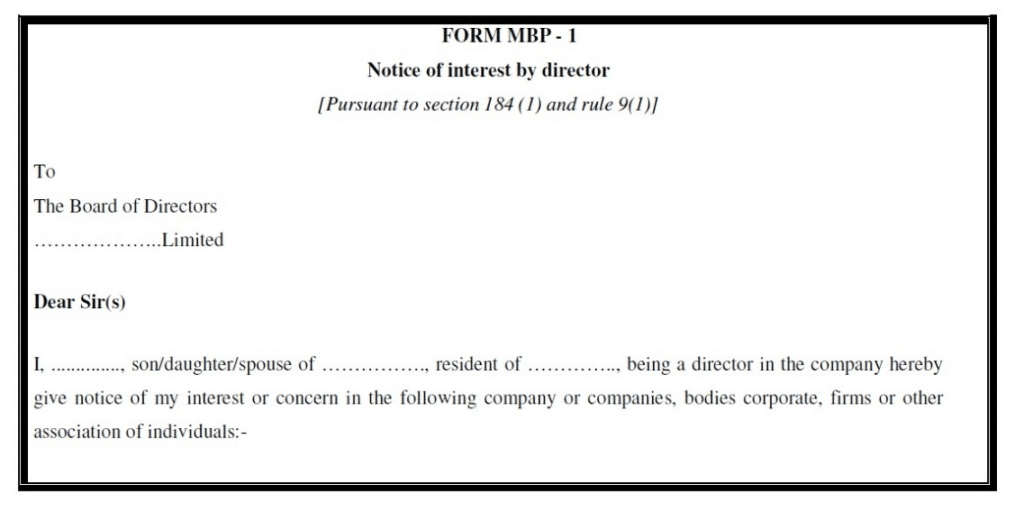

click here: Form MBP-1 is available on MCA Portal.
As per section 184(1) under companies act, 2013.
Section 184 is a rule that says directors must clearly tell the company if they have any personal interest in a deal, contract, or arrangement the company is involved in.
This rule helps keep the company honest and fair.
It is important because it:
- Prevents directors from hiding personal benefits
- Avoids conflicts of interest
- Makes sure directors act for the company’s benefit, not their own
Section 184 ensures transparency, honesty, and good corporate governance.
Why it is necessary to fill?
Section 184 is needed so that directors cannot hide personal interests in company deals. It keeps decision-making fair, transparent, and honest, protects the company and its shareholders, and makes sure directors act for the company’s benefit, not their own.
understand through the story style:
just Imagine a director owns another company and the company wants to buy goods from it.
Section 184 ensures the director must declare this interest so the company can decide fairly, avoiding cheating or bias.
Types of Disclosure of Director’s Interest
Under Section 184, directors must make two types of disclosures:
- General Disclosure
Directors must tell the company about all interests that could affect their decisions.
Example:
- Owning many shares in the company
- Having financial interest in a competing company
- Specific Disclosure
Directors must reveal interests in a particular deal, contract, or transaction.
Example:
If a director’s relative works at a supplier the company is dealing with, it must be disclosed.
Penalty of Non-Compliance [Section 184(4)companies Act, 2013.]
If a director violates the disclosure rules, they are liable for:-
- Before 28th September 2020 (Amendment): They Could face up to 1 year in jail, ₹1 lakh fine, or both. But
- After this amendment: Director must pay penalty of ₹1 lakh (₹ 1,00,000) only. [After the amendment, a director who violates disclosure rules will only have to pay a penalty of ₹1 lakh; jail or fine is no longer applicable.]
[In section 184 of the principal Act, in sub-section (4), for the words "punishable with imprisonment for a term which may extend to one year or with fine which may extend to one lakh rupees, or with both", the words "liable to a penalty of one lakh rupees" shall be substituted.]
Need help: Drop your queries at Finodha.in
Relevant case
Pearce Services Global Pvt. Ltd. — ROC Chandigarh (3 May 2024)
Fact: In this case the directors did not disclose their interests at the first board meeting of FY 2022-23. Form MBP-1 was filed later, but too late.
Legal Provisions Invoked under section 184(1) & 84(4), Companies Act 2013 — disclosure of director's interest, penalty for non-compliance.
ROC/Adjudicating Officer Findings in this case that Late filing does not excuse non-disclosure at the first board meeting and The explanation of "inadvertent mistake” was not accepted.
Order Summary:
- Penalty of ₹1,00,000 per defaulting director.
- No penalty on the company itself.
Learnings:
Directors must disclose their interests on time. Filing the disclosure late does not excuse non-compliance or avoid penalties.
Compliance with Section 184 of the Companies Act is strict and mandatory. Every director has a personal responsibility to submit accurate disclosures.
click here: If need any information related to company compliances.
Conclusion
In this article, we have covered all the important details about Form MBP-1, like- What section 184(1) of the Companies Act says, Importance of this form for compliance, types of director disclosures, and also explain the penalties if the form is not submitted on time.
I have tried to explain all the necessary points related to Form MBP-1, so this article can be useful for all readers.
If you feel any important points are missing, please share your suggestions, and I will be happy to include them to make this article complete and more valuable.
You can also send your queries to the email address provided below.
At Finodha.in, We serve a number of clients who need assistance/guide for various regulatory compliances including setting up business in India, company formation in India, income tax return filling, bookkeeping, accounting, GST and auditing. If you require any guidance for any professional service, we are here to serve you! You can also book a free consultation with us!
Join with us today!
We shall be happy to assist you, and in case you require our services, please feel free to contact us at the below mentioned email details: – help@finodha.in.
FAQs: Get answers to all your queries!
Q.1.How to fill MBP-1 form?
Next, include any interests of your relatives in other companies that may create a conflict, or write “Nil” if none.
At the end, provide:
Signature of director
Name
DIN
Date and place
Q.2.What is minimum disclosure?
This includes only the basic compulsory details, not extra information.
Q.3.What is the MBP-1 Form?
The director fills in their personal details, roles in other companies or partnerships, and any financial or business interests that might affect the company. MBP-1 is kept by the company and not sent to the government.
Q.4.When to file DIR-8 and MBP-1?
DIR-8 is submitted to the ROC to declare that the director is not disqualified, usually within 30 days of appointment.
Q.5.What is the MBP-2 form?
click here: for deep knowledge about the Private limited Company registration!
Q.6.What is the full form of MBP?
Q.7.How to prepare MBP-1?
MBP-1 is submitted to the company and updated whenever interests change.
Q.8.How to fill form MBP-1?
MBP-1 is submitted to the company and updated whenever interests change.
Q.9.When should MBP-1 be filed?
Q.10.What is MBP-1?
Q.11.What are the requirements for filing form MBP-1?
Q.12.What is disclosure of interest in form MBP-1?
Q.13.What is meant by disclosure of interest ?
Q.14.When should a declaration of interest be made?
Q.15.What is the disclosure of interest in the companies Act?
Q.16.Is MBP-1 mandatory?
click here: for more information about stages of formation of Company!
Q.17.Who needs to file ROC?
Q.18.What are the forms to be filed with ROC after incorporation?
MBP-1 is internal only and not filed with ROC.
Q.19.What is the minimum turnover for CSR?
Q.20.Can I do business without registering a company?
Q.21.Is MBP-1 required to be filed with ROC?
click here: for deep knowledge about the Post-incorporation compliance to Pvt. ltd./OPC company
Read more Article:
- Post-Incorporation Compliance: Private Limited/OPC Company.
- How to Register Private Limited Company in India.
- How to choose a Company Name: Meaning, Importance and Types.
- How to Create Brand Name: Meaning, Importance, Types, What is?
- Company Name vs Brand Name: Key Differences/Ultimate Guide
Why Choose Finodha.in?
- Quick Services & Affordable Fees Guaranteed
- Complete Online, No Hidden Cost
- Serviced Thousands Of Customers
- 15 Days Quick Process
We’re Always Available
We'll handle the paperwork while you focus on building your business
If you have any questions to wish to know more about “FORM MBP-1: Director's interest | Format, Penalty, Explained"
“Book your free consultation with Finodha.in today”.
Call: +91-8512022044
Email: help@finodha.in
Read more interesting articles: